Sunday, December 18, 2022

Comparing Whitebox FMAG with Delving Deeper

 Good day people.  I thought it might be fun to do a basic compare and contrast between two games which claim to be based on Original D&D.  I was going to also add Iron Falcon into the mix but since IF explicitly contains the Greyhawk supplement, in addition to the original three little books, I decided not to add it to the mix.

Both Delving Deeper (DD) and White Box Fantastic Medieval Adventure Game (FMAG) are reworkings of the original three D&D booklets, plus a smidge of Greyhawk.  I will break this review down into sections and give one or the either a point based on which I prefer.  As usual, my opinions are mine and y'all can most certainly form opinions of your own.  This also isn't some graduate-level course in comparing Critical Text to Textus Receptus, this is just lil' ol' me with a once over of both books.

I took some pictures of some interesting details.  I tried to include the original, comparable, D&D booklet when able.

I am comparing FMAG, ordered from Amazon and DD, ordered from Lulu.  

FMAG is 140 pages long, plus 2 pages for house rules, a character sheet, and the OGL.  It is printed on scratchy pulp paper.  I paid $4.59 for it and it has the fighter, cleric, and magic user fighting some lizard men on the cover.

DD is 129 pages long, plus OGL; the character sheet is within the text.  It is printed on smoother paper.  I paid $3.96 for it.  The cover is also a fighter, magic user and cleric fighting some lizard men, with some large critter in the background - a hydra, perhaps.  The cover is black and white.

The point here goes to DD.  I like both of the covers but DD is both cheaper and printed on higher-quality paper.  I will judge the internal layout and such later.

Since both games start with character creation, we shall start our comparison here.  FMAG has gone with a standard modifier array, -1, 0, or +1 for ability score modifiers.  DD has stuck closer to the original with a variant range of modifiers.  Both games have organized the tables better, of course.  I mean, really though, it would be difficult NOT to organize better than OD&D.  I see the pros and cons for both games and their modifier choices.  Generally, I prefer a static chart but the simple DD tables are really nice.  Interestingly, DD has gone with strength-based door opening while FMAG bases it on race.  Though I prefer a single chart for ability score modifiers, I find that I prefer the few charts that DD uses.  DD gets a point here, as well.  So far we have DD 2 and FMAG 0.

 
Next up we have classes.  Both games include the original three classes - cleric, fighter (originally fighting man), and magic-user. Additionally, both games dip into the Greyhawk supplement and insert the thief as a playable class.  Both games make sure to point out that the thief is optional.  I am very happy that both games included the thief, as it is my favorite class.
 

In regards to thieves, FMAG allows thieves and x-in-6 chance to perform thievery, whereas DD gives a 3-in-6 chance for thievery at all levels.  FMAG allows thieves to do double damage for successful backstabs while DD adds on damage based on the thief's level.  As far at thieves go, I think that neither one is better.


Cleric turning in both games is different than in the original.  DD sticks with 2d6 vs. target number but makes the target number a bit easier at each level but otherwise follows OD&D.  FMAG makes the odd decision to switch to 3d6 vs. target number.  I cannot fathom why they chose this.  I assume it is to make the bell curve more belly, but it seems to be a really arbitrary change.

Both games go with the fairly normal one attack per fighter level against schlubs.  Neither game allows clerics a spell at first level.  A 10th level cleric in FMAG will have a few more spells per day and will average a bit more hit points.  A 10th level wizard in FMAG will have one additional spell but will average 7 hit points less.

I can't really decide which game I prefer for classes.  I definitely prefer the 2d6 clerics' turning but I prefer the level-based thief improvements in FMAG.  I will give both books a point here and call it a tie.

FMAG 1, DD 3 so far.

Spells.  The mighty sorcery of magic-users and the powers on high anointing their chosen ones the ability to alter reality with faith.  Here's a little something about me.  When I see OD&D cleric spells go from 6 at 1st level, to 4, to 4, and back to 6, I start to twitch.  

Gygax and Arneson couldn't have spent a few minutes and thought up two more spells at each of these levels?  

FMAG follows OD&D in this regard, while the author of DD has soothed my soul by giving six spells per level at each level.  The same with wizard spells.  FMAG has various numbers of spells per level for magic-users while DD gives the same number at each spell level.  DD breaks spells down per class and per level while FMAG combines them into one list, organized alphabetically.  FMAG also uses a larger font and a line at each spell so they are easy to find.  I like this.

I prefer the layout of the spells in FMAG but I prefer the distribution of spells in DD.  FMAG follows OD&D much closer here.  However, since my review isn't on how close the games follow OD&D, I will have to give the point to DD for spells.

FMAG 1, DD 4 is the count.

The equipment chapter is about what you would expect in both games.  Prices vary, items vary, but both games include the important stuff.  FMAG has options for both ascending AC and descending AC while DD follows descending armor class only.  DD uses the standard OD&D 1d6 damage with all hits, regardless of weapon uses, while FMAG varies this a bit with heavy weapons doing +1 damage and light weapons doing -1.  Even though plate armor in FMAG is too cheap, in my opinion, I do prefer variant damage.  The point goes to FMAG for equipment.

FMAG 2, DD 4.


Having both ascending and descending armor class is a much better choice, especially for the kids who are new to gaming, having started after 2000.  Of course, converting takes like half a second so it's not a big deal at all, but I do prefer having both options.  

Fighters in DD are slightly better at 1st level than FMAG, which follows the original game.  This makes the fighter a bit better than the other non-fighter classes in combat, right from the start.  I like this.  Both games have their strong points in regards to combat, ascending AC for FMAG and better 1st level combat for fighters.  I will say this is a tie and each gets one point.

FMAG 3, DD 5 is the current count.

When it comes to movement, both games have food, beasts, and water speeds.  FMAG has the charts all in the same place while DD has them spread out, character movement in one place, water movement in the sailing section, etc.  Since both books are so short, it is not a big issue to flip to the sailing chapter for ship speed but FMAG gets the point for keeping pertinent information together.

FMAG 4, DD 5.


Critters will be our next point of comparison.  As you can see, DD follows OD&D's style with a table of pertinent information in one place and other information on each monster.  FMAG breaks up each monster into its own stat block.  I compared black pudding from all three games and they match up.  Both DD and FMAG are an improvement on OD&D's scattered monster chart.  I much prefer all information on each critter in one spot and not flipping through the book for something that is going to happen constantly.  I mean this is D&D, right?  The characters are going to throw down with all manner of beasts.  Keeping it all together is is more useful.  Separating sailing speed from mule speed is forgivable.  This is not.  FMAG gets the point here. 

We are tied up at 5, folks!  Do you feel the pressure building?  Ready to place some bets on who is going to get the win?

Jumping to treasure, I wanted to show y'all an interesting change.  In both OD&D and DD, a healing (or curing) potion is going to be rolled 4% of the time whereas in FMAG, it jumps to 25%!  I imagine this is because you can't swing a dead cat in a published module back then without hitting a potion of healing in every third room, so FMAG decided to make this actually make sense in the rules.  I don't particularly care one way or the other so I won't give a point to either or, or rather I'll give a point to both to keep with what I've been doing.

FMAG 6, DD 6.

Both games have rules for dungeon exploration, populating the dungeon, wilderness exploration, jousting, and campaigning.  Both games limit dwarves to fighter or thief, both games give elves a bonus to find secret doors, and both games include everything needed to successfully play a game of D&D.  FMAG limits all classes to 10th level while DD does not have this limit.  FMAG has a BX-like elf which is both a magic-user and a fighter as well as the old swaparoo that OD&D and DD use.  

It is difficult to give either book a point here since they all include basically the same information.  I prefer having the BX-like elf but I prefer allowing levels higher than 10.  I think DD edges out FMAG a hair, so I will give DD the point.

FMAG now sits at 6 points while DD climbs to 7.

The last comparison is going to be how pretty each book is.  FMAG womps DD in this category.  It has great art, a great layout, I love the font and the chapter headings.  DD has very little art and what it has is not as good as FMAG.  FMAG is filled with art and there isn't a sucky piece in it.  FMAG easily get the point here.

So there we have it folks.  Each game gets 7 points based on my preferences and general awesomeness.

The question is, which book should you buy?  The answer is simple, buy both!  They are both dirt cheap.  Heck, shipping will cost as much as the books.  Take the one which you prefer, grab yourself a Ticonderoga #2 pencil, and make adjustments which you prefer from the other book into the one which you think you will use as your base.  This is what I am going to do.  I will use Delving Deeper as the base, primarily due to the icky paper in FMAG, and write in any changes from FMAG.  All that being said, you won't regret either game.  Both games are 100% usable as is and are far, far better for gaming that whatever sewage WotC is spewing forth these days.


Wednesday, October 5, 2022

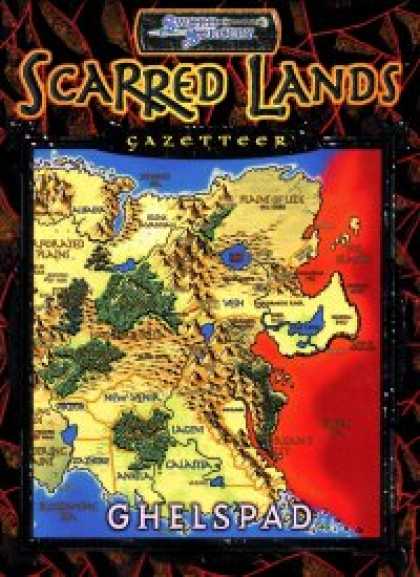
Scarred Lands Gazetteer - Ghelspad

Scarred Lands Gazetteer
Ghelspad

Stephan and Steward Wieck
Published by White Wolf Publishing, 2001

Available at https://www.drivethrurpg.com/


The Good, the Bad, and the Ugly

Scarred Lands Gazetteer Ghelspad (hence Ghelspad) was part of the D&D 3e line produced by Sword & Sorcery Studios, an imprint of White Wolf Publishing.  The book is 48 pages of campaign setting yumminess.  Forget that overly detailed Forgettable Realms hardback that is selling for the price of a used kidney.  If you have fond memories of the World of Greyhawk (either boxed set or folio), you very well might like Ghelspad.  Everything you need to know about the continent is included in this manual.

The inside covers have black & white pictures of the coats of arms for both nations and city states.

The book begins with the History of the Scarred Lands.  The short version is that 125 or so years ago, the gods got into a scrap with the titans.  The gods, as well as one titan who joined them, won the war but the planet has been messed up pretty badly.  The "Scarred Lands" encompasses the entire world, but this book covers just the continent of Ghelspad.

I will note here that throughout the book, the person narrating the section changes, so you may have an uppity wizard narrating one part of the book, or a conniving sycophant of a tyrant narrating a part, etc.

A history of Ghelspad follows. This section gives a brief history of the Divine War, the rebuilding that followed, the Druid War, the Blood Monsoon, the rise of the fore-mentioned tyrant, and the "here you are" point.  The entire history covers only three pages!  Amazing!  The genius of a concise book is that the DM can fill in every minor detail and not have to worry about some obnoxious player who read in some 400 page campaign setting that Super Wizard #1 wears mismatched socks, who then berates the DM for not following canon.

Something that I enjoy is that the Blood Sea actually has blood in it, which causes the red color.  This is because a dead titan is chained at the bottom.  The titans are "dead" but it is more like Cthulhu dead; dead but not really.

A two-page spread map of Ghelspad follows the history.  It is quite nice but it seems obvious that the map was originally in color and they converted to grayscale for this book.  Some of the place names are very difficult to read but I imagine they are easy to spot on a color map.

Nations and City States follows.  Each nation has its common name listed in alphabetical order, the predominant or official worship, the complete name of the nation (as opposed to its common name), the capitol, other cities of note, the ruler, the form of government, population composition (what % is elf vs. human vs. half-orc, etc.), and allies and enemies.  Each nation and city state gets a few paragraphs detailing it.  The continent has two different city states controlled by necromancers.  Some of the details specify certain magical or physical effects.  For instance, the city of Mithril has a giant golem overlooking the city.  The golem has not moved since the Divine War.  Can it move?  Will it move?  Can doughty explorers break into it and look around?  None of this is detailed, leaving it to a crafty DM to determine what the golem actually is or does.  The nations section covers 14 pages.

Topography of Ghelspad comes next.  This section notes many neat, unnatural areas such as a floating island, a forest that seems to never run out of monsters to send into the world, and the Blood Sea that I mentioned earlier.  Reading this section reminds me of reading a Black Company novel, due to the simple but evocative names, "Plains of Lede", "Inferno Gulf", "the Sweltering Plains" are some examples.

The next section of the book encompasses organizations on the continent.  There is a cult of whore-spies who infiltrate the various governments, a group of magic using thieves who are in it for the laughs, a cult of assassins, some Mongol-like horse warriors led by an undead king, some mercenary companies (I wonder if the authors read the Black Company chronicles?), and others.  This section is 7 pages long.

Cosmos and Cosmology follows.  Here is listed the eight gods (at least one died during the Divine War), as well as their titan ally.  The gods do not have alignment listed but it's pretty easy to determine which gods fall where on the law vs. chaos and good vs. evil axes.  The known titans are also listed, along with what they were known for in the old days.  Most of them are dead but still have worshipers, and druids of the Witch Queen and Mother of Serpents, Mormo, still receive spells, so there is that...

The last two pages list calendar days, holidays, the heavens, and planes of existence.

⇒ GRIT: ★★★★ The book packs a whole passel of info into its short 48 pages.  Some gamers would want stats for characters, new spells, and all that jazz.  I don't.  This game setting is truly universal since it has no game stats at all in it.  It can be used for whichever version of D&D the referee wants, or Savage Worlds, or GURPS, or RISUS.  It doesn't matter.  

⇒ VIGOR: ★★★☆: As I stated, as this book is statless and is intentionally sparse with details, the campaign won't be limited as it would be with every nook and cranny detailed, as is common in some campaign settings.  I would have liked to have a better map in this book, as well as regional maps, and perhaps an army roster for gamers who do mass battles.  One thing that is definitely missing is scale on the map which is included.  I have no idea how big this continent actually is.  This is a huge blunder, in my opinion.

⇒ GRACE: ★★★☆:  The book includes some decent line drawings, it has a neat border on most pages, and has plenty of white space to rest the Mark 1's between pages.  The map being a b&w rendering of a color map was a big oops to me.  They should have included a color map or removed all of the labels when it was converted to b&w and retyped the labels, allowing white space around the words. 

Saturday, September 24, 2022

Challenges Game System

Challenges Game System
by Tom Moldvay
Challenges International Inc, 1986

Not available anywhere that I can find.


The Good, the Bad, and the Ugly

The Challenges Game System (henceforth, Challenges) is a booklet authored by Tom Moldvay (yes, THAT Tom Moldvay of the greatest version of D&D fame).  The booklet includes 8 pages of rules and is 12 pages long, including front and back covers.  Challenges is designed to be an easy-to-play alternative to AD&D.  The booklet claims that this is the foundation for a fantasy game.  I believe, though it does not make this claim, that the TSR-produced AD&D books were meant to supplement Challenges.

The booklet begins a short introduction, a list of abbreviations, and then jumps right into character creation.  There is no "what is a rpg?" paragraph.  

The game uses six ability scores, which are mostly comparable with AD&D:  Muscle, Dexterity, Stamina, Willpower, Wisdom, and Charisma.  I find it interesting that Mr. Moldvay replaced Intelligence with Willpower.  Willpower tends to be consolidated with Wisdom much of the time - at least in modern iterations of the game.  In Challenges, Willpower is used to "influence the environment with sheer force of will" and that it is sometimes called Intelligence.  I don't see these two jiving but it is what it is.  Wisdom is "intuition and subconscious intelligence".  Obviously, Muscle and Stamina are actually Strength and Constitution.  I don't know why Mr. Moldvay switched from the six standard abilities but I assume it was for legal reasons.  

Ability score modifiers tend to start at 13 or 16 for positive modifiers and 5 or 8 for negative modifiers.  The modifiers don't track exactly with AD&D but they are pretty close.  

An interesting note here is that a high Stamina means the character can go to lower Life Points (hit points).  Characters, in general, can go to -10 LP before dying, but with a Stamina of 16+, the character will die at -11 to -14 LP instead.

One interesting tidbit is that all ability scores get a percentage breakdown once the score hits 18.  As most of y'all know, AD&D (and OD&D Greyhawk before it), broke down Strength at 18 into percentages, but only for fighters.  

The game includes five classes - the warrior, sorcerer, cleric, thief, and mirager.  The mirager is an illusionist in AD&D.  It's a pretty bold move including the least played AD&D class, other than monk, as a core class.  

Each class has its own experience chart.  Each class has a Luck score, which improves with level.  The Luck score is this game's Saving Throw.  Swords & Wizardry uses this concept in their currently produced game, which is a good thing.  I much prefer a single saving throw to the original group of five.  Each class also has a Base score, which is for all intents and purposes, its THAC0.  Each character class goes to level 10.  The rules state that this is due to space restrictions but I feel that 10 levels is the perfect number, anyway.  

The sorcerer and mirager use the same class chart.

Thieves have two scores, Stealth and Thief Skill, which encompasses lockpicking, traps, picking pockets, and the rest of the non-stealth skills from AD&D).  These two skills are percentage-based, presumably to be compatible with AD&D.

Clerics have a Turn Undead score, which is nothing unusual for a D&D-based game.

Characters can choose to play a human, dwarf, elf, gnome, or hobbit.  It is also a bold move for Mr. Moldvay to use the term "hobbit" after the kerfuffle that TSR got into with the Tolkien cats back in the day.  He does point out, and makes it very explicit, that "hobbit" comes from British folklore, and has been used in print since at least 1859.

There is nothing unusual with any of the race options, and anyone who as played any version of TSR xD&D will recognize the racial abilities.  Dwarves get special skills when doing underground stuff and have a bonus to magic saving throws.  They can become warriors, thieves, or multi-class.  The rest of the races have their own benefits and hindrances, of course.  It is mentioned that humans alone can advance beyond 10th level.

For some reason, weapon damage follows the section on races.  Well, actually, the weapon chart is split in two with how to create a multi-class character mixed in with it.  I assume that this is a mistake done by the layout crew.

The game uses descending armor class.  Shields improve the AC by -1 to -3, depending on the armor worn.  It is an interesting take on armor and shields and I like it.  Shields are less useful in D&D than they should be.  Challenges rectifies this but also keeps metal armor more useful for defense.  I don't know if this is accurate in the real world, or not, but from a game mechanic point of view, I like it.  The reason this is done, according to the author, is to ensure that the best AC available is 0.  I still like it.

Combat follows and is what a player of AD&D would expect - roll initiative and then roll d20 to hit your foe.  There are two tables which give modifiers based on exact die roll.  I think this is interesting but would not use it, personally.  For example, if you miss your foe you might lose an attack, lose initiative next round, or even take damage; if you hit your foe, you will do extra damage and if you roll above the number needed by high enough, you can cause a light or serious wound.  Light and serious wounds give attack roll penalties until healed.  Mr. Moldvay mentions that a cure light wounds spell can be used to remove this condition and a cure serious wounds spell can remove a serious wound condition.  As I said, I would not use this at all - it is all too fiddly for me.

Spells come next.  Each spell gets a one or two sentence description, which includes range, damage, effect, duration, etc.  I really like the abbreviated spell descriptions.

Here is the sorcerer's light spell.  Light (range 60', duration 1 turn per level; magical light in the shape of a sphere with a 2' radius).  Concise, to the point, and allows the player and referee some wriggle room to make decisions based on circumstances.  Is the light floating in the air?  Is it cast on an object?  Is it stationary?  Is it the equivalent of a torch?  Some referees and player would cower in fear at the power a simplified rules set provides groups but I find it refreshing that in 1986, an author was not piling on the crunch.

Monsters come next.  I will note first off that monsters have a Morale score, which is necessary for any game.  If your D&D game doesn't have a morale mechanic, you are playing a poorly designed game.  The Base and Luck scores of a monster is based on its Life Points.  For example, a monster with 20 LP has a Base 16 and Luck 15.  There is no list of monsters given.  I assume that the AD&D Monster Manual is expected to be available.  The monster section mentions Challenges Inc adventure modules but I do not believe that any were produced.

Would I run Challenges?  Maybe.  I like the 8-page format for a game.  I like the simplified format for races, classes, and spells.  I doubt I would use the combat modifiers and would instead implement a typical natural 20 does double damage, or something.  If I did use the combat tables, I would maybe simplify them.  I don't know, I still maybe would referee it.  I would definitely play it, though!

⇒ GRIT:  ★★★★☆ This game packs everything needed, except monsters into eight pages.  This is some serious game design ninja skill and I love it.  As a beginner rpg or for someone who has not refereed or played a version of TSR D&D, this would instead be one star.  If this pamphlet included a handful of sample monsters, I would give it 5 stars.

⇒ VIGOR:  ★★★☆☆ Limited to 10 levels, this game will keep a game group going for a few years.  Challenges suffers due to a lack of construction rules and charts, domain play, and all that high level jazz.  I suspect that the author assumes folks would have the AD&D Dungeon Masters Guide available for this.  I feel that a page or two of what characters might want to do at higher levels is warranted.

⇒ GRACE:  ★☆☆☆ Challenges is ugly.  I mean fugly-level ugly.  The front cover is nice, with some hapless warrior about to get his butt handed to him by some fire monster.  After the cover, though, reading is rough going.  Dumping racial descriptions in the middle of the weapons table is silly.  Walls of text make reading a bit difficult.  The booklet succeeds, though, in its brevity.  Reading this is like reading any late 70s AD&D book.  I think that by 1986, books looked better.  I know that in 1989, the AD&D 2e books looked better than the 1e (except for the cover art of course, 1e was WAY better with covers).


Monday, August 22, 2022

Eldritch Hack

Eldritch Hack
by Dan Masters
Dungeon University Press, 2022

Available in pdf from https://www.drivethrurpg.com/


The Good, The Bad, and The Ugly

Eldritch Hack a 46-page pdf (not available in print), of which 18 pages is the "Eldritch Hack" portion, while the remainder is the adventure "Cloque House".  The rules are an homage to Call of Cthulhu.  It is not without its issues, but is a really neat way of simplifying the Cthulhu setting to a very small amount of rules.

The pdf starts with a quick introduction, which specifically mentions that this game hearkens back to Cthuluesque horror, and is meant to avoid Indiana Jones or Aliens -style horror.

At page 5, we get the rules of the game - roll 1d20 and pray to Nyrlathotep for a high number.  Natural 20s are really good and natural 1s are really bad.  The Keeper, errr Game Master will decide on a target number for the d20 roll.  The rules are basically any version of WOTC Fantasy Gaming from 2000 through now.  They are nothing spectacular but they are uber simple, which is exactly what I want in a game.

While I'm thinking about it, let me bring out an "ugly" in this game - the background color.  I recognize that Mr. Masters was going for the crumbly, yellowed old manuscript look but the color he chose is way too dark.  It does not make the text unreadable but if he toned it down a few shades, it would be much better, in my opinion.

Character creation comes next and here things get pretty wonky.  Skill, Lore, Sanity, and Hit Points are all perfectly reasonable for the game.  I agree completely with Mr. Master's choices here.  How they are generated is just really odd, however.  While reading this page, I opened a Word doc and made notes on how I would do character creation if I ever run a game of Eldritch Hack.   The rules want a player to roll three 6-siders and take the best ("assign the highest") one for Skill, Roll two 6-siders and take the best ("discard the lowest") for Sanity, and finally to roll 6d6, divide by two, and then round up, if necessary to get Hit Points.  Lore starts at 0.  Sanity gets a +3 bonus, ending up with a 4-9 range.

Now, I know for a fact that Mr. Masters has said specifically in some of his YouTube videos that he won't ever go back to playing D&D with percentage thief skills, and here he is complicating something that should be super simple.  I am not mathematically equipped to determine what the best result of three 6-siders would be but wouldn't it be easier to just say Skill starts at 3, or something?  What I put down on my notes would be to allow the player to roll dice for all abilities, and then pick where they go, so one die each for Skill and Sanity, one die for Lore (as a bonus die, you will see), and three for HP, giving six dice.  The player will then drop one die and assign 0 to Lore, and then pick any three dice for HP, with one die each assigned to Skill and Sanity, which gets the +3 bonus.  Or, for a more D&D style, start all characters with a Skill of 1 and Sanity of 9.

Money isn't a thing in Eldritch Hack, which makes sense since all characters are expected to be middling to wealthy bookworms.  I would have to beat my players over the head with this.  Some of them have the primary goal of gaining wealth in every game of any genre in which we play!

Each character gets an occupation, which is what the Skill score is used for - a doctor adds it to doctory things like healing, diagnosing, etc., while an archaeologist adds it to deciphering dead languages, using brushes and pick-hammers, etc.  Characters can pick a couple of non-occupation electives in which they are skilled.  The author dials back on the "No Indiana Jones, daggummit!" (Ya, not a real quote) here, by specifically mentioning an archaeologist could pick "expert with a bullwhip" as an elective in which he excels.

The Skill ability score as a catch-all for everything occupation-related is a really great idea.  Gone are horrible lists of skills like rope use, fire starting, straw drinking, teeter-totter, and the rest of that ridiculousness.  If it is something that makes sense for your occupation (or electives) to have as a skill, you add your Skill ability to your d20 test.

The next page is a list of names, broken down into names for men, women, and last names.  Useful I do believe.  

The GMs section comes next, beginning with a list of weapons.  I have what I believe to be a legitimate gripe in the weapons list.  The author has a weapon called a "Baretta" and it does d6 damage.  He also has a semi-automatic pistol that does d8 damage.  Now, I'm a gun guy.  I was the kid in the early 80s with a fully-automatic MAC10, laying waste to bushes on our property.  I am not the world's greatest authority on firearms but I don't recall every reading about a "baretta".  I assume what the author means is a Beretta.  The question then must be, why specify Beretta and not lump it in with pistol?  If the author wanted a smaller, concealable pistol, he might have broken semi-automatic pistols into two categories, "standard" and "light", or pistol < .32 and pistol > .380.  Something like that.  I thought perhaps that "baretta" was 1930s slang for a derringer, but with an ammo capacity of 7 rounds.... I just don't know.  He also mentions specifically that Tommy guns are not included because stuffy old professors won't use them, which is perfectly fine, but what if said professor runs into a mob hit and the torpedo is shooting AT the professor.  It would be nice for the GM to have something to go by.  Personally, for those ne'er-do-well bootleggers, a Tommy gun would be d8 damage (.45 cal), 5 shots per round (consecutive -2 to hit, as in the rules), with an ammo capacity of either 20 or 50.

Combat is super simple and I love it.  Roll a d20, try to to beat a TN 10.  If the character is a private dick or a copper, he can add his Skill to the roll.  Natural 20 is double damage and natural 1 is knife dropped, gun jams, etc.  A minor critique is that in the included scenario, this Armor Class equivalent is DR (I assume Defense Rating, but it is never actually spelled out) but in the included bestiary, it is abbreviated TN.  I would prefer to have the abbreviations consistent.

Combat can be deadly.  At 0 hp, characters are unconscious, and below 0, they either die immediately (50% chance, or die in d6 rounds, 50% chance).  Healing is the typical 1 HP per day, which was standard when D&D was good.  Were I to run Eldritch Hack, I would probably have all characters die if below 0 HP if I have a large number of players or die in d6 rounds if I have only a few players.

Since this is a Cthulhuesque game, Sanity tests are obviously needed.  Mr. Masters avoids the annoyingly specific list of mental degeneracies from Call of Cthulhu (or AD&D 1e, or Palladium, etc.)  Basically, the player does a standard d20 vs. TN roll, with a +1 bonus if he is still mostly sane.  If he fails, the Sanity score drops.  When it hits 0, the character is insane, either temporarily or permanently, each 50% chance.  Recovering Sanity requires a doctor or a sanitarium.

After an adventure or game session (GMs choice), players can attempt to increase an ability score.

There is a list of forbidden manuscripts and a couple of paragraphs on magic and spells.  Characters must roll Lore vs. TN 15 to cast a spell.  Obviously, they must have access to a spell.

The next few pages are instructions on creating scenarios, along with a sample.  There are also rules here for searching for clues.  

Next we have a few pages of critters, with the aforementioned TN for armor class.

A color character sheet and a B&W character sheet follow.  Both are serviceable.  The rules portion of the pdf ends with rules recaps.

I won't go into too much detail about the adventure, other than a brief synopses.  The adventure is good.  It hearkens back to some of the old Call of Cthulhu adventures that came in compilation books - short and to the point.  I find no fault with this.

"Some old geezer dies.  Y'all characters are nieces and nephews who might inherit some of that sweet, sweet cash, provided you survive the night in the house.  Each of you is some sort of backstabbing deviant.  Y'all arrive at the house.  What do you do?"  I won't say more so as to not give the plot and secrets away.  I know I have seen a Rifftrax riff on a movie with this same story but I don't remember the name of it.

The adventure has some nice maps of the mansion and a list of each room and what's noticeable about it.  A list of characters and NPCs follows, with one page per dirtbag PC.  As I mentioned previously, the armor class in the module is labeled DR.   I would love to have two sets of maps, the first being for the players with room labeled, and the second being for the GM with the secret doors and whatnot labeled.

I must mention the art.  The Cloque House adventure is really well-illustrated.  Jason McDonald is the artist and he really comes into his own with people.  The biplanes, lungfish, and ants were all serviceable, but his drawings of people are downright disturbing.  He uses this liney, veiny, wormy style of (I assume) computer brush strokes.  I know as little about art as I know about math, so I'm sure there is a style for his technique.  The characters are very creepy.  The picture of William Cloque-Overton, Sr. reminds me of a painting in a Scooby Doo mansion, but actually scary.  Is Scary Scooby Doo an art style?  According to the bio, Mr. McDonald lives in NYC, so he may not actually be human, anyway...

⇒ GRIT:  ★★★ The rules would work, as is, I believe.  I would love to play in a game of Eldritch Hack.  Heck, I'd love to run a game of it!  In addition to my notes I made at character creation, I also typed up some other notes for making his system more generic, so other genres could be emulated.  This is the style of rules that I love for pickup or convention games.  With some fleshing out, reconciling abbreviations, and two pages of "life in the 1930s" or something, this would easily be 5 stars.

⇒ VIGOR:  ★★☆☆ The game either needs to slow down on advancement, or add in an optional way to improve characters.  As is, characters could potentially be maxed out in a few months of regular play.  As stated in GRIT, there needs to be some amount of setting information and perhaps more genre immersion information.  I know that it is a short pdf but the author can drop off the combat target and the color character sheet and fit in some good setting information without upping the page count.  If you use these rules to run Masks of Nyarlathotep, you are golden, but if you use just them to create your own campaign, I think that the GM will find them limiting.

⇒ GRACE:  ★★  The pdf looks functional.  I mentioned before the background is too dark.  Even so, it does not limit readability, which is good.  The white on blue in the Designing Scenarios chapter is more difficult to read.  From watching some of the author's videos on YouTube, I know that he and I are about the same age, so I'm surprised he doesn't find this part of the book difficult to read - that being said, it is certainly readable.  Again, I just would prefer a lighter color background.  The layout is clear, the text is readable, the section headings are nice and large and easy to find, AND the art, especially pictures of living (or undead...) things, is top notch.


Wednesday, August 3, 2022

Warlords of Atlantis

Warlords of Atlantis
By Paul Elliott
Zozer Games 2022

Available at:

Drivethrurpg:  https://www.drivethrurpg.com/

Lulu:  https://www.lulu.com/


The Good, the Bad, and the Ugly

Warlords of Atlantis (WoA) is a supplement for the Barbaric! rpg, which is part of the Cepheus Quantum suite of games; hence WoA can be used with any of the Cepheus/Quantum games.

WoA is a digest-sized, 55-page document.  The version I have was printed from Lulu so I will be reviewing this version.  I did not purchase the pdf from DriveThru so if there are differences with the pdf, I apologize.

The book starts with a quick history of the Atlantean Age, which is around 10,000-12,000 BC in modern day reckoning.  From the first sentence of the first paragraph, vibes of Robert E. Howard are oozing from the text.  "Back beyond the known ages of Man, to the lost beginnings of civilisation, there was a time of war and conflict".  Tell me you can't imagine Mako narrating this!  Also, with this sentence we can learn that the author probably British.

The next two pages consist of maps, one of Atlantis, proper, and the other of Europe, western Asia, and northern Africa in the Atlantean Age - basically the Mediterranean region "Inner Sea".  Both maps are very usable and it was fun to see the differences that Mr. Elliott applied to this region compared to a map I drew years ago for a similar themed campaign.  His is better.

Before I forget, I should review the Barbaric! rules as well.  I really dig them.  Back to the review.

The next eight pages are a gazetteer of the various nations, city states, and colonies, each of which get between one sentence and one half-page of text.  Most of the write-ups have notes on landscape, leader, and maybe local gods.

Modifications to standard Barbaric! character generation comes next.  You are expected to pick an archetype, which gives the character a free trait.  It doesn't state this, but a player could just choose not to take an archetype and not get the free trait.  If I was running a farmer-to-hero type campaign, I would maybe start characters with no free traits.  The list of archetypes includes a couple which give access to new traits from this book, these are Knight (access to Leader trait) and Temple Warrior (access to Sacred Shield trait).  I'm fond of the Merchant Adventurer and it seems to be included for Sinbad the Sailor inspired campaigns.

The following seven pages are write-ups on the various cultures.  The cultures include:  Aquitanians (Spanish-French folks), Arimaspians (Egyptians, but a mix of local guys, the Sokars, and the Anukan, which are the dudes who colonized Atlantis), Atlanteans (they seem to be a mix of Babylonian types and whatever the Anukan are - perhaps pre-Aztecs?), Greeks (come on, you know who they are), Kythians (Celt-Germanic folks), Sokarians (Masai, or a similar tribe, maybe?), Thalangorians (animal-clan-Viking), and Voluscians (Italians who are being influenced by Greek culture and dress).

The next page is a list of weapons allowed (bronze age, plus long sword) and an optional combat rule regarding initiative (longer weapons are better than shorter weapons).

This is followed by a list of 16 sorcerous tomes.  For those who want to know, neither the Scrolls of Skelos nor the Necronomicon are listed.  A shorter magical mishap table immediately follows the list of tomes.  It is quite a bit shorter than the one in the Barbaric! rulebook but it gives the Referee more freedom I think.  There are no "you are followed by cockroaches" mishaps and more "terrible toll on your frail body" type mishaps.

There is a short list of demons (seven of them) and how to summon them, which is followed by a list of the common gods of the land.  There are rules for becoming an acolyte of a deity and the benefits and obligations by doing so.  Since Barbaric! is a sword and sorcery genre game, there are no clerics, per se.  These rules give a way for players who enjoy playing clerics a way to do so.  One thing to note is that Hero Points are only gained by praying to the gods.

There are a few pages of new monsters, as well as a list of critters from the main rulebook which exist in this setting.

The book then has a few pages discussing war and sea travel in the Atlantean Age.  The wind table seems really useful.

We next have six interesting locations detailed, followed by six NPCs.  Tar-Nergal seems like he would make a great "mission giver" if the Referee wants to run his campaign this way.  The players will be sent to various ruins and far-off lands searching for the McGuffin.

The next section is 4 or 5 adventure seeds, all tied together under an adventure arc around two brothers vying for control of a kingdom, once their father passes.  I think this might be fun if the adventures are squished up time-wise.  I know that some players would probably just wander off and do their thing while the kingdom falls - the Ref will need to ensure that the party keeps on track with helping one prince or the other, or both if they want to go that way. 

The second to last section is one page of Atlantean machines - bronze titans, sunstones, Greek fire, etc.  The final section is bringing "pulp heroes" from other campaigns into this campaign.  It includes a handful of 1930s pulp NPCs and a short list of guns.

What are my thoughts, you ask?

I like this supplement.  It is just the right size.  It has just the right amount of detail.  One of my pet peeves with supplements is the information vomit.  Unless it is pertinent to most campaigns, I do not want to read about the 3% chance of the 7th daughter of left-handed galley slaves of having an extra toe.  I want just the basic information.  This supplement delivers the absolute minimal information for a country or culture.  A Barbaric! campaign, with this sourcebook, would make a fine gaming campaign.

⇒ Grit:  ★★★★☆:  This supplement is just what an aspiring Barbaric! Referee needs to get his campaign off the ground.  It is very straight forward and covers all of the bases.  I would have liked to see army lists, since the book includes information on warfare.  Perhaps, a standard soldier or hoplite from a few nations could be included.

⇒ Vigor:  ★★★★☆:  Warlords of Atlantis, as a setting book and rules supplement, works.  I think that having the basic information provided will give gaming groups a good grasp on the Atlantean world.  What I think would make it just a bit better would be more maps, preferably of trade routes, maybe one showing some ancient serpent men ruins, that sort of thing.  With a few more maps, the campaign could go longer for those like me who are not good with the maps.

⇒ Grace:  ★★★☆:  The book is not beautiful but it is also attractive enough.  The cover is pretty cool, the layout is good, and so much better than what I grew up with.  The fonts are nice, the clipart breaks up the text handily, and the white space helps my old man eyes.  I have no fault with Grace but I also can't rave about it.


Sunday, July 3, 2022

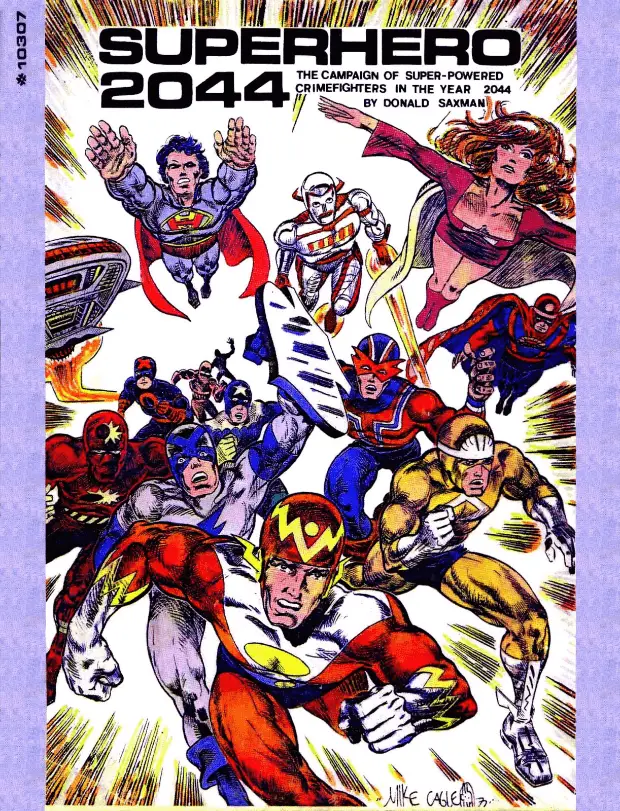
Superhero 2044

Superhero 2044
By Donald Saxon
Gamescience, Inc. 1977

Availability is only through third-party - EBay and the like.  As far as I know, the game has been out of publication since the late '70s.


The Good, the Bad, and the Ugly

Superhero 2044 is certainly one of the first three RPGs that I played as a kid.  It might be the first but I am pretty sure it was the second.  That being said, I only ever had photocopies of the equipment lists, map of Inguria, and most of the character creation rules.  The rest we just made up.  We were awesome like that.

This is also my first review by request! Go me!

Casting our minds back to the summers of the early 80s, a group of kids might be found playing a game of superheroes and supervillains.  The average game went a lot like this:  a few PCs enter a Circle K to rob it.  A shoot out with the police happens.  The PCs, if they survived, were now wanted criminals, who went on a crime spree, knocking off liquor stores, banks, convenience stores, until they were inevitably killed or captured.  On a couple of occasions, enough money was acquired to build cool vehicles.  I remember that a character of mine built an AT-AT and Mikey's character built a hovercraft.  Of course, none of knew what a hovercraft was, so the vehicle was more airplane than anything.  Obviously, characters are supposed to be heroes.  Since we didn't have the rulebook, we did not know that and chose to play villains.  

Mikey (Michael Thayer) had a couple of older brothers and one of them must have owned the rulebook, which is where we acquired the photocopies.  These 5 or 6 pages of a rulebook kept us into superhero games until the yellow box of Marvel Superheroes came out.

This review is based on a pdf that somehow appeared on my hard drive.  I cannot confirm where it might have come from but some deviant obviously found it online and sneakily put it on my computer.  Reading the pdf makes me realize how little of the game we were following.  Honestly, our games were better than the way the game is supposed to be played.

Before I start the actual review, I must state that I have a serious dislike of superheroes nowadays.  I loathe those ridiculous superhero movies.  My knowledge of comic books stops around 1988 or '89.  I will endeavor to not let my dislike color the review of this game.

The book is 44 pages long.  It was typed on either a typewriter or a really early word processor, if they had been invented by 1977.  The pdf is difficult to read, most likely due to the poor scan.

After the introduction by Mr. Saxon, the book jumps into the history and setting of the game from the [then] current 1970s through 2044, when the game is set.  There was a nuclear war, which lasted six days.  Some alien fellows came to earth called the Formians, some people, called Uniques, developed super powers; the remaining governments after the war created the Science Police, who are tasked with suppressing anything that will lead to another nukefest.  

The game takes place on the island of Inguria, which is an island in the pacific that survived the Six Day War unscathed.  There is a few high-tech city on the island, a port, an active volcano, and apparently a boat load of superheroes.  The New Whole Commonwealth of Nations is the remaining worldwide organization (basically the United Nations, after a worldwide catastrophe).  The island itself is a a republic, run by a senate with an elected president.  There are three major political parties, which include the New Republicans (pro individual rights in public but curtail individual rights behind the scenes; they are also really into eugenics and enjoy having Uniques around, they are big spenders of public funds, and have pushed through a bill to allow the buying and selling of human body parts).  Opposing the New Republicans are Citizens' Rights Party (pro technology, anti Unique and anti Formian).  The last party is Popular Progressive Party, which is very small, and their major plank is to oppose genetic manipulation and to increase the world's population after the massive depopulation due to the war.  

The next five pages of the book detail the island itself, and the cities upon it.  The major cities are Bloomburg, Martinstown, and Nash City.  There are a couple of maps of the island and some information on newspapers, the streets, schools, arts, and finishing with a place called the Superhero Shop, which the GM can stock with tech which he wants his players to have access, plus, it doesn't state this, but the tights have have to purchased somewhere, I guess, and why not buy your spandex while also buying your super space laser X duplo-beam!

Character creation takes three pages (I had the first two as a kid).  Characters are statted out with 140 points divided between Vigor (meat hit points and used to avoid disease), Stamina (melee combat and running), Endurance (fatigue, torture resistance, poison resistance), Mentality (memory and intelligence), Charisma (the usual), Ego (mental attacks and resistance), and Dexterity (also, the usual).  A player then has to pick one of three types, which modifies the ability scores.  The three types are Uniques, which have actual powers (Superman, Spiderman), Toolmasters, who use equipment to fight crime (Iron Man, maybe Batman), and Ubermensch, who use training and physical skills (Tarzan, also maybe Batman).

One thing the game lacks is a list of super powers.  This is a problem, I think.  As kids we just decided that Uniques get one "major" power or two "minor" powers.  The rules state that players decide what the powers will be, provided the GM approves it, but the powers will be limited.  Powers gain strength as the character improves (no Superman at character creation!). I think that this is a good way of doing it but I wish there were an entire page of examples so the players know what sort of range of power they should be deciding upon.

Combat is stamina vs. stamina for physical combat and ego vs. ego for mental combat.  Combat is 3d6, roll high, vs. a difficulty number.  The difficulty number is attacker's stat with defender's stat subtracted, and then referenced to a chart.  I don't recall what we did as kids but I know it wasn't this.  I assume we just rolled percentile vs. ability score, but I don't remember.  There is a page of wargame-inspired modifiers - I mean a few pages.  Modifiers can be based on class of weapon, range, number of attacks, etc.  Mr. Saxon went all out on chart after chart of modifiers.  This has to be a holdover from wargaming.  Damage is done to endurance and/or vigor, depending on the weapon.  Endurance heals very quickly but vigor damage requires medical care and time to heal.

Movement is hex-based.

The equipment list is good and covers many of the things an aspiring superhero would want to buy.  I do remember asking my dad as a kid what an apartment costs per month since it isn't listed.

The majority of the rest of the book involves superheroes patrolling the island, handicap scores due to frequency of patrol, and, thank God for this, rules for litigation and insurance.  I'm not joking.  99% of super "heroes" in those horrid movies should all be locked up for property crimes, manslaughter, and a host of other crimes.  Sorry about that.  Back to the regular review.  I would say 1/3 of the book is rules on patrolling.  I'm happy I didn't have this part of the book as a kid.  Basically, heroes are expected to patrol sections of the island and dice rolls determine which crimes are witnessed.  Chart.  Chart.  Chart.  Oh, look, here are another couple of charts.  Reading the rules, I think it would work as the author expects but I don't expect that I'd enjoy it.

Interestingly, the time in the game is based on real life.  A player will turn in his patrol plan to the GM and if the group meets up two weeks later, two weeks would have passed in the game.

The book ends with a couple more character examples.

⇒ GRIT:  ★★☆☆☆ The book really needs either a power list or a page of sample powers.  There is negligible information on character advancement.  The number of charts is very reminiscent of a 70s wargame and will slow down game play significantly.  

⇒ VIGOR:  ★★I am rating this 4 stars based on the book doing what it sets out to do.  With the massive amount of prep the players and GM put into patrolling, the game can potentially go on forever, due to the entirely random (though modified) chances of crimes happening.  Personally, as I stated, I would find this style of play very boring.

⇒ GRACE:  ★☆☆☆ The book (the pdf, rather), though it has a pretty cool cover, is really ugly and difficult to follow.  I assume that all of the charts were placed to have them all fit since there is not much rhyme nor reason as to where you find them.  The art is really rough, though I enjoy the Astrotank (an army tank with Korean war-era jet wings on it) and the superhero I dubbed The 'Sploitation Blaster due to his rocking afro and jetpack.

Monday, June 27, 2022

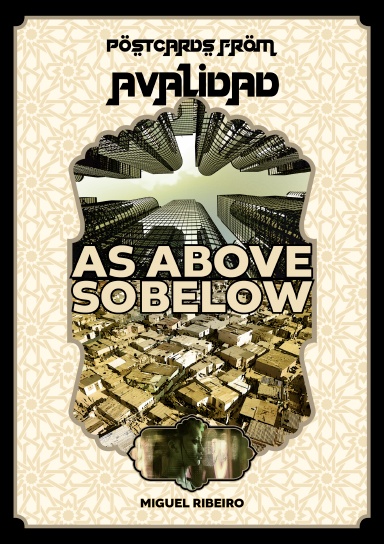
Postcards From Avalidad - As Above So Below

Postcards From Avalidad - As Above So Below
by Miguel Ribeiro
Postmortem Studios, 2021

Available in pdf from Drivethrurpg:  https://www.drivethrurpg.com/

Available in print from Lulu:  https://www.lulu.com/


 The Good, the Bad, and the Ugly

As Above So Below is a supplement/adventure to Postcards From Avalidad (hence, PFA), the cyber-horror-punk-noir-ish game I reviewed previously, on May 23, 2022.

The book is 96 pages long, including table of contents, OGL, and map.

Whereas PFA details the Moroccan city above-ground, As Above So Below details the city below the streets.  The city below can be reached from a handful of points from Avalidad, proper.  Avalidad, below, is called Agartha.  As with PFA, this supplement includes stats for both Actual Fucking Monsters (AFM) and *Punk.  As I mentioned on my review of PFA, I know very little about either game system.  From the character's stat blocks, I suspect I would prefer AFM.

Starting with the table of Contents, the reader will realize that this is a beautiful book.  I really like the cover as well, though I wish the picture on it was a bit less busy.  This is a really gorgeous book and it shows that with some extra loving, and a person who can do layout and graphics and all that jazz (I cannot), a relatively cheap print-on-demand book can be made to look fabulous.

The book has a quick introduction (evil monsters living below ground) and then jumps right into the game system chapter.  In this chapter, the author gives some quick notes on the two game systems for which it was written, and has a very handy several pages on loss of sanity, for those who want to rock the supplement in a Call of Cthulhu style.  There is a list of 14 different mental illnesses which a Referee might inflict on a character.  Interestingly, the book also says that the player can choose the illness himself.  I think this can make for a really interesting game.  I can see a couple of my players really having fun with it.  

The Sanity stat in the game is for *Punk but it could easily be worked into any game I feel, and the same goes for the supplement's fear rolls.  I would definitely work both of these mechanics into a game system I was using for the supplement, if the game did not already have the mechanic.

There is a list of "Appendix N" movies to watch for inspiration (I have seen 8 of them I think, and Dark City is the best of the ones which I have seen).

After this, we get into the meat of the matter.  

Chapter 2 explains how the "adventure" starts.  I use quotes since this is not a traditional adventure.  Those familiar with the author's Giallo "adventures" will feel right at home here.  The adventure has an overarching plot which can be summed up as, "A Portuguese sailor whacks off for some creepy alien entity, scores the gizmo as payment, some other stuff happens, and then the gizmo disappears into Agartha.  The gizmo is worth some serious ducats.  What do you do?"  There is more to it than that, of course, but this is the gist of it.

Like Miguel's Giallo adventures, you get a very simple plot and then a slew of NPCs and locations.  Many of the characters are repeats from the main rulebook, but have abilities altered slightly to bring them all to a similar power level, specifically so they can be used as player characters.  The author does note that some of them might actually have been killed previously since there were not designed originally as PCs.  There is a mix of ZoneSec (remember, this is what passes for cops in this setting), Yakuza, hitmen, hackers, mercenaries, and the typical ne'er do well types that players enjoy playing.  Side note, the character on page 35 looks like a model from the magazine Gothic Beauty that I might have, err, uhhh, noticed from part of my misspent early 20s.  On page 52 there is a picture of a gill woman, which is nice since the gillmen live down below, in Agartha.  This brings us to the end of chapter 3.

Chapter 4 is all about Agartha.  This chapter goes over some NPCs, including Pigface the Mayor.  There is a random encounter chart in this chapter and a few of the adventure locations also have random tables with treasure.  The list of locations is pretty fun and characters can perhaps find a copy of the Necromicon, some sexy underwear, a mutant mating ritual, and for those curious, there is a 33% chance that if you shoot someone in the head who is taking matters into her mouth of painfully and permanently "freeing willy", if you know that I mean.  

The book ends with a not-very-helpful map of Agartha.  I think that with the detail spent on layout in this book, a two-page spread with a more detailed map would have been lovely.

So, what does your not-quite-humble reviewer think?  I like it.  I don't like it as much as the setting book for which this is a supplement but I do like it.  It is a very pretty book, it has useful information, and works well as a supplement to Postcards from Avalidad.

⇒ GRIT: ★★★★☆  As a supplement, this book does what I believe it has set out to do.  I hesitate to use the term adventure for it, since, to me, an adventure is Keep or the Borderlands or Masks of Nyarlathotep.  The book is an adventure location for under the streets of Avalidad, and it is good for what it is.

⇒ VIGOR:  ★★★☆ There just aren't enough adventure locations for me.  I think that if the author cut out all of the possible player characters which were duplicated from the core setting, and replaced those pages with more locations, this book would be better.  I also would have loved to see a few pages with notes on other reasons why characters would adventure to and from Agartha.  The adventure won't take very long without a lot of stuff added by the Referee

⇒ GRACE:  ★★★★ This book is freaking lovely!  The only two complaints I have are that the page numbers on what I assume to be an Islamic pattern are not readable (there are not that many pages like this) and the map at the end.  I'm not going to ding a star for these issues.  This book, to me, is a benchmark on what a home-based, indie rpg publisher can do.


Monday, June 13, 2022

Cowpunchers

Cowpunchers
Crunch-light Roleplaying in the 1870s Southwest

by Jonathan Torres "The Basic Expert"

Available in pdf from Drivethru RPG:   https://www.drivethrurpg.com/
Or in print from Lulu:  https://www.lulu.com/


The Good, the Bad, and the Ugly

Cowpunchers is a short, 22 page, game.  It is set in the desert southwest of the USA, following the American Civil War (or 2nd Revolutionary War, the 2nd War for Independence, or a few other options, depending on where you call home).

The book is illustrated by the author, giving it a nice, consistent look.  

Cowpunchers is a d6-only dice pool system.  If you don't like die pool games, you probably won't like this one.  There is no limit for the amount of dice rolled from what I read, which can conceivably cause problems as characters grow in power.  Yes, this is also a level-based game; fortunately, it is classless, so the author did not need to shoehorn in "cowboy", "train engineer", or "Apache" into classes.

Right off the bat, we learn that the Referee in this game is called the Range Boss.  I like that.

Characters have three ability scores (vigor, finesse, and smarts), which should be self-explanatory.  Ability scores are rolled with 3d6.  The first brush with the dice pool system happens here.  Characters with low scores (3 to 6) get 0 "bonus dice", average characters get 1, and high scores give 2 dice.  These dice are added to a single d6 that everyone gets to roll to succeed at tasks.  Each ability score also has a modifier, which is used in rare circumstances.  The modifier matches the number of bonus dice.

Characters will roll from one to three 6-siders to ability score tests and saving throws, which are ability score tests.  This is one "core die" and 0, 1, or 2 bonus dice, based on ability score.

There is an average-sized list of skills and all of them could potentially be important in a campaign.  Most of them make perfect sense, a couple are for social encounters, and one is escamatoge.... gezundheit!  My favorite description of a skill is for "Cookin'".  When the posse sits down around the camp fire and ol' Cookie hands out the beans and bacon, a cookin' roll is made; if successful, the posse each gains 1d3 hp.  I know that I usually feel better about life after a good meal!

Characters begin with 3 to 18 skill dice, depending on how smart they are and how well they roll.  This is a place where one character can be significantly outclassed by another.  Doing some of that there cowboy math, I reckon that the average dummy (smarts 1-6) will have 4 skill dice, the average cowpoke will have 8, and that educated feller from back east will have 12.  I don't mind this spread but since there is no limit, from my reading of the book, of points to be assigned to a skill, our high IQ snake oil salesman from some yankee hellhole city might be able to drop 18 points into one skill!  This means 19 dice on a roll!  This is pure on crazy, I reckon!

This is where my first house rule would come into effect.  I would have some sort of limit to skill dice.  Maybe at 1st level, players can put 0-3 dice in a skill, allow a 4th die at 6th level and a 5th at 10th level.   Or, not allow skill dice more than half the character's level, rounded up.  Or, something. 

So, when the player grabs that handful of dice and rolls it, he is looking for 5s and 6s, which are successes.  Moderately difficult tasks require 1 success, hard tasks require 2, and extremely difficult tasks require 3, or whatever the Range Boss determines is needed.  A 1 or 6 on the core die is a fumble or critical.

Hit points are rolled with a d6, with a minimum of 6 hp for a character with no bonuses.  these hit points won't last long - see below.

The game has a paragraph for movement and one for advancement.

Next comes weapons, and here is where another eye-opener occurred to me.  Most weapons are reasonable as far as damage goes, basically 2d6 for most firearms, but perhaps with a +1 or +2 bonus, and a 12-gauge shotgun does 3d6 damage.  Just from this, the reader will realize that combat can be very deadly, very quickly.... and then we get to the rifles.... a regular old John Wayne-style Winchester can make 3 or 5 shots per round, depending on model!  A cowpuncher letting loose with his Model 1866 will do an average of 35 points of damage if he targets one foe!

The weapons section finishes with some rules on adapting other real world guns to the system.

The section on combat specifies that a character can do a move and attack, two moves, or two attacks per turn, and nowhere that I've seen limits the shots from a gun.  If a character stands still and uses both attacks with his $45 Winchester, does this mean he averages 70 points of damage?  If this is the case, I would absolutely remove the "shots per turn" from every weapon for house rule #2.

There is a decent equipment list, and I really like that there is a listing for housing costs.  The characters can pool their money and start their own homestead, right from character creation.  Equipment is recorded based on the number of "slots" it needs. 

I've already gone over the basics of combat and the combat section of the rules just has a handful of modifiers for shootin' tests, such as range, firing from horseback, etc.  Losing dice from the pool is a really fun way to do it and saves all them new-fangled mathing that real cowpokes don't know nuthin' bout, anyhow, other than maybe countin' heads of cattle.  There are a few paragraphs on duels, for those posses who want to do the old Main Street showdowns.

Next we get a couple of pages on cover, reactions, damage (you really, really do not want to get hit!), travel, and how much a feller ought to eat.  

A short section follows with some standard critters and townfolk.  The rules end with reaction rolls and random encounters.

The rulebook ends with a sample town, some buildings in said town, and a gang of the villainous sort, who enjoys raiding this town.  I think any genre game really needs to have a section like this.  I would have loved the author to have included about twice the number of adventure seeds (there are six) but I dig that one of them can lead to a supernatural campaign.

The book ends with a character sheet and the standard OGL that most games seem to have.

My overall impressions are that the game is really good.  There are a handful of sentences that needed another couple of read-throughs to fix some grammatical issues.  Of course, this Range Boss durn sure can't find the one that really stuck out to me, but trust me, it was there, two words were reversed.

⇒Grit:  ★☆ The rules seem like they would really work, with the caveats I mentioned above in regards skill dice.  The book is very short but touches on all of the standard cowboy movie tropes.  A campaign based on any of the small handful of cowboy movies I've seen could be played through with this one book.

⇒Vigor:  ☆ My big issue with the skill dice is slinkin' in like a rattler into a bedroll.  If a character starts out with a god-tier skill check, what is the point of advancement?  Other than that pretty big (to me) problem, and the one sample town/adventure, I would really like to see 6 to 10 pages on some historical details, railroads, conflicts between the settlers and Indians, and between the various settlers themselves.  If the War to End Yankee Oppression just ended, I would like to see at least something on why this war led to hordes of people moving to the West.

⇒Grace:  ☆ This game is good-looking, in its functional way.  It isn't beautiful, and some blank space between paragraphs would be appreciated, but there is nothing wrong with the book.  I think that if it was reformatted for a 6x9 printing, it would be much better.  The copy I got from Lulu is very floppy due to thinness, and I think that a smaller form would suit it quite well.  The art is really good, I think.  I would like to have some more pieces in it, especially in the equipment chapter so those of us who did not grow up on westerns have some clue what these items looked like.  I know exactly what a Winchester looks like and how it feels in the hands, but I wouldn't know a Mauser 1871 if it jumped up and bit me.


Sunday, June 5, 2022

The Legacy of Zorro

The Legacy of Zorro Introductory Adventure Game
By Mark Arsenault
Gold Rush Games 2001

Availability is probably only through Ebay or on the "make it go away shelf" in your local gaming store.


The Good, the Bad, and the Ugly

The Legacy of Zorro Introductory Adventure Game (LoZ, hereafter), like the Masters of the Universe game I reviewed a couple of weeks back, was intended as the first book in a line of RPG books.  

The Zorro campaign is set in 1820, in California.  Characters are cohorts of the famous Zorro.  Zorro cannot be everywhere at once so he recruits the player characters to help him in opposing the corrupt governor, comandante, and alcalde in Pueblo Los Angeles.

After the traditional "what is a rpg", websites, and all that jazz, the LoZ book gives some basic information on California in the early 19th century.  You find here forms of address for high status individuals, landowners, and rules for who can carry a gun or a sword.

Following the basic campaign information on the world of Zorro, there are 6 pages of rules, which constitutes the entirety of the rules!  This is amazing.  All games should strive for such concise rules.  The rules are based on Fuzion, which I might review at some point.  

I should note that there are no character creation rules.  Like the MotU game, these rules would have been included in a subsequent release.

Character abilities are ranked from 2 to 6, and include Mental, Physical, Action, and Movement.  Characters have special attributes, two of which make obvious sense - Hits and Defense.  There are a few other abilities that are specific to this game.  The first is Faith, which can be used so gain a bonus on dice rolls which are peaceful or beneficial to others.  The second is Pride, which the player can use to gain a bonus on dice rolls which are selfish or violent.  Both Faith and Pride can be used to reduce damage to the character in combat.  The last special attribute is called Z Points.  By spending a Z Point a character can accomplish extremely heroic feats.  Swinging from a chandelier and flipping into a triple lindy through the glass window, and landing in the saddle of your horse would be a good example.

The list of skills is very broad and very brief - which is perfect for a skill-based game.  Actually, the skill list in LoZ is about perfect.  The skills are:  Athletics, Combat, Education, Reasoning, Social, and Shady (thief skills fall in this category).  Skills are ranked from 1 to 7.  

To succeed in a task, a character will roll 3d6 and add a skill score and ability score to this.  The total of these three numbers must meet, or exceed a difficulty number.  Easy tasks require a 10, average 14, hard 18, etc.  A dice roll of 18 is a critical success while a roll of 3 is a critical failure.

Combat follows this same principle, but includes pinning opponents, breaking pins, blocking, retreating, and whatnot.

An example of play follows, along with the included characters.  The character sheets are simple and have a nice layout, along with a picture of the character.  The characters which can be played are Miguel Galvez, who is a teniente (lieutenant) in the Spanish army, Esperanza Salazar, the daughter of a wealthy land owner, Luis Valasco, a commoner thief, and Father Sebastio Miro, a compassionate priest.  Each character has a special talent that can be used during a game - Esperenza has a knack with horses and Father Sebastio can heal characters by spending Faith, as examples.

The last page of the rules portion of the game is a one-page summary of the rules.  

Following this, the LoZ book includes a sample scenario.  The scenario is 7 pages long and is followed by a 2-page spread of the fort (cuartel, in the lingo).  The scenario has the characters rescuing Zorro.  The scenario is decent but nothing extraordinary.  It functions as a good introduction to get the players into the setting.

So, is this game good?  Yes, it is good for what it is - an introduction.  A follow up book, The Legacy Continues, promised to have character creation rules.  I don't know if this book every came out.  The Fuzion rules are good enough and this book whittles them down to their base, which is a plus.

⇒ Grit:  ★★★☆  This game is an introductory game and does not pretend otherwise.  The rules are clear, concise, and work for the genre.  I love the short skill list, the broad ability scores, and the lack of over-complicated rules.  I would rate this 5 stars if there were actual character creation rules.  I don't knock it being an introductory but the players won't get much use out of this game after a few sessions.

⇒ Vigor:  ☆ Players will get very little from a Zorro campaign using just this book.  The base information for a California campaign is good, and the introductory adventure serves to get the players into the genre, but there is next to nothing here to keep the campaign moving along.  Without any rules for character advancement or character creation, players will probably get bored with playing these characters.

⇒ Grace:    This book looks really good.  The cover is really cool and I like it a lot.  The character sheets are lovely and I really enjoy having examples for nearly all of the rules - remember that the entire rules section is only 6 pages!  I have no complaints with any of the layout choices.  The map of the fort is really well done, too.  The font is readable and not too small.  This short book of rules is nearly perfect when it comes to the Grace category.  

D&D Capped at Level 3

Using ONLY one of the Basic D&D sets as a complete set of rules. AKA "Holmes Only" D&D This whole project started as a pos...