Showing posts with label d&d. Show all posts

Friday, September 29, 2023

D&D Capped at Level 3

Using ONLY one of the Basic D&D sets as a complete set of rules.
AKA "Holmes Only" D&D

This whole project started as a post on Dragonsfoot in 2008.
The link is right here -> Holmes as complete game.

Now, I know what you are thinking - how is this a game review?  Technically, it isn't, but this has been stuck in my mind for a couple of weeks so I have gone through the Holmes basic rules, its retroclone Blueholme Prentice, and for the sake of both completeness, and because it is my favorite version of Dungeons & Dragons ever, I did the same for the Moldvay basic rules.

I will be doing some direct comparisons between the three rules sets as well as posting my "house rules" I would use if I ever decide to do this in a real campaign, and not just as an intellectual exercise.

This is the cover of the 1977 Holmes Basic Set rules.

Some notes on it:

  • Classes are fighting man, cleric, magic-user, and thief; it allows dwarves, halfling, elves, and humans as races. 
  • Clerics automatically turn skeletons at level 2 and both skeletons and zombies at level 3.
  • 1st and 2nd level magic-user spells and 1st and 2nd level clerical spells are listed and described.  3rd level magic-user spells are listed but not described.
  • Contains 57 monsters (considering all colored dragons as a singular "dragon", e.g.)
  • All weapons d6 damage, daggers attack 2x per round, heavy weapons every-other-round.

This is the cover of the 1981 Moldvay Basic Set rules.

Some notes on it:

  • Classes are cleric, fighter, magic-user, thief, dwarf, elf, and halfling. 
  • Clerics automatically turn skeletons at level 2 and both skeletons and zombies at level 3.
  • 1st and 2nd level magic-user spells and 1st level clerical spells are listed and described.
  • Contains 68 monsters (considering all colored dragons as a singular "dragon", e.g.)
  • All weapons do d6 damage but an optional rules it to use the d4, d6, d8, and d10, depending on weapon.  All weapons attack once per round.

This is the cover of the 2017 Blueholme Prentice rules.

Some notes on it:

  • Classes are cleric, fighter, magic-user, and thief; it allows dwarves, elves, halflings, and humans as races.
  • Clerics do NOT automatically turn skeletons at level 2 and both skeletons and zombies at level 3, requiring a successful turn check at all 3 levels.
  • 1st and 2nd level magic-user spells and 1st level clerical spells are listed and described.
  • Contains 70 monsters (considering all colored dragons as a singular "dragon", e.g.)
  •  All weapons do d6 damage but light crossbows attack every 2nd round and heavy crossbows attack every 3rd round.


ADDITIONAL NOTES ON CLASSES

According to the Holmes rules, dwarves and halflings MUST be fighting men according to the dwarf and halfling descriptions, however according to the fighting man description, both races can opt to be thieves.  It gets even trickier with elves.  They advance as fighting men AND magic-users according to the both the elf description and the fighting man description, but according to the magic-user description, SOME elves are magic-users.  As a DM, I would be lenient and allow dwarves and halflings to be fighters or thieves and I would allow elves to be fighting men, thieves, or multi-class as fighter/magic-user.

Moldvay uses the much-maligned, but better in my opinion, "race-as-class".  A dwarf is a fighter with some additional special abilities, and the same goes for the halfling.  An elf is a combination of fighter and magic-user.  Mr. Moldvay cleaned up most, if not all, of the head-scratching which made it into Holmes from the 1974 original D&D rules.

Bluehome Prentice, like Moldvay, forces dwarves and halflings into the fighter class and makes it clear from the actual Holmes rules, that elves can be fighters, magic-users, or a combination of both.  Interestingly, Blueholme also has rules for "Combination Classes", which allow characters to combine any two classes (elves do this by default).  Theoretically, you can create a halfling-thief or dwarf-cleric with these rules.

 Mr. Thomas made the decision to never give clerics the ability to automatically turn undead.  I find this strange since he stuck really close to the rest of Holmes for his rules.


OTHER GENERAL NOTES

Treasure types and hordes differ between using a letter (Type A, Type B, etc.) or a number (1, 2, 3, etc.) for treasure types.  Most of the differences in the books, especially in regards to Blueholme Prentice is probably to avoid copyright infringement.

Other than what has been mentioned, all three games are either the same or nearly the same on all other details.   


MONSTERS

All three rules have a good assortment of monsters.  

Holmes has monsters from 1/2 hit die (kobold) through 15 hit dice (purple worm), 4 types of dragons, and 6 types of giants.

Moldvay has monsters from 1 hit point (bat) through 11 hit dice (gold dragon), 6 types of dragons and no giants.

Blueholme Prentice has monsters from 1d2 hit points (normal centipede) through 15 hit dice (storm giant and purple worm), 4 types of dragons and 6 types of giants.

We see that Moldvay, I assume because the Expert set was produced along with the Basic set, has a lower-powered spread of monsters.  Additionally, quite a few monsters are just humans (acolyte, bandit, noble, etc.) with differences in armor, spells, higher-level leaders, etc.  For a game maxing out at 3rd level, I think this is a good choice.  It would be nice to have a few higher-level critters, though, if only to show the DM what his players might be getting up to.  Again, with the Cook-Marsh set right on the heels of Moldvay, high power monsters in the basic set wasn't needed.


MY IDEAS AND NOTES

As an intellectual exercise, as stated before, I decided to make house rules for each of the sets.  I gave myself one page per game, each nicely organized, and (hopefully) easy to understand.

Some other thoughts were to boost the combat ability of fighters since all character classes have exactly the same "to hit" values on levels 1 through 3.  I ended up giving fighters a damage bonus at each level.  I could easily have given them an attack bonus, instead.  I suppose I thought that fighters should be "closers" when it comes to killing foes, especially since all weapons do 1d6 damage across all three sets of rules.

With thieves, I ditched percentile thief abilities completely and went with a 1d6 thief skill test.  I did this partly because thieves are wretched at thievery until mid levels, and I wanted them to be adequate thieves at level 1, and partly because percentile thief skills are too fiddly as a general rule.  They are nearly always at 5% or 10% increments until the highest level as it is.  If you have not read my comparison of White Box Fantastic Medieval Adventure Game and Delving Deeper, rest assured that the authors of those two books feel as I do and ditched the percentage skills, too.

I mentioned clerics and turning a couple of times, so I added back in automatic turning when using Blueholme.

Experience in any of the three games will be an issue if giving experience points for treasure.  To alleviate this, simply switching to a silver standard for purchases and living, while keeping 1 gold piece = 1 experience point is the simplest solution for me.  You could also just give 1 xp for 10 gp, and keep a gold standard.  I prefer a silver standard anyway, so I did what I did.

I also adjusted Holmes' attacks per round, since as written, it is pointless to ever carry anything besides a dagger as a melee weapon and crossbows are horrible, so I gave bonuses when using them.

I have the exact same "X-in-6 Rule" on each document.  This is how I often adjudicate 

- "Hey ref, can my fighter, Conanyan jump across this gorge and attempt to grab that broken rope bridge hanging down on the other side?"  

= "Sure you can, roll 1-3 on a d6!"

- "Hey, I want my magic-user Urkle to do that too!"

= "Ok, if you insist, roll a 1 on 1d6.  Oh wait, you have a 15 dexterity, make it a 1-2 on d6."

In all three systems I allowed higher level spells as rituals.  This would work for non-combat spells, which I find desirous - summoning monsters and dispelling magic seems quite suited to swords & sorcery, while fireball doesn't.

I suppose this is a good time to mention I made additional notes for each rules for a more sword & sorcery game, which is the biggest benefit of limiting all classes to 3rd level.  They are also exactly the same on each of the rules documents.

Oh, one more thing, I don't own Mentzer Basic set, so I could not compare it.  I assume it is nearly identical, as far as rules, spells, and mosters as Moldvay, but if there are differences, one of you fine folks can do your own basic set as entire campaign thingimajig and let me know what you think.

Firstly, the original rules which caused the conversation back in 2008.


Secondly, Blueholme Prentice retroclone.


And finally, my OG game set, Moldvay.


Wednesday, July 5, 2023

Points of Light

Points of Light
by Robert Conley

The pdf can be purchased here:  https://goodman-games.com
It can also be purchased in hard copy from Ebay for about $10.

The Good, the Bad, and the Ugly.

First things first, I own this in hard copy and do not have the pdf.  One thing which jumped out me right away is that there is no copyright which I can see in this product.  I was trying to find the date this product was printed and I don't see this either.  Based on the game systems it is designed for, according to Goodman Game's website, the product is designed for 3e, 4e, or system neutral.  Seeing that the Wizard's versions of "D&D" are so unrelated to real versions of D&D, if this book is to be used, the DM is going to have to ignore the class and level information included.

Just an off-the-top conversion note:  I suspect that if the Dungeon Master was to keep the levels in this setting, don't adjust levels 1-3, divide levels 4-6 by half, and divide levels 7+ by three.  This book is in the typical Wizard's style "D&D", where every back alley bum, sleeping in the street has a class and a level.  Even after doing the above math, if it seems reasonable that the NPC should be a normal man, just set him to HD 0 and ignore the uber-bum issue.

With that out of the way, you, dear reader, probably want to know what this product is all about.  This book is 48 pages of mini settings; three are in the remains of a fallen empire, and the fourth is a vast swamp on an outer plane which the Acheron River flows through.

The book introduces a new class named Myrmidon.  There are no class-specific details other than stating it is a lawful evil version of the paladin.  Speaking of mechanics, the setting does a good job of steering clear of them, other than the inflated level and class mumbo jumbo.  I recall reading one spot where a saving throw vs. paralyzation (I think) was needed and all other saving throws are in 3e-speak - save vs. reflex, etc.

The first setting is called Wildland.  It is set shortly after the empire fell.  It is advertised as being similar to the Dark Ages of Europe.  The second is called Southland.  It is a relatively empty land, where brave characters might carve out their own realms.  The third is called Borderland.  It takes place after the primary gods of the empire had a falling out and now two of the gods' followers are warring with each other.  The fourth is called Swamps of Acheron.  It is a massive swamp where one of the gods holds sway and tests his followers when they seek advancement in the hierarchy.

Each of the settings includes its own map and I really like the maps.  Each map is made of 5-mile hexes and takes up one page (say 125 miles in one direction and 100 miles in the other direction).  The Swamps of Acheron takes up about half a page.  I spent a few seconds looking, to see if the maps fit together, and it doesn't seem that they do.  They seem to be set in different parts of the fallen empire.

The Wildland setting is centered on a two very large rivers which dump into the ocean.  There are two large forests, which make up a decent portion of the map.  Trade centers around the massive rivers.  The background here is that about a hundred years after the Bright Empire fell due to civil war, tribes of barbarians and humanoids invaded the formerly peaceful lands.  

Several tribes of barbarians and humanoids live and survive in the Wildland.  The scattered towns are the only really peaceful places to be found here - and they may not be peaceful if you don't follow whichever deity is in vogue.  There was a large nation of elves living in the woods but they have been chased out by the humanoids; only a small number of them are left.  The town of Delen is the one place where the various locals can meet and discuss trade, treaties, and the like.  Even humanoids are allowed in this town to make their cases in regards to treaties and to trade.  This town also has some stone golems, which are used to punish peace-breakers by drowning them.

Wildland is very much the stereotypical D&Dish fantasy setting - but with more barbarians.  I like this one but I prefer the following setting.

The Southland setting is primarily desert and steppes, with some small wooded areas and a large river.  There is also a massive bog, called Olden Bog, which sits near the main river.  This setting is set somewhere between 200 and 1000 years after the fall of the Bright Empire (text isn't that clear, here).  Ruins are scattered here and there.

We have the standard humanoid invasion from the previous setting, as well as an invasion of dark elves.  There are fewer towns that in Wildland and trade is more rudimentary.  The author expects the PCs to find a nice place to settle and then conquer territory, setting up their own trade routes, etc.

Some of the fun names in this setting include Blood Forest, Forsaken Plains, Nightshade Canyon, and Titan Head Mountains.  There is a very Black Company-vibe naming scheme with some of these.  

Overall, I prefer Southland to Wildland.   

The Borderland setting is very mountainous with scattered hills and a couple of small forests.  The setting includes four main areas:  the side fighting for Sarrath (god), the side fighting for Delaquain (another god), the side who wants to remain neutral, and the side which is just trying to rebuild from the war.

This setting is set up so the player characters can join one faction or another, or spaghetti western the whole thing and play each side off the other, while making that shiny, shiny gold.

I find the geography in this setting the most boring.  It is nearly all mountain or hill.  There is one major river which separates the two warring sides from one another.  Most of this section details the small number of settlements and which faction they support.

This is the weakest of the three standard, prime plane settings, in my opinion.  It isn't bad but I find the "new civil war, but this time it's god vs. god!" not to my taste.

Scattered throughout the first three settings are small inset maps of towns or castles.

The final setting is The Swamps of Acheron.  As I stated earlier, this one takes place on the outer planes.  This setting confuses me a bit.  It is set up so followers of Sarrath make a pilgrimage to this swamp to be tested for advancement in the god's hierarchy.

The land is a swamp, which is fed by smaller rivers branching off the Acheron, with some mountains here and there.  This setting clocks in at five pages and isn't all that exciting.  The monsters, of course, are more powerful. The 999 story tower is the best part of this chapter, it has a few big bads to keep the peasantry at bay, but no map, which is to be expected in a supplement which is so short.

There are four main civilized deities which are used throughout the settings, and one which the humanoid scum prefer.  The big religious conflict is between Dalanquin and Sarrath.  We have:

  • Dalanquin - goddess of honor and justice.  Lawful good.
  • Sarrath - god of order, discipline, and war.  Lawful evil.
  • Thoth - god of knowledge and wisdom.  No alignment stated.  I assume Lawful neutral.
  • Veritas - god of truth and law.  No alignment stated but I also assume Lawful neutral.
  • Azeel - god of blood.  Some form of evil, presumably Chaotic.

Overall, I really enjoy this supplement.  I doubt I would ever use the 4th setting but the first three (especially the first two) can be used quite easily.  The maps are lovely and usable, but would have to be edited to remove location information about monster lairs before they can be handed to players.

⇨ GRIT: ★★★★ This supplement certainly accomplishes what it set out to do.  The owner gets four short settings which can be used for a fantasy adventure game.  Even though I am not a big fan of one of the settings, no doubt there are many people out there who love that extra-planar stuff.  I believe the author did a good job of capturing four settings different enough for different tables but all related, more or less, so a DM can combine them into one larger setting (this will take work for sure, plus some mapping).  Nearly everything in this setting is going to require the DM to put in a bit of work.

⇨ VIGOR: ★★★☆: Each of the first three settings have quite a number of detailed encounters of various difficulties for parties.  Goblins here for the Chuds just leaving the farm to an old dragon with lots of loot for the Chads which our farmer Chuds hope to become.  The fourth setting is a bit lacking in these details.  This is not a module and it won't work as one but a competent DM can take what is here and keep the campaign going for a while.

⇨ GRACE: ★★☆: This is a pretty good-looking book.  The page backgrounds are a faded map and do not interfere with reading the text at all.  There is a fancy border at the top and bottom of each page which also does not interfere.  The maps are hexed-based and each hex has a 4-digit number on it, which makes finding a description a piece of cake.  The maps are gorgeous!  There are a few tables in the book for wandering monsters and rumors.  They are too dark and would be nicer if they were light and dark rather than dark and darker.
 

Thursday, March 30, 2023

First Fantasy Campaign

First Fantasy Campaign
Playing Aid

Dave Arneson and Richard Snider

This book can be purchased from Ebay but it will probably set you back a few hundred dollars.

The Good, the Bad, and the Ugly

Dave Arneson's First Fantasy Campaign is a 64 page book comprising notes from the original Blackmoor campaign.  It was published in 1980, the year before I started gaming.  The copy I have has a paper khaki-colored cover.  As I go through this, you will see that it is a fun historical document.

The book starts with two introductions, one by Bob Bledsaw and one by Dave Arneson.  Arneson's is more interesting to me.  As you read it, you learn about some rules that were used in the campaign which did not make it into the published Dungeons & Dragons game in 1974.  There is some history of monsters, as well.  One interesting rule that did not copy over into OD&D is that character hit points did not improve after character creation.  Instead, characters got more difficult to hit.  What is even MORE interesting is how this was accomplished.  Apparently, characters made a saving throw when hit, and if successful, no damage was done.  As saving throws improved with level, higher level characters were more difficult to damage.  Fighters gained advantages with this saving throw but magic-users and clerics did not.  Remember folks, these were the only three classes in OD&D prior to the Greyhawk supplement.

The first chapter of the book is strictly army lists and costs for troops.  Since I don't play wargames, I have little interest in this chapter, other than as a curiosity.  I will point out that the original Blackmoor campaign included firearms.  Bombards are a standard weapon, with cannon being optional.  We also learn that Tarns can be purchased.  I'm pretty sure these are the giant birds from the Gor novels but perhaps they also existed in different fantasy, as well.  I am really curious what a "Female (special)" slave is.  The cheapest one costs more than the most expensive "Female (white)" slave.  In my deviant mind, I'm thinking a special female slave is a succubus or naga or something like that.  There are price lists for the Earl of Vestfold, City of Maus (where our special slaves are purchased), Regent of the Mines, the Duchy of Ten, and Egg of Coot.  

There is also included a price list for armor and weapons.  Some interesting notes in this section are that prices for pistols, muskets, and arquesbuses are included.  Or is it arquesbusi?  For how much can your character sell that cart full of weasel pelts?  As it so happens, a weasel pelt goes for 4 silver pieces, so how many pelts are in your cart, hoss?  We also learn here that Arneson was as hot and bothered about shields as Gygax was with polearms.  There are nine different types of shields listed!  Don't worry folks, slave prices are listed and it's cheaper to buy a slave off this list than the original list.

There is a small section following, which describes where the Blackmoor campaign is located on the Outdoor Survival map.  

Speaking of maps, a small map of the campaign setting is included in the book but it is very small and is drawn with very thick lines, making detail difficult to make out.  The book does come with fold-out maps of the setting which are much more useful.  My copy has what I believe are a player map, including outlines of the land, major cities, and geographical details surrounding the cities, and a much more detailed map, which I assume is for referees.

The following chapter details player characters and non-player characters from the original campaign.  Egg of Coot, of course, is the most cool.  How can a character not be cool with this name?!  The Egg enjoys things such as writing dirty words on latrine walls and creeds such as "never give a sucker an even break".  The other characters covered are Ran of Ah Fooh (a dragon breeding fellow), Gin of Salik (powerful wizard who travels the land banging chicks), Marfeldt the Barbarian, Duke of the Peaks, The Blue Rider, Mello, The Great Svenny, and the Bishop of the Church of the Facts of Life (the tv show came out in '79, so this name might just be coincidence).

Facts about the kingdon of Blackmoor follow, including population, history, and points of interest.  Personally, I think the population is way off.  According to this book, 1000 peasants reside in a kingdom of 4,346 square miles.  I'm certainly no medieval population guru but these seems to be an extremely small number.  I believe this is a typo.  An amazing old school graph paper map of the town of Blackmoor is included in this chapter.  There is also a map of Blackmoor castle, as well as a list of its haunted rooms.

Encounter tables for the area are included, as well as yet another equipment list.  Once again, we have slave prices, and once again they don't match what came before.  Fortunately, we have both wholesale and retail prices, so if your party has a huge haul from slaying the latest dragon, buying slaves in bulk will save a lot of coin!  

Specific rules for designing your own campaign come next.  This information would be useful, I believe.  One of the rules is about population density.  This here is why I believe that the preceding population is wrong.  Based on the rules here, there is fully a 40% chance that every hex will have a hamlet of 50-500 people or a 30% change of a village of 100-1000 people.  Taking the median numbers of just these two population results, the entire Kingdom earlier would be filled in 2 or 3 hexes.  Fans of the modern "hex flower" layouts are going to freak when they see the author forcing a square peg into the hex hole on page 27.  Trust me.

The Blackmoor Dungeons is the next chapter.  This is what people mostly know about the Blackmoor campaign.  We have ten fully keyed and mapped dungeon levels as well as an additional minor dungeon.  Fans of modern, thought-out dungeons will have to forego their sense of versimilitude and just enjoy these encounters for what they are - a pioneer of the hobby just writing stuff down, probably as it came to him, for his players to encounter.  Your character might encounter a mummy, or a hydra just wandering around underground, or maybe a pack of giant weasels.  It's all good.  Does your wussy magic lamp ONLY give you there wishes?!  You chump!  This dungeon can grant 20 wishes from one encounter!  I see your silly encounter with 10 goblins and raise you 200 goblins in this room right here!  That pansy Gandalf struggled fighting one balrog?!  Delvers are tripping over them in this dungeon!  It is a heck of fun jaunt reading through the dungeon key.  The maps are pretty good, oozing that OG vibe.  The scale changes based on the map and most of them don't include a scale.  Those of you familiar with the sample dungeon in the OD&D rules will recognize how freaking difficult mapping will be in the Blackmoor dungeon.  Ain't no virtual table top N-S and E-W corridor 5e crap here!  

The next 3 and 1/2 pages are about magic swords and rules for generating unique swords.  Fortunately quite a number of them are really handy when fighting balrogs, you are going to want one of these.  There is a lack of swords which get the bearer a good deal on buying female (special) slaves, however.  Your adventuring party will have to buy them the old-fashioned way!  Joking aside, this chapter is really cool.  Creating unique magical swords is in most versions of D&D.  Arneson kicks it up a notch, here.

Gypsy sayings, legends, and Chance cards follows.  The book does not actually tell us what a "chance card" is.  I assume that Arneson wrote this information on index cards and randomly pulled one when needed.  The "cards" in this book are organized into a d100 table, though, so this is perfectly workable.

Notes on the original Blackmoor magic system comes next.  Something interesting I find here is that magic-users only advanced in level by using spells, whether in the dungeon or just practicing.  Some magic items listed include Tricorder, Borer, Skimmer, and Robots.

The next section is something I wish would have made it into the D&D rules - special interests.  Loot taken from the dungeon does NOT award experience points until it has been spent (unless the character's interest happens to be stockpiling).  If the character's special interest in wine, then he needs to throw some raging parties!  Just a funny nitpick here, the book states that the booze has to "consumed by the player" and not player character.  No mention on whether your character gets extra XP if you ply the referee with fine wines as you, yourself, get hammered.  Clerics will convert GP to XP by donating the gold.  Yes, for those of you who have kept up with our female slave soap opera, spending gold on "room plus extras" will allow you to convert that gold into experience points, as well as allowing your character to release some stress after a high adventure dungeon delve.  In a surprising 1970s twist to "current year" players, your character can convert GP to XP by snuggling up to the slave gender of your choice.  There are % chance rules to determine your character's special interest.  It would be amusing to have a paladin whose special interest is women - not sure how that would play out!  The book mentions the original three classes earlier on but also brings up here, in this section for special interests, the newer classes.  They are:  fighting man, cleric, magic-user, ranger, paladin, assassin, merchant, and sage.  These last two are not from any OD&D supplement but they probably came from The Strategic Review magazine.

There is a quick blurb on page 52 on adjusting monsters so they can advance in levels similar to PCs.  If the referee wants to create a "hero" (i.e. 4th level) monster, this goes over XP requirements for the monster.  Unless the monster is being run as an adventurer by a player, I don't see the point of this.  The ref will just make a monster better without racking up XP.

Four maps of Svenson's Freehold follow.  It is spelled Zvenzen on one map.  I am guessing, but perhaps the player and Arneson each drew maps or wrote down notes and one of the two wasn't corrected.

Richard Snider's Additions is the final chapter.  We see detailed dragons indexed by color and level.  Dragon breath weapons causing damage equal to the dragons maximum hit points is included.  My players in the Dragonlance BX game I ran know all about this.  Breath weapons were the demise of many a PC and NPC.  We learn here, as well, that as dragons get older, their movement rate suffers.  I don't recall reading this anywhere else in D&D lore.  For those who find it amusing that D&D rules cover the characters subduing dragons, we here get rules for dragons subduing characters!  Subdued characters might be taken back to the lair because "junior might want a pet to play with".  The rest of the rules here are not as exciting.  A couple of pages of notes on Loch Gloomen are included, and then the book ends with information on some specific creatures such as orcs and nomads.  Those who have read the Lord of the Rings books will get a kick that Isengard orcs are listed.  Unfortunately, Saruman isn't statted out.  There is a listing for Tarns, where we learn that they are large Rocs.  Oh, and Balrogs yet again make an appearance.  I swear, you can't swing a dead cat in Blackmoor without hitting a freaking balrog!

Before I go into my rating, I must point out that there is an EXCELLENT documentary about this setting, and the pre-history of D&D.  It is called Secrets of Blackmoor: The True History of Dungeons & Dragons.  If you have ANY interest in D&D history, this movie is an absolute must.  I cannot stress this enough.  This movie is two hours long and it ends with D&D being created.  There is all sorts of history in it that would be difficult to find anywhere else.  I bought it on Amazon but I assume it is available for purchase or rental at other places as well.


⇒ GRIT: ★★: I am going to just say this here, this book is a lot of fun but it is only usable by a niche market.  It is more an historical artifact nowadays than a game supplement.  If you are looking for an actual Blackmoor campaign setting, buying one of the WotC era fantasy game books is probably going to be a better value.  This book hints at Blackmoor the Setting-isms but doesn't have a lot of setting meat on its bones.  I really like this book but it is extremely unlikely that I would ever use it in a game.

⇒ VIGOR: ★★★: Like the above score, this score is sort of arbitrary.  The longevity of this book is primarily in the Blackmoor dungeon.  The dungeon itself is extremely bare-boned and the referee is required to flesh out everything other than the treasure, the monsters, and the massive balrog population.  When fleshed out, the dungeon should provide many sessions worth of gaming.  The additional information on armies will help a high-level campaign, assuming that the players want to move into wargame territory.

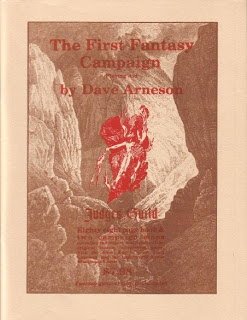
⇒ GRACE: ★★:  The First Fantasy Campaign is not a pretty book.  The mountains on the cover look cool but the red on brown is very difficult to read.  The book is US Letter sized, but other than that, it matches the old school layout you would expect from a vintage 1970s D&D book.  What elevates this book from its OG peers is the art.  Ken Simpson did nearly all of the art, with Dave Arneson knocking out some art as well (I assume this is his original Blackmoor map in the book, as well as the dungeons and the pull-out maps).  Mr. Simpson's art is good and there isn't a bad piece.

Sunday, January 8, 2023

Cursed Scroll Issue #1

This is a review of the first issue of Cursed Scroll, a zine for the Shadowdark rpg.  If you have not heard of the game, you should check it out.  This is not a review of the Shadowdark (hence SD, if I need to reference the game system) book, which is not out yet.

If you want to pick up the free quickstart of the game, it can be found here:  Shadowdark

The author is a cool chickadee named Kelsey Dionne.  She has a YouTube channel (Arcane Library, I think it's called).  The zine is OGL, which as of this past week, might pose an issue with getting new copies in the next few weeks.

So, are you kids ready to dive in to this most happy and uplifting zine?  No?  Well that is probably good since this zine is dark, dreary, gloomy, and slimy.  

The zine is black and white, with a dash of yellow on the cover.  The cover is an evil-looking, horned dude, swinging a big axe, chopping through two unlucky foes and perhaps into a third fellow.  I think this gnarly, beastly dude might be a dralech, which is one of the new monsters in the book.  I will get to new monsters later.  

The back cover is a random table of twenty diabolical treasures.  All of the treasures are pretty neat.  Anything from a ring of daisies to a shrunken head might be rolled.

When the zine is opened, you get right into the gloomy, slimy goodness.

Before we open it though, this issue is all about devils, demons, slimy things, and other sorts of badness.  Be warned!  You, unwary reader, might end up gibbering in the darkness as mighty Mugdulblub dissolves  your flesh as a tribute to Its Ooziness.

The inside cover is a map for a hex crawl, called the Gloaming.  The map is usable but the hex lines are unusable other than for the numbered encounter hexes, the outside edge, and in Finimere Lake.  Elsewhere, they are so light as to be unreadable.  

Once past the map, we get to the first page, which is random encounters and rumors for the Gloaming.  The encounters include monsters from the rulebook and well as this zine.  We start to get the gist of the zine and the adventures by reading the rumor table.  It has sort of a dark fairy tale, black forest, swamp witches vibe - think Grimm fairy tales without the hideous Disney (the real diabolical cultists) whitewashing.  The encounters and rumors are really cool.  My only hesitation with them is that I worry that in future issues of the Cursed Scroll, encounters might point back to monsters in this zine, which would require referees to own each issue.  That isn't an issue for me so far as I'm madly in love with this game and I will probably purchase them all as they come out.  But for others though, I can see this being a future problem.  I would encourage the author to only reference the rulebook or the zine in question when creating encounter tables like this.

We next have the table of contents and introduction.  Nothing out of the ordinary so far.

The zine then delves into three different character classes.  My biases will come out here, just so's ya knows...

The first class is called Knight of St. Ydris.  These are knights who voluntarily accept a curse in order to fight demons.  This class is fine for the included hex crawl.  My issue with it is that it fills a very narrow niche.  In a class-based game, I want classes to be as broad as possible - fighter, the guy who fights! - thief, the gal who steals! cleric - the crusader bringing God to the heathens! - the wizard, using sorcery to subvert reality!  Characters who want to play this class have to do it in the included adventure (no spoilers, but there is really one specific place for the knights to be generated).  I would rather have just had a list of options for the Knights - something like "Fighter with d6 hit points but can cast 1st level witch spells or 3 times per day, you gain demonic possession (player choice at creation)".  Something like that.

All of that being said, the Knights of St. Ydris are basically a fighter-witch multi-class.  They can use demonic possession to do extra damage in combat and get minor and mid-range magical abilities, starting at 3rd level.

The next new class is the Warlock.  Now, as everyone should know by now, I jumped off the D&D bandwagon at 3rd edition.  Warlock wasn't a thing in the D&D games I played.  Warlocks in this zine are characters who gain a boon from a dark patron.  There is a list of patrons in the book, and some of them are doozies!   I do have another gripe.  I will have a few more, don't worry.  My issue with Warlocks is that they can use daggers as weapons and they can use long swords as weapons.  What is the reasoning for disallowing short swords?  It is not logical.

A quick sidetrack on the SD game system.  There are no specific, level-based benefits, other than hit points.  At each odd level, the player makes a roll to find out which "talent" his character will gain.  You need to know this while reading about the classes.

Ok, back to our Warlocks.  They are "howling warriors with sharpened teeth" and "wild-eyed doomspeakers".  I can imagine them as cannibalistic cultists, dancing around a statue of Cthulhu in the swamps of Louisiana - except, you know, a different patron and it's the Gloaming, rather than Louisiana.  This class has broader game play for players than the previous Knights.

The last new class is the Witch.  Forget those lame, dirty hippy, wiccan freaks of our degenerate modern times!  No, THESE witches are the real deal!  Cackling crones with bubbling cauldrons, outcast maidens with milky eyes, covered with dirt and talking to their pet toads.  My oh my, this is the way a witch should be portrayed!

So, what does Esmerelda get in this game?  Witches have a familiar, of course, and they can cast spells.  Witches have their own spell list.  I will point out some spell list details when we get to it.  

The next page is a list of class titles, which is something that SD is really into.  I'm ambivalent about class titles.

Following class titles, we get the descriptions of the patrons.  Some of them are really cool.  I will say, though, that as awesome as they sound, a couple are statted out in the included adventures, which turned them from "oh heck ya!  This thing is some elder god from beyond the stars!" to "oh, wow, my fighter has just as many hit points as this patron of immense eldritch power?!"  It is a lot like getting Deities and Demigods as a kid and having your players go into battle against the gods so they can score Thor's hammer.

I will quote the entirety of Mugdulblub here so you can see how awesome it sounds.  "The Elder Ooze that leaks between the cracks in memory and the darkness between the stars, Mugdulblub seeks the dissolution of all physical form".  Sounds bad ass, huh?  In the zine, there is the Mugdulblub, Almazzat (a wolf demon guy), Kytheros (sort of a Cronus I think), Shune the Vile (mother of the witches), Titania (fairy queen), and the Willowman (fear and nightmare thing).

Patron boons follow.  Some are basic between all classes (ability score gain, spell bonus, etc.) but some are unique, such as turning into slime for a few rounds or able to hypnotize foes.  There is a list of diabolical backgrounds which follows the boons.  Some are very fairy taleish (is that a word?), such as "Woodborn.  They found you in the hollow of an oak tree" or dark fairy taleish (Witchborn.  They burned your mother, but spared you".  I dig them.

Diabolical Mishaps comes next.  Another side note.  Shadowdark, as written, requires a spell casting check, and on a natural 1, the player or referee needs to roll on a table for the spell fumble.  Some of them make a lot of sense for the included hexcrawl/setting.  Cackles, Wither, or Mother of Night are all very setting-specific and make sense.  One of the mishaps has iron spikes which appear and cause damage.  This one I don't dig that much.

Next up we have witch spells.  The spell names are freaking awesome - eyebite, frog rain, dreamwalk - all are evocative.  When/if I ever run this game and if I allow Witches (or Knights of St. Ydris) as a class, I would modify a few of the spells.  Bogboil?  Awesome as written.  Cauldron?  Eh, not as much.  Having a witch with a cauldron is M1A1 standard.  This spell, however, conjures the cauldron.  I'd make the witch have her own cauldron and then, when this spell is cast over it, the effects can be used.  Having a boiling cauldron just pop into existence is too high fantasy for the genre this zine is emulating.  The Coven spell allows the caster to gain the reuse of a spell.  That makes sense for a witch with a coven.  Another change I would make is for Pin Doll.  I'd make the character already have the voodoo doll before the spell would work.  I wouldn't allow it to just poof into existence.

After spells, The Gloaming hex crawl is detailed.  All of it is dark fairy tale goodness.  Hexes can contain anything from an orc village, to a dragon, to a down and out village that is burning witches (hell ya!), to the Greywall Priory, which is where the Knights of St. Ydris are based.

New monsters are next.  As stated, some of these are needed for the included adventures and won't have much use elsewhere (named NPCs fall into this category).  Unfortunately, as stated, a couple of the warlock patrons are statted out.  If I was to use them, I would probably have the Mugdulblub in this section be a minor avatar of the real Mugdublub.  The characters can kill it (not an easy thing, fyi) but it's just a blip on the real Mugdulblub's galaxy-spanning goopiness.

The Hideous Halls of Mugdulblub is one of the included adventures (I'm counting the hex crawl as one and the cardstock encounter the third).  Hideous Halls is an adventure for 1st level characters.  The adventure oozes (get it?  Yuck yuck yuck) charm, sliminess, and fun.  There are three factions all living in the dungeon.  Any of them might recruit the characters or at least remain neutral.  There are a couple of issues with the adventure though.  My biggest issue with it is that every room has an occupant or something notable in it.  I can see players after four or five rooms saying, "alright folks, another room up again, something will be there".  Monster, trap, or weirdness, there are no empty rooms.  Personally, I think that 20-25% of dungeon rooms should be empty.  Empty rooms both keep players on their toes, not knowing if it is empty, and also give characters breathing room and a place to fall back to.  I will avoid specifics about the adventure as I don't want to spoil it for players.  There are some really neat NPCs, traps, and treasures.  One of the three groups living in the dungeon is quite memorable (the ones that really need to be near water), one group is very Lovecraftian and degenerate, and the third are a bunch of junkie, mushroom eaters.  I like all three.  One other issue I have with the adventure is the stairs in room 18.  From what I can tell, they don't go anywhere.  It is stated in the adventure that there are two ways to enter the dungeon and this isn't one of them.  I would probably not even mention the stairs to the players unless I expanded the adventure.

The book finishes with the map of the dungeon.  

There is a card included that is a small encounter.  It has a map and random encounters on one side and room descriptions on the other side.  This mini adventure is also pretty cool.  It is less dark fairy tale and more Lovecraftian.  The referee is going to have to hit up a dictionary though unless he is well versed in jurassic lore (I have kids so I know all about ammonites and trilobites and all that prehistoric jazz).

So, should you get this zine?  Hell ya!  Provided you like dark fairy tales, Cthulhuisms, or proper, old-school witches.  

⇒ GRIT:  ★★★★☆ This zine is 64 pages of dark, dreary, swampy goodness.  Want to run a game of Grimm fairy tale D&D?  Get this zine.  The classes (well, two of them) are great, the adventure is really fun, the spells are witchy.  Do you have fond memories of fighting Kuo-toa in the depths of the earth?  Did you fear Blipdoolpoolp and her lobster boobs in the 80s?  Do you enjoy listening to Acid Bath?  This zine is for you.

⇒ VIGOR:  ★★ As awesome as the stuff included in this zine is, it is really only usable in the specific genre it is emulating.  Bits and bobs of it can be stolen to be used in other genres but, really, it is limited to a dark, fairy, swampy, setting.

⇒ GRACE:  ★★★  Yowza!  If the rulebook, when it comes out, is as gorgeous as this zine, we gamer folk are in for a treat!  Now, I give it four stars, but I LIKE black and white for my fantasy.  If you want lots of color, you may not like it as much.  The zine has an incredible layout.  The only real shortcoming with this issue of Cursed Scroll is the faded hex lines on the inside cover.  Some of the art is perfect (witch and cauldron on page 25, for example).  The rest of the art certainly fits and I'm not knocking it.  I would like to see more art but I imagine Mrs. Dionne is saving some pieces for the main rulebook.  I assume that if the main rulebook is as great as I believe it will be, she may score some more art in subsequent issues.

If this zine seems interesting to y'all, I strongly recommend you buy it now because in a few weeks, it might not be available if Lizards of the Toast go through with their OGL backstab.


Thursday, January 5, 2023

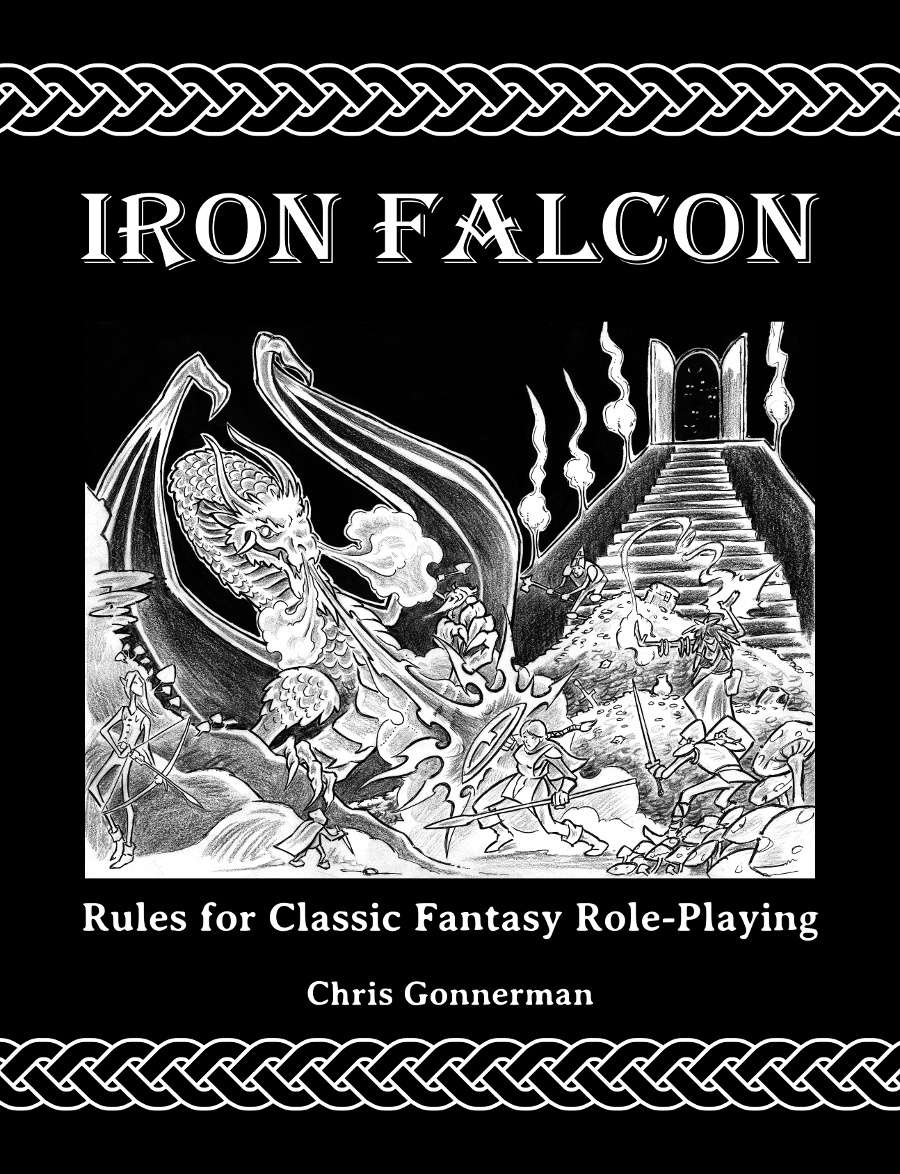
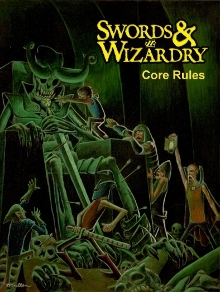
Comparing Blueholme Journeymanne, Iron Falcon, and Swords & Wizardry Core

Since I had such a fun time in my previous post comparing WB:FMAG and Delving Deeper, I thought I would compare three other retroclones that are based on OD&D plus Greyhawk.  Technically, Blueholme is based on Dr. Holmes' rules, which were designed to restate the OD&D rules in a coherent fashion.  The Journeymanne rules are really close to OD&D though, so I think it is fair to compare here.


Blueholme Journeymanne is the Holmes 1977 version of the game, expanded to 20 levels.  It is written by Michael Thomas.  Iron Falcon is a different way of saying Grey Hawk, which is Chris Gonnerman's contribution to the early days.  Swords & Wizardry core is by Matt Finch.  All of the games go to at least 20 levels, so these comparisons should be kosher.  I will abbreviate them as Blue, IF, and Core, to make my typing easier.  I was going to abbreviate Blueholme Journeymanne as BJ but I know how you degenerates think!  For shame!

I purchased Blueholme from Drivethru, I believe.  I don't see S&W Core listed as a hardback so I perhaps got it from Lulu.  I know that Iron Falcon came from Lulu since it is the newest of the bunch.  Here are the Drivethru links if you want to pick any of them up:


Blueholme Journeymanne
Iron Falcon
Swords & Wizardry Core

I am not using Swords & Wizardry complete since it includes OD&D booklets which the other two do not include.  I own all three of the books I'm comparing in the post in hard back print on demand, so please keep that in mind when I discuss the physical books.

I am going to pick a handful of topics and then compare and contrast them between all three of these books.  I will also compare them to God's Own D&D from time to time, as necessary.  I, of course, mean the Moldvay-Cook 1981 version of the rules, sent down from Heaven into the mind of Saint Moldvay, to write and publish via TSR.  If any of my biases come through, you can probably assume it is because no D&D version is as good as his version.  I will also be scoring with 2, 1, or 0 points, for highest, middle, and lowest.

Oh, I will also go ahead and choose which of the three I prefer for each of my comparisons.  At the end, we will all know which one I would keep if I could keep only one.  I am excited to find out!

Comparison #1:  Ability Scores

All three games have the standard six, of course.  Each of the three games has idiosyncrasies and none of them match 100% with any other for all abilities but some match for individual abilities.

Strength:  Blue does not have ability score modifiers here, allowing only a prime requisite adjustment for fighters.  Core and IF both match exactly, assuming you translate the coins-to-pounds weight adjustment.  Both allow only fighters to receive bonuses for melee attacks and damage but both allow it for other classes with GM approval.

Intelligence:  Blue gives one additional language per point of INT over 10 but does not not give us details on intelligence for chances to learn spells, nor number of spells known until the chapter on classes.  IF uses the same additional language range as Blue but allows magic-users to only learn spell levels up to a number based on their INT score.  Core does not have this rule.  All three have minimum and maximum spells known for magic-users and also a chance to learn spells.  They are basically the same but Core gives a 4% greater chance to learn spells with an 18 INT.  Intelligence is the prime score for magic-users, of course.

Wisdom:  Core gives a bonus spell to clerics if their wisdom is 15, or higher.  No other benefit, other than prime requisite bonus, is given for any of the games.  Wisdom is the prime score for clerics.

Constitution:  Blue and IF match up here, giving bonus hit points starting at a score of 15, or higher; the bonus ranging from +1 to +3 hp per level.  Core gives a +1 bonus at 13 but does not improve.  Both IF and Core have a resurrection survival number, while Blue does not.

Dexterity:  All three games give a +1 bonus to attack rolls if dexterity is 13, or higher.  Core and IF give a bonus to armor class with high DEX.  Core is a straight +1 bonus while IF ranges from +1 to +4.  The +4 of IF seems too high, to me, but I think that this corresponds with Core's "parrying" for fighters.  Dexterity is the prime requisite for thieves, of course.

Charisma:  All three games use charisma for followers, as should be expected.  Core limits followers ("special hirelings" in their lingo) to 7, while Blue and IF max at 12.

I am not a fan of large ability score modifiers.  I actually think that ability scores can be either done away with or severely limited.  In the original game, a high score was mostly to get an experience bonus, so I suppose they need to be kept for that reason.  I like IF and Core for limiting the melee combat modifiers to just fighter.  Personally, I'd rather the modifier go to all classes and limit the level-based melee "to hit" bonus even further for non-fighters.  IF's dexterity AC modifier is nuts.  Maxing at +3 is acceptable since there is only a 0.5% chance of rolling an 18 with 3d6.  You ARE doing 3d6, in order, I hope?!  I like the 12 followers for Blue and IF.  I have never used min and max spells and spell level limits based on intelligence so I'm tossing that right out for any game.  I think I am going to have to choose Blue for the best ability score section since it is the most streamlined, though I would prefer a melee combat modifier, whether limited to fighters, or not.  It's a tossup for 2nd place but since I prefer a HP modifier based on CON and the 12 followers, let's go with IF in 2nd place.  None of them match up to the streamlined BX modifiers.

Blueholme:  2
Iron Falcon:  1
S&W Core:  0

Comparison #2:  Classes

All three games have the core four classes - cleric, fighter, magic-user, and thief.

Clerics:  all three games do not allow the cleric to receive spells until 2nd level.  Here are tables to show number of spells allowed per level, based on character level.

Blueholme Cleric Spells per Level:
Level    1st    2nd    3rd    4th    5th    6th    7th       
5            2        2        -        -        -        -        -
10          3        3        3       3        3       -        -
15          6        6        6       5        5       2        -
20          8        8        8       8        8       5        2

Iron Falcon Spells per Level:
Level    1st    2nd    3rd    4th    5th    6th    7th       
5            2        2        -        -        -        -        -
10          3        3        3       3        3       -        -
15          6        6        6       5        5       2        -
20          8        8        8       8        8       5        2

S&W Core Spells per Level:
Level    1st    2nd    3rd    4th    5th    6th    7th       
5            2        2        -        -        -        -        -
10          3        3        3       2        2       -        -
15          6        6        6       5        5       2        -
20          8        8        8       8        8       5        2

You can see that spells available per day are nearly identical, with Core limiting a smidge in the mid levels.

Clerics can turn undead in all three versions.  Blue cleric's roll 2d6, IF rolls 1d20, and Core rolls 2d10.  Using 2d6 limits the types of undead the cleric can turn in Blueholme, but this is what I'm used to seeing in BX.  All three have automatic turn and destruction of some undead, based on the cleric's level.  Clerics max rolled hit dice is level 8 in Blue and level 9 in IF and Core.  All games have d6 hit dice for clerics.

XP for levels, Cleric
Level    Blueholme    Iron Falcon    S&W Core       
5            12,001            12,800            12,000
10          300,001          400,000          310,000
15          800,001          1,240,000       590,000
20          1,300,001       2,560,000       940,000

There is a noticeable difference when clerics reach high level, or rather the xp required to reach high levels. 

Both Blue and Core include building a stronghold in the character description chapter and Blue also includes rules for creating holy water and healing potions. 

Fighters:  As I stated earlier, under Dexterity, IF builds in "parrying" into armor class with high scores.  Core has a parrying bonus, which is actually a penalty that enemies have to attack the fighter.  This bonus maxes at +5 (well, -5 for enemy attacks, actually).  Blue doesn't have anything like this but gives fighters a bonus to damage with all weapons, ranging from +0 at 1st level up to +9 at 20th level.  Core gives multiple attacks to foes of 1HD or less.  Both Blue and Core have baked-in stronghold rules within the character class chapter. 

Fighters roll d8 for hit points in all three.  Rolled hit dice cap at 10 in Blue, 9 in IF, and 9 in Core.

XP for levels, Fighter
Level    Blueholme    Iron Falcon    S&W Core       
5            16,001            16,000            16,000
10          360,001          500,000          350,000
15          920,001          1,500,000       850,000
20          1,320,001       2,500,000       1,350,000 

We see that Blue and Core are pretty close through all levels for XP required.  IF is the outlier and I can't figure out why since they have few abilities than the either two rule sets. 

Magic-users:  All three books allow magic-users to cast spells, of course.  Blue includes the INT-based spell bonuses in this section of the book, which is an odd choice.  I get that only MUs will need this chart, but it would perhaps look "cleaner" if this info was included in ability scores.  At any rate, the info is here.  As you should expect by now, Blue and Core include rules on strongholds included with class details.  Blue includes rules for spell research and scrolls in this chapter, Core includes them in the magic chapter, while IF doesn't include them at all, as we should expect by now.

Magic-users roll a d4 hit die in all three games, Blue and Core has them roll through 11th level, while IF has MUs stop rolling for hit points at 9th level

Blueholme Magic-user Spells per Level:
Level    1st    2nd    3rd    4th    5th    6th    7th    8th    9th       
5            4        2        1        -        -        -        -       -      -
10          4        4        3       3        2        -        -       -      -
15          5        5        5       4        4       3        1       -      -
20          7        7        7       7        7       7        3       3     2

Iron Falcon Spells per Level:
Level    1st    2nd    3rd    4th    5th    6th    7th    8th    9th
5            4        2        1        -        -        -        -       -      -
10          4        4        3       3        2        -        -       -      -
15          5        5        5       4        4       3        1       -      -
20          7        7        7       7        7       7        3       3     2

S&W Core Spells per Level:
Level    1st    2nd    3rd    4th    5th    6th    7th    8th    9th
5            4        2        1        -        -        -        -       -      -
10          4        4        3       2        2        -        -       -      -
15          5        5        5       5        4       4        2       -      -
20          7        7        7       7        7       7        3       3     2

 All three games are pretty close in magic-user spells per day.  Core gives a couple more spells at high levels.

XP for levels, Magic-user
Level    Blueholme    Iron Falcon    S&W Core       
5            20,001            19,200            20,000
10          200,001          600,000          200,000
15          700,001          1,700,000       700,000
20          1,200,001       2,800,000       1,200,000  

Blue and Core match up in regards to experience required.  IF is similar at low levels but by mid levels, they are really jacking up the XP required.  This is less noticeable with clerics and fighters but it really is noticeable with wizards.  I personally think that Blue and Core requirements are too low at mid and high levels.  Once magic-users hit the mid levels in Core and IF, it is easier for them to level than either clerics or fighters.  I would prefer to have wizards' requirements higher than other classes through all levels.

 Thief:  The Greyhawk supplement added the character class, thief.  Some groups out there who play OD&D play a thiefless game.  I get that but as thief is probably my favorite class, I don't think I'd run a game that way.

 All three games allow thieves to backstab unaware foes.  All three games also award extra damage based on the level of the thief.  Blue has x2 damage at level 1, increasing up to x6 damage at level 17.  IF follows this scheme but awards x7 damage at level 21, which Blue doesn't go to.  Core tops out at x4 damage at level 8.

The other thief skills are what you would expect from any version of traditional D&D - open locks, remove traps, hide in shadows, hear noise, etc.  These are represented as a % chance of success, as normal.  Of course, % chance is dumb, and thief skills should be x-in-6 like all other skills (especially since hear noise is traditionally x-in-6; White Box FMAG and Delving Deeper are an improvement with x-in-6 for all thief skills), or d20 like combat and saves.  Having one particular set of abilities percentage-based was an odd choice, even in 1974.  Blue has hear noise being a % chance, while IF and Core keep the normal x-in-6.  IF and Core allow thieves to read languages at 3rd level, Core allows them to read magical writings at 9th, while IF allows this ability at 10th level.  Blue allows these from level 1, and also allows thieves to use magic wants at 1st level, even if the chance of success is very small.

Blueholme Thief Abilities by Level:
Level    Climb    Hear    Hide    Locks    Move    Pockets        
1            80%       35%     10%    15%      20%      20%
5            100%     65%     35%    40%      45%      45%
10          125%     105%   75%    75%      85%      85%
15          150%     130%   105%  115%    115%    115%
20          175%     155%   130%  140%    140%    140%

Iron Falcon Thief Abilities by Level:
Level    Climb    Hear    Hide    Locks    Move    Pockets 
1            87%       1-2       10%    15%      20%      20%
5            91%       1-3       35%    40%      45%      45%
10          94%       1-4       75%    85%      85%      85%
15          97%       1-5       93%    93%      95%      95%
20          99%       1-5       98%    98%      100%    100%

In IF, Pick Pockets and Move Silently use the same column for success.

S&W Core Thief Abilities by Level:
Level    Climb    Hear    Hide    Locks    Move    Pockets 
1            85%       1-3       10%    10%      20%      15%
5            89%       1-4       30%    30%      40%      35%
10          94%       1-5       75%    75%      80%      70%
15          99%       1-6       100%  100%    100%    100%
20          99%       1-6       100%  100%    100%    100%

In Core, thief skills max out at level 16.  Hide in Shadows and Open Locks have different columns for success but the % chance is exactly the same.  Also, in Core, removing traps and picking locks are the same skill, called Delicate Tasks.

You will notice that Blue has chances which go above 100%.  The rules note that sometimes the skill check will be modified based on the ease of task.  The other two don't specify that task difficulty is taken into consideration and both IF and Core are pretty close as far as success chance goes.

Blueholme does not modify the success chance based on the race of the thief while both IF and Core do.  This would be fine if either humans got bonus points to put where they want or to give some for of penalty to at least one skill for non-humans.  As it stands, non-humans get nothing but bonuses in Core and IF.

Both Core and Blue have thief strongholds (thieves' guilds) while IF ignores this yet again.

All three games use the d4 for hit dice for thieves.  Blue and Core max out with 10 hit dice and IF maxes at 9.

XP for levels, Thief
Level    Blueholme    Iron Falcon    S&W Core       
5            9,601              11,200            10,000
10          125,001          350,000          120,000
15          750,001          1,400,000       760,000
20          1,375,001       2,500,000       1,410,000 

As with all classes, Blue and Core but jive with each other pretty well while IF is quite a bit higher XP required for mid and high levels.

In summation for the classes, each of the games works with XP requirements within the game itself, though Iron Falcon requires quite a bit more experience at mid and high levels.  This will slow down character progression, of course, which isn't a bad thing, but it should be noted.  I don't really have a preference with either slow or fast advancement since the DM is going to award bonus XP anyway if he wants the characters to advance faster.  Blueholme and Core are very compatible, but with the additional information included in Blue, I find that I like it the best.  I will say that I enjoy having Iron Falcon cap all hit dice at 9.  Core gets 2nd billing in this category

Blueholme:  2+2=4
Iron Falcon:  1+0=1
S&W Core:  0+1=1

Races:  Bluholme Journeymanne takes the bold move here to not include the standard elf, dwarf, and halfling.  They note that many of the monsters can be used as PCs  Blueholme apprentice does use the standard races so I will use them for this comparison.  I have already noted that demihuman thieves have bonuses.  Both IF and Core limit demihumans in level, which is how it should be.  Blue does not have this limit.  All three games limit classes available by race, which is also a good thing.  Core does have an optional rule to allow demihumans to advance past maximum level, which requires a XP penalty once they reach "maximum" level.  I find this a good way to continue advancement.

Dwarves in Blue gain a +2 on saving throws, they save as 4 levels higher in IF, and Core gives them a +4 bonus.  In all three, dwarves are good at dwarfy stuff like finding moving rooms, new construction, and all that.  

Both IF and Core limit dwarven fighters to level 6, 7, or 8, depending on the character's strength.  Blueholme Apprentice requires all PC dwarves to be fighters, Core allows fighters or fighter/thieves, while IF allows fighter, cleric, or fighter/thief.  Dwarven clerics are limited to 7th level in IF.

Elves are great at finding secret doors (4-in-6) in all three games and elves are immune to ghoul paralysis in all three, but you have to look in the monster section for ghouls to realize this in IF.  Apprentice requires elven hit dice to d6 for all allowed classes.

Blueholme Apprentice allows elves to be fighter, magic-user, or fighter/magic-user.  IF allows fighter, cleric, magic-user, thief, fighter/magic-user, fighter/thief, magic-user/thief, or fighter/magic-user/thief.  In IF, fighters are limited to 4th or 5th level, depending on strength, magic-users are limited to 8th or 9th, depending on intelligence, and I already mentioned IF dwarven clerics.  Core requires PC elves to be fighter/magic-user (hearkening back to both OD&D and God's Own BX), thief, or fighter/magic-user/thief.  In Core, the fighter portion of elves is limted to 4th, 5th, or 6th level, depending on strength and to 8th or 9th level as magic-users, again, depending on intelligence.

In regards to halflings, Apprentice requires that halfling fighters use d6 for hit dice, and also requires all PCs to be fighters.  Halflings in Apprentice receive +2 to all saving throws and attack with +1 bonus with all ranged weapons.  IF gives them a +3 bonus to hit with all ranged weapons and allows halflings to be fighters or thieves, limited to 4th level as fighters.  In IF, they also roll all saving throws four levels higher.  Core gives halflings a +4 bonus on all saves and a +1 bonus with missile weapons.  They also limit halflings in the same manner as IF.

IF alone allows half-elves as a choice.  They can be any class or multi-class, with either two or three class choices.  They are limited to 6th level as clerics, 6-8 levels as fighter and/or magic-user, depending on the character's strength or intelligence.

Frustratingly, IF and Core allow unlimited levels for demihuman thieves.  With the extra bonuses for thief skills and unlimited level advancement, demihuman thiefs are always going to overshadow their human compatriots.

I think Blueholme Journeymanne dropped the ball by not including these common races in the book.  I had to purchase Apprentice and print out the page and stick it in the book.  Allowing monster races hearkens back to the days of old, which is fine, but it was a big miss to not inlcude all standard races.  Core also allows DMs to include various monsters as PCs, if wanted.  IF is silent on minotaur thieves and harpy wizards.

Overall, I like the way Iron Falcon does races the best, with Core following behind.  Including clerics as an option pushes IF to the top.  Blueholme fails here due to lack of standard races in the rule book.

Blueholme:  2+2+0=4
Iron Falcon:  1+0+2=3
S&W Core:  0+1+1=2

Alignment is the standard Law-Neutrality-Chaos in both IF and Core, while Blue uses Dr. Holmes' 5 point aligment (LG, LE, N, CG, and CE.  I think both are fine and I'm not going to award points to any game for this.

Equipment:  All three games have a decent list of gear available for purchase by characters.  Both Blue and IF group same items so it will cost a whole number of gp to purchase, while Core uses fractions of gold.  It costs 1 gp for 12 iron spikes in both IF and Blue, where it cost 0.05 gp for one iron spike in Core.  

Armor Class for armor tracks across all three books but the prices vary.  Blue and IF price chain mail at 30 gp and plate at 50 gp while Core has them at 75 and 100 gp, respectively.  

The weapon list in Blue and Core match up pretty well.  

Blue follows the Holmes set and has all weapons do d6 damage as the standard rule but allows for an option where light weapons do lesser of 2d6, heavy weapons do the better of 2d6, and extra-heavy weapons do the best of 3d6.  Attacks per round are also addressed in Blue (light 2 attacks per round, heavy attack every other round, and extra heavy allows one attack every 3rd round).  This is all well and good, but just using other polyhedral dice for damage makes more sense to me.

Core uses "standard" dice for damage, which might be modified.  For example, a crossbow does 1d4+1 damage, a battle axe does 1d8, and a two-handed sword does 1d10.  Core has a single number for range while Blue and IF write out the ranges for missile weapons by range category.

Both Blue and Core have a good range of weapons, hitting all of the standards.  IF, on the other hand, is missing the short sword, which is a pretty common weapons in D&D games.  IF inlcudes line items for spear, thrown or thrust, spear, set vs. charge, and spear, thrust vs. charge while the other two games just have spear as a single item.  IF throws back to differing damages for small and medium creatures and for large creatures.  Core wisely went away from this.  Core also notes that some weapons, when used in two hands, do +1 damage.

Blue and IF have prices for ships and rules for waterborne movement while Core does not.  Core has movement but not prices (technically, it has a price for a rowboat).

I like the look of IF's equipment charts, I find that they include the most information and the layout is nice.  Core's weapons tables include the information needed but are not very handsome.  Blue missed out by not having variable weapon damage by polyhedral as either a core rule or option.   I also like that Core has both descending AC and ascending AC as options.  Blue has descriptions for all equipment items, or at least most of them, I didn't count them.  Core has descriptions for a few items and IF describes none.  I will rate them as Core, Blue, and then IF for the equipment chapter.

Blueholme:  2+2+0+1=5
Iron Falcon:  1+0+2+0=3
S&W Core:  0+1+1+2=4

 It looks like all three books are now getting closer together!

Combat:  since all three games have a descending armor class as either the only resolution or an option, I will use it for comparison.  All three games use the same 2-in-6 surprise mechanic.  IF and Blue have a reaction table, while Core does not.  Blue has five results for reactions while IF has three.  Both would work fine.  I don't know why Core left this bit out, it is a standard in old school gaming.

Core includes two initiative systems, one of which is based on the Holmes set.  Blue and IF have one initiative system.  Blue and Core have specific segments in which combatants act (surprise, then spells, then ranged, etc.), whereas IF doesn't specify initiative based on weapon use.  All three systems give fighters the best attack rolls (this makes sense), Blue and IF lump thieves and clerics together, while Core lumps thieves and magic-users together.

For the tables below, I'm going to use THAC0, which isn't a standard option in any game.  For those youngin's out there who haven't used it, THAC0 is the "To Hit AC0".

Blueholme THAC0, per Level:
Level    Fighter    Cleric    Magic-user    Thief      
1            19            19                19            19
5            17            17                19            17
10          12            14                17            14
15          10            12                14            12
20           6             10                12            10

Iron Falcon THAC0, per Level:
Level    Fighter    Cleric    Magic-user    Thief      
1            19            19                19            19
5            16            17                18            17
10          12            15                15            15
15           8             12                13            12
20           4              9                 10             9

S&W Core THAC0, per Level:
Level    Fighter    Cleric    Magic-user    Thief      
1            19            19                19            19
5            17            17                18            18
10          12            14                15            15
15           9             11                13            13
20           6              8                 11            11

As we see, each game is within 2 points (10%) at each of the notated levels.  Any of the three games is fine with the numbers.  I do question lumping thieves and magic-users together in Core, though.

Blue has rules for parrying (allowed to all classes and not just fighters), subdual damage, shooting into melee, retreating, special attacks (oil, poison, wolfsbane, etc.) and siege engines.  IF has rules for charging and oil.  Core has rules for subdual damage, shooting into melee, and two-weapon fighting.

Blue has two examples of combat, Core has one example that includes adventuring and combat.  IF has no examples.

All three games use saving throws and they are close enough that I'm not going to bother typing them out.  Core has a single saving throw as default but includes the standard old school saving throws as an option.

IF inlcudes weapons vs. armor worn in an appendix.  I would probably never use this but it is pretty cool that they inlcuded it as an option.  IF has damage determined by foe's size so they might as well have included this.

Core has its positive points but I find that Blue takes the cake here.  IF is perfectly acceptable in regards to combat but it falls behind its two homies.

Blueholme:  2+2+0+1+2=7
Iron Falcon:  1+0+2+0+0=3
S&W Core:  0+1+1+2+1=5
 

Spells:  Blue takes the bold move to require clerics to have spell books.  They are basically missals, but the author doesn't use that word.  Other than that, all three games are pretty much the same in regards spellcasting.  

In organization, Blue organizes spells by class and level while the other two have spells combined into one alphabetical section.  I prefer this way.  The spells are pretty much the same between all three versions.  Blue includes reversed spells as specific spells in their lists while the other two notate that a spell can be reversed, either in the list (IF), or in the description (Core).  Blue and Core include range and duration in the spells header.  IF requires you to read through the description.  Blue makes it a point to have the same number of spells available for each spell level (praise the Lord!) while IF and Core have a varying number of spells at each level.

* Cure Light Wounds cures 1d6+1 hp in each version. 
* Light has a 120' range and duration of level x 2 turns in Blue and IF, while in Core it is a 60' range and duration for clerics is 2 hours and for magic-users it is 1 hour + 10 min per level.
* Magic Missile requires an attack roll in Blue and does 1d6+1 damage with two missiles at 3rd level, three at 5th level, and one additional missile for each two levels, thereafter; range is 70/140/210. IF does not require a to hit roll, does 1d6+1 damage, and adds two missiles for each 5 additional caster levels (three missiles at 6th, five missiles at 11th, etc); range is 150'.   Core does either 1d6+1 damage with a successful attack or 1d4+1 with an automatic hit, at 5th level the caster gets three missiles, five missiles at 10th level, etc. and the range is 150'.  

I like the way Core does magic missile but dislike the way they chose to do light.  I dislike Blue's spells broken down by class and level but enjoy the headers having range and duration.  IF falls in the middle.  I like Blue having both standard and reversed spells in their spell tables, as well as the same number of spells (disregarding reversed) at each level I'm giving Blue the win here with IF coming in 2nd. 

Blueholme:  2+2+0+1+2+2=9
Iron Falcon:  1+0+2+0+0+1=4
S&W Core:  0+1+1+2+1+0=5
   

Adventuring:  All three games have some typical adventuring rules.  I won't list them all but just generalize.

Blue has all adventuring rules in one chapter of the book.  IF is very pared down from Blue but does include the most important rules, such as traps, listening at doors, finding secret doors, and land/air/water movement.  There is a different reaction table in IF for NPCs and the book lists 8 different types of specialists, plus a page of men-at-arms.  Blue has 10 NPC types plus several types of mercenaries.  Core has 13 types of NPCs but lumps all mercenaries into one type.  Core has movement rates but has rules for doors, traps, and whatnot spread throughout other chapters of the book, from ability score generation to "high level adventuring".  IF has no specific rules for strongholds or pricing for structures, which makes sense since it wasn't even brought up in the class section.  Core has a very limited selection of structure prices but does have some rules.  Blue has the most exhaustive list of the three books.  Blue also has a pretty comprehensive chapter on designing the campaign setting.  Core has a cool dungeon laid out as a sample, as well as a one-page campaign setting and map.  IF has no campaign information.  All three games include random encounter tables based on dungeon level or terrain type.  Blue-IF-Core are the winners.  I could have gone either way with IF and Core but since IF has most of it's adventuring rules in one place edges them ahead of Core.

Blueholme:  2+2+0+1+2+2+2=11
Iron Falcon:  1+0+2+0+0+1+2=6
S&W Core:  0+1+1+2+1+0+0=5
   

Monsters:  All three books have good selection of monsters and all three have the usual suspects that one would expect to see in a core rulebook bestiary.  Blue has stat blocks differentiated by using bold type.  There is not a lot of space between each critter.  IF uses a clean table layout, with a large, bold font for monster type.  Core uses a bold font as well but separates the monsters with white space.  I will be judging art later one but a note that Blue has more of its monsters illustrated.

Goblin:
Rules                    HD      AC      Damage    Align        Other?      
Blueholme           1d6        9        1d6            2N:1LE    -1 attacks in daylight
Iron Falcon          1d8-1     6        1d4            C              -1 attacks and morale in daylight
S&W Core           1d6        7        1d6            C              -1 attacks in daylight
All three games have damage by weapon as an option for goblins.

Red Dragon, Adult:
Rules                    HD      AC      Damage            Align        Other?      
Blueholme           10d8      2        4d6/1d6/1d6     1N:1CE    fire breath weapon 50 hp damage
Iron Falcon          10d8      2        3d10/1d4/1d4       C           fire breath does uninjured hp in damage
S&W Core           10d8      2        3d10/1d8/1d8       C           fire breath weapon 50 hp damage
I selected middle stat block for all three, figuring it was halfway between young dragon and old dragon.  Red dragons do not cast spells in Blueholme, and at the middle age category cast two 1st and two 2nd level spells in IF; however number and levels of spells varies by age category..  In Core, they cast 1d4 1st level, 1d3 2nd level, and 1d2 3rd level spells.  Blue has only white, black, red, and brass dragons.  Core has black, blue, gold, green, red, and white.  IF has black, blue, brass, bronze, copper, gold, green, red, silver, and white.

Black Pudding:
Rules                    HD      AC      Damage    Align        Other?      
Blueholme           10d8      6        3d8            Nil            only damaged by fire
Iron Falcon          10d8      6        3d8            N              unaffected by weapons or lightning
S&W Core           10d8      6        3d8            N              immune to cold
All three games are very similar with black puddings.  The notable differences are immunities.  Blue has them dividing in two when hit by any attack; IF has them dividing when hit by weapon or lightning; Core has them dividing only when hit by lightning.

Stirge:
Rules                    HD      AC      Damage            Align        Other?      
Blueholme           1d8        7        1d3                       N           1d4 blood drain per round
Iron Falcon          1d8        7        1d4                       N           1d4 blood drain per round; +2 attack rolls
S&W Core           1d8+1    7        1d3                       N           1d4 blood drain per round
We see here that stirges are pretty close.  Blue switches from Nil to Neutral for alignment (black pudding is Nil) and I don't know why.  IF stirges have the most details given, including that a stirge will flee if it kills a foe in order to digest the blood.

Finally, let us end with the humble zombie.

Zombie:
Rules                    HD      AC      Damage            Align        Other?      
Blueholme           2d8        8        1d8 or 1d4            Nil         immune to charm and sleep, salt poisons
Iron Falcon          1d8        8        1d8                       C            never check morale
S&W Core           2d8     8 or 7   1d8                       N            some might be contagious
Our simple walking dead fellow.  Blue gives damage for both fist and bite and we are back to Nil for alignment.  Hearkening to real voodoo lore, zombies might be poisoned with salt and the zombies are immune to a few spells.  IF specifies that their zombies never check morale but the other two systems don't mention any specific morale rules for zombies.  Core gives an option for movie zombies, in that they can transmit a disease to create more zombies.  It specifies that this is optional. 

Blue has a decent list of monsters unique to itsself - amazon, dagonite, deep one, dreenoi, and the great race are some examples.  The other two rules don't have anything too different.  Blue has four standard horses, IF has three standard plus an optional "paladin's steed", and Core has one lonely horse.

Blue has 114 general monsters, discounting types of giants, types of dragons, types of horses, etc.  IF has 89 general monsters.  Core has 96 monsters, including a large list of demons.  Blue has a small number of demons.

Judging between the three games for monsters is difficult.  They all have good and bad points.  I like that Blue has more types of monsters but dislike their limited selection of dragons.  IF has the best layout in this section but all three are totally usable.  Both Blue and Core have rules for creating or modifying monsters.  I think I will place Core in the lead here as it has both a good selection of critters and they cover the broadest base.  Blue comes in 2nd as they have the largest selection of monsters and also have some cool Cthulhuesque type foes.  So far, this is the hardest category to judge.

Blueholme:  2+2+0+1+2+2+2+1=12
Iron Falcon:  1+0+2+0+0+1+2+0=6
S&W Core:  0+1+1+2+1+0+0+2=7
   

Treasure:  Of course, all of the rules have a chapter on treasure.  Blue and IF have the standard "treasure type" that all versions of D&D, except S&W uses.  Core has a simple hoard mechanic, and the DM has to "trade out" the treasure value for gems and magic items.  I find this the least useful way of doing it.  The types of magic items are comparable between all rules.  Blue has a broader range of enchantments, from -4 AC armor to +5 AC armor, -2 weapons to +4 weapons.  IF goes from -2 to +3 for armor and -2 to +4 for weapons.  Core ranges armor and weapons from -3 to +5.  All three have the standard magical items that adventurers like to find - healing potions, elven cloaks, and the like.

Core has the worst treasure section I feel.  I don't like their trade out system and their magical item selection required the referee to roll on chart A, then maybe chart B, then maybe chart C, etc.  Blue and IF limit moving from chart to chart to just one jump, say roll and get a +1 weapon and then roll to find out it's a dagger.  That sort of thing.  I think that I prefer the treasure system in Blue to IF, but just barely.  Blue's layout is better, breaking up charts rather than having ten charts on facing pages.

Blueholme:  2+2+0+1+2+2+2+1+2=14
Iron Falcon:  1+0+2+0+0+1+2+0+1=7
S&W Core:  0+1+1+2+1+0+0+2+0=7
   

Optional Rules:  Blue has one page of optional rules, covering ability rolls, additional classes (none inlcuded but says it is easy), alignment change, and "no hope" characters.  They also have a usable character sheet but it is pretty ugly.  IF has an extensive selection of optional rules, including the weapon vs. armor that I mentioned already, paladins, intelligent swords (Core has one in its magical item list), and different ways to run the game for Referees (Author's choice, Oldest school, and Full Gary), variant rules for spellbooks, a campaign checklist, and a very ugly, but usable, character sheet.  Core has a handful of variant rules spread throughout the book (ascending or descending armor class, single save or standard saves, etc.)  The Core character sheet is, by far, the best looking.

I'm giving props to IF here.  It's section on options is quite large and they are all lumped in the appendices, showing that they aren't core rules.  Blue is quite limited and their optional rules aren't really necessary.  I like Core's options for saving throws and combat but I don't like that you have to read side bars to see them.  I am going to go with IF, then Core, and finally Blue for optional rules.

Blueholme:  2+2+0+1+2+2+2+1+2+0=14
Iron Falcon:  1+0+2+0+0+1+2+0+1+2=9
S&W Core:  0+1+1+2+1+0+0+2+0+1=8
   

Physical Book:  All of the books are hardback and print on demand.  All three are perfectly usable and all three were not that expensive.  

Peter Mullen did the cover for Core.  He is my favorite rpg artist after Erol Otus.  The cover of Core is freaking amazing.  Alexander Cook did the cover for IF. It is decent but I find that I prefer the other two covers.  Blue was done by Jean-Francois Beaulieu.  It also is really, really good.  I think that most folks would find it the best of the three but since I have a think for Otus and Mullen, I'm going with Core as the best cover.

Blue has the most interior art and it's nearly all good or great.  Mr. Thomas manned up and commisioned some topless women, which is always nice - it hearkens back to the earliest days.  There is even a spooky piece, used to illustrate zombies.  Anyone who played AD&D back in the day will recognize the homage paid in the piece with some folks dividing treasure.  IF has the least amount of art.  Some of it is good or great and some is just passable.  Core has some really good art, including full-page art, but there isn't a lot of it, though it has more than IF.

The paper quality is what you would expect from a POD book - good but not silky smooth.

The layout for some portions of IF I find I like the best, but this isn't consistent through the book.  Blue has the best, most consistent layout, and I find I prefer this layout the best.  Core isn't bad but formatting every table with equally-sized rows (a good thing) and then aligning them all to the top causes me mental anguish.  There is so much space wasted.  Blue > IF > Core

Blueholme:  2+2+0+1+2+2+2+1+2+0+2=16 <- winner winner chicken dinner
Iron Falcon:  1+0+2+0+0+1+2+0+1+2+2=11
S&W Core:  0+1+1+2+1+0+0+2+0+1+0=8
   

Final Thoughts:  It looks like Blueholme Journeymanne is my favorite of the three rulebooks.  Not one of the three is bad, however.  I am kinda tempted to use Blueholme for my next game instead of what I am currently planning (BX/OSE), just to see how it works out.

If I did use it, I would probably change the following:

1.  Adjust ability score modifiers a bit, maybe give a bonus for high strength, limited to +1 or +2.  Maybe.
2.  Use the standard elf, dwarf, and halfling.  I prefer humanocentric campaigns but you can't stroll through Alfheim or the Five Shires and not trip over an elf or halfling.  Also, they would be limited in levels.   I would use the classes allowed as Iron Falcon does it, but with a higher level limit and definitely limit the demihuman thieves.
3.  Ditch thief % scores and do d20- or d6-based success.  I do this for every D&Dish game I've run since the 1990s.  Percentage just irritates me.
4.  Use traditional polyhedral damage with weapons, daggers do d4, short swords do d6, normal swords do d8, etc.  I would also ignore the attacks per round and say that all weapons attack once per round except heavy crossbows, which attack every other round.
5.  I'd also probably give fighters two attacks at 10th level and three at 20th level.
6.  I think that I might prefer the 1d20 cleric's turning.  I know that I like giving low level clerics the ability to turn more powerful undead, even if it is only a 5% chance.

D&D Capped at Level 3

Using ONLY one of the Basic D&D sets as a complete set of rules. AKA "Holmes Only" D&D This whole project started as a pos...