Showing posts with label adventure. Show all posts

Thursday, June 15, 2023

The Stars are Fire

The Stars are Fire
by Bruce R. Cordell

PDF can be had from DTRPG:  The-Stars-Are-Fire
or, from Monte Cook Games webstore (PDF and real book versions):  the-stars-are-fire
or, most likely from your friendly local gaming store.


The Good, the Bad, and the Ugly.

The Stars are Fire (TSAF, to save some finger damage) is a 224 page rules supplement and campaign setting for the Cypher System RPG.  I bought the book based (mostly) on the cover.  Take a look at that cover.  I'm happy to say, that at least in this case, judging a book by its cover worked out well.  I also must say this up front - I have next-to-no knowledge on Cypher System.  Some cat on the ShadowDark Discord pointed me in the direction of the free download, which I downloaded and skimmed.  I have since ordered the forthcoming boxed set but please don't expect a lot of rules details from me as I have only a rudimentary understanding of the rules.  Now that I have said that, rest assured, you do NOT need much knowledge of the game for this supplement to make sense.  In fact, the game mechanics in this supplement are a very minor part of it and can be ignored, in general.

OK chiruns, let's get into this.

The inside front cover is an extremely "not to scale" layout of our solar system.  The inside back cover is a vehicle scale representation, but doesn't include capital ships as they are too big.  There is a fold-out poster map which has both of these pictures on it, one on the front and the other on the back.

Chapter 1 is a list of sci-fi adventure seeds.  By reading through these, you will quickly realize that the author is dropping the kitchen sink of science fiction into this book.  TSAF is designed for any style of sci-fi, as this list and the rest of the rules supplement section shows.

Chapter 2 covers the very basics of the Cypher System, some minor advice on running science fiction, and then an example of play.

Chapter 3 digs into more detailed advice on running science fiction games.  TSAF simplifies tech levels into Contemporary (near future), Advanced (think Aliens or the Expanse), and Fantastic (Star Wars or Star Trek).  I prefer this delineation model to Traveller's more expansive tech levels.  I imagine that many folks would prefer the Traveller version, though.

Chapter 4 is about science fiction subgenres.  There are 21 included, by my count, of which several have a few paragraphs as examples.  Each of the subgenres lists a novel series, tv show, or movie which fits into the subgenre.  Some of these I have read or seen but some I have not.

Chapter 5 is a d100 chart about "conflicts of the future".  This would be useful for a really basic adventure generator but I don't envision using it very often.  

Chapter 6 are optional Cypher System rules for science fiction.  This includes issues with Zero G, high gravity, and the effects of vacuum.  There are several "GM Intrusion" tables in this section.  I assume that these GM Intrusions are something similar to the GM "spending a benny" in Savage Worlds.  It's a meta currency.  I read that players also have these "Intrusions" as well but this might have been in the free download of the core rules.  This chapter includes details on starship combat, with notes on both Star Wars style fighters and Star Trek style bridge crew.  Included is a page on vehicles vs. creatures for those who want to bring your Star Fury fighter to the Godzilla fight.

Pages 48 and 49 might be interesting but due to the darkish blue on black background, I find them unreadable and therefore skipped these pages.

A few pages discuss psionics and posthuman upgrades.  

Throughout this section, the GM Intrusions are listed based on the subject matter. Salvage from a wreck?  Intrusions are covered.  Ship damage from radiation?  Yep.  

Chapter 7 is filled with equipment lists. Page 67 has a very useful chart for light speed communication delay between planets in our solar system.  Each of the equipment lists is divided based on each of TSAF's three tech levels.  Each piece of equipment includes its default Level, which is the roll needed to use the equipment (I think?  Maybe it is to actually find the piece of equipment?)  My lack of Cypher System knowledge means that this isn't super clear to me.  The equipment is listed in order of Level, from low to high, at any rate.  Each equipment piece also includes a price.  There appear to be five price levels in the game; again, due to lack of Cypher knowledge, I don't know how this translates into actual credits, dollars, or gold pieces.  There is a conversion rate in a chapter further on, but it also isn't very detailed.

Some of the equipment has a small mono-color picture of it.  I really enjoy these mono-color pictures.  Actually, I prefer them to the full color art pieces.

Chapter 8 is the equipment list for vehicles and spacecraft, plus a couple of useful sidebars - the most useful to me is the transit time between planets in the solar system.  Travel times for nuclear plasma engines and the fusion engines used in the setting included in this book.

Chapter 9 is the bestiary for the book.  The critters are all pretty unique, other than Posthuman and Synthetic Person, from what I can tell.  I like all of them.  Some of them are used in the Revel setting, which is the included setting.

Chapters 10 through 17 are all about the included setting, The Revel.  Dumb name aside, I LOVE this setting.  I don't love it as much as the included setting in TSR's Buck Rogers in the 25th Century RPG, but this is a close second.  When I read through this section, I compared everything I read to the XXVc setting.  The Revel is perhaps less cheesy than the XXVc setting but it certainly has its own cheesiness (Mars as an example).  

To shortly summarize the setting:  Earth has "gone silent" and any ship that enters the Earth's atmosphere disappears forever.  Luna One (our moon) is high tech and is run by an [assumed] friendly AI.  The Big Five Spirals are massive space stations owned by the local mega-corps.  Venus has floating cloud cities.  Mars is the "Old West" planet.  The outer planets and asteroid belt are space stations and pirates.  There are some extra-solar planets included as well.  Men were able to build FTL ships and get a few colonies going before the earth went silent and the knowledge to build FTL ships is no more.

This section of the book includes some history about the setting, of course, as well as notes for players and GMs for playing in the setting.  I mentioned earlier in the equipment section that these chapters include more details on the prices.  Currency is based on the Lunar Lumen, which is the most stable currency.  The price range for price levels is extremely wide.  Whereas I like the very limited tech levels in the book, I believe that the price ranges should be narrowed and have additional price levels.  For example, a very expensive item might be from 10k to 250k Lumens.  I understand what the intention of the author is, here, but to take this to real life, this one price level includes everything from a used car to a really nice house.  Know what I mean?

Chapter 17 includes the actual history of, and what is going on with, both the Earth and some hidden tunnels on Luna.  I appreciate what the author does here but I think this chapter would be better served with the words "Make it up, oh, and here are 100 options if you want to randomly decide the Truth", followed by many options of what could be going on.  I won't spoil it though for you folks who are playing in the setting.

Chapter 18 includes various ways to get the PCs involved in the setting.  It isn't long but I enjoy the sidebar which states that if the characters need a ship, just give them one, and make up the details if you want as to how they got it.  

The first included adventure, Salvage Over Saturn, takes place in the Revel setting, and ties back to the example of play in chapter 2.  It is good.  If I run this setting, I will definitely use this adventure, probably as a way to get the party together.

The other two adventures are not as good and not as detailed.  I don't love either one but Alien Planet seems better than Prison Break, to me.  These two are generic sci-fi, and not specifically for the Revel.

The last page of the book is the Space Combat Status Tracker, which is used for space combat, especially when multiple players are on the same ship, such as Kirk, Spock, and the gang.

⇨ GRIT: ★★★★★:  This book contains all one would need to run a science fiction campaign in the game system, in any of the included tech levels.  If you want to play a campaign based on X Files, Babylon 5, or Total Recall 2070 television shows, this book has you covered.

⇨ VIGOR: ★★★★☆: The Stars are Fire is mostly rules adjustments, equipment lists, science fiction "how to's" and a setting.  You can certainly play using the Revel setting (I would) but you will need to take pretty expansive notes on the three TV shows I mentioned earlier if you want to use them as a campaign setting.  This book is detailed enough for me but I imagine that some folks would want more detailed notes on any of the included topics.

⇨ GRACE: ★★☆: The Stars are Fire book is "ok" looking.  The layout is very useful and I enjoy the sidebars which point to other sections in the book itself, as well as the Cypher System rule book, which I don't have yet.  Where this book fails is the color scheme, including the full-spread I mentioned earlier that is blue on black.  The art is also very iffy to me.  I like nearly all of the monochrome pieces but the full color pieces are too computery for me, I guess I will say.  When it is a picture of a ship flying through space (pg 93) it looks fine to me, but when the art piece is a person (pg 50), it looks too cartoony for me.  This is no doubt related to growing up with Trampier and Otus as artists.  I'm too old to enjoy computer art.

Thursday, March 30, 2023

First Fantasy Campaign

First Fantasy Campaign
Playing Aid

Dave Arneson and Richard Snider

This book can be purchased from Ebay but it will probably set you back a few hundred dollars.

The Good, the Bad, and the Ugly

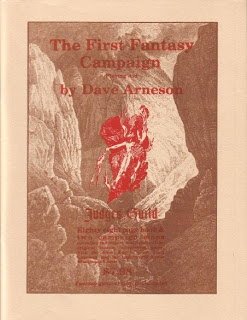
Dave Arneson's First Fantasy Campaign is a 64 page book comprising notes from the original Blackmoor campaign.  It was published in 1980, the year before I started gaming.  The copy I have has a paper khaki-colored cover.  As I go through this, you will see that it is a fun historical document.

The book starts with two introductions, one by Bob Bledsaw and one by Dave Arneson.  Arneson's is more interesting to me.  As you read it, you learn about some rules that were used in the campaign which did not make it into the published Dungeons & Dragons game in 1974.  There is some history of monsters, as well.  One interesting rule that did not copy over into OD&D is that character hit points did not improve after character creation.  Instead, characters got more difficult to hit.  What is even MORE interesting is how this was accomplished.  Apparently, characters made a saving throw when hit, and if successful, no damage was done.  As saving throws improved with level, higher level characters were more difficult to damage.  Fighters gained advantages with this saving throw but magic-users and clerics did not.  Remember folks, these were the only three classes in OD&D prior to the Greyhawk supplement.

The first chapter of the book is strictly army lists and costs for troops.  Since I don't play wargames, I have little interest in this chapter, other than as a curiosity.  I will point out that the original Blackmoor campaign included firearms.  Bombards are a standard weapon, with cannon being optional.  We also learn that Tarns can be purchased.  I'm pretty sure these are the giant birds from the Gor novels but perhaps they also existed in different fantasy, as well.  I am really curious what a "Female (special)" slave is.  The cheapest one costs more than the most expensive "Female (white)" slave.  In my deviant mind, I'm thinking a special female slave is a succubus or naga or something like that.  There are price lists for the Earl of Vestfold, City of Maus (where our special slaves are purchased), Regent of the Mines, the Duchy of Ten, and Egg of Coot.  

There is also included a price list for armor and weapons.  Some interesting notes in this section are that prices for pistols, muskets, and arquesbuses are included.  Or is it arquesbusi?  For how much can your character sell that cart full of weasel pelts?  As it so happens, a weasel pelt goes for 4 silver pieces, so how many pelts are in your cart, hoss?  We also learn here that Arneson was as hot and bothered about shields as Gygax was with polearms.  There are nine different types of shields listed!  Don't worry folks, slave prices are listed and it's cheaper to buy a slave off this list than the original list.

There is a small section following, which describes where the Blackmoor campaign is located on the Outdoor Survival map.  

Speaking of maps, a small map of the campaign setting is included in the book but it is very small and is drawn with very thick lines, making detail difficult to make out.  The book does come with fold-out maps of the setting which are much more useful.  My copy has what I believe are a player map, including outlines of the land, major cities, and geographical details surrounding the cities, and a much more detailed map, which I assume is for referees.

The following chapter details player characters and non-player characters from the original campaign.  Egg of Coot, of course, is the most cool.  How can a character not be cool with this name?!  The Egg enjoys things such as writing dirty words on latrine walls and creeds such as "never give a sucker an even break".  The other characters covered are Ran of Ah Fooh (a dragon breeding fellow), Gin of Salik (powerful wizard who travels the land banging chicks), Marfeldt the Barbarian, Duke of the Peaks, The Blue Rider, Mello, The Great Svenny, and the Bishop of the Church of the Facts of Life (the tv show came out in '79, so this name might just be coincidence).

Facts about the kingdon of Blackmoor follow, including population, history, and points of interest.  Personally, I think the population is way off.  According to this book, 1000 peasants reside in a kingdom of 4,346 square miles.  I'm certainly no medieval population guru but these seems to be an extremely small number.  I believe this is a typo.  An amazing old school graph paper map of the town of Blackmoor is included in this chapter.  There is also a map of Blackmoor castle, as well as a list of its haunted rooms.

Encounter tables for the area are included, as well as yet another equipment list.  Once again, we have slave prices, and once again they don't match what came before.  Fortunately, we have both wholesale and retail prices, so if your party has a huge haul from slaying the latest dragon, buying slaves in bulk will save a lot of coin!  

Specific rules for designing your own campaign come next.  This information would be useful, I believe.  One of the rules is about population density.  This here is why I believe that the preceding population is wrong.  Based on the rules here, there is fully a 40% chance that every hex will have a hamlet of 50-500 people or a 30% change of a village of 100-1000 people.  Taking the median numbers of just these two population results, the entire Kingdom earlier would be filled in 2 or 3 hexes.  Fans of the modern "hex flower" layouts are going to freak when they see the author forcing a square peg into the hex hole on page 27.  Trust me.

The Blackmoor Dungeons is the next chapter.  This is what people mostly know about the Blackmoor campaign.  We have ten fully keyed and mapped dungeon levels as well as an additional minor dungeon.  Fans of modern, thought-out dungeons will have to forego their sense of versimilitude and just enjoy these encounters for what they are - a pioneer of the hobby just writing stuff down, probably as it came to him, for his players to encounter.  Your character might encounter a mummy, or a hydra just wandering around underground, or maybe a pack of giant weasels.  It's all good.  Does your wussy magic lamp ONLY give you there wishes?!  You chump!  This dungeon can grant 20 wishes from one encounter!  I see your silly encounter with 10 goblins and raise you 200 goblins in this room right here!  That pansy Gandalf struggled fighting one balrog?!  Delvers are tripping over them in this dungeon!  It is a heck of fun jaunt reading through the dungeon key.  The maps are pretty good, oozing that OG vibe.  The scale changes based on the map and most of them don't include a scale.  Those of you familiar with the sample dungeon in the OD&D rules will recognize how freaking difficult mapping will be in the Blackmoor dungeon.  Ain't no virtual table top N-S and E-W corridor 5e crap here!  

The next 3 and 1/2 pages are about magic swords and rules for generating unique swords.  Fortunately quite a number of them are really handy when fighting balrogs, you are going to want one of these.  There is a lack of swords which get the bearer a good deal on buying female (special) slaves, however.  Your adventuring party will have to buy them the old-fashioned way!  Joking aside, this chapter is really cool.  Creating unique magical swords is in most versions of D&D.  Arneson kicks it up a notch, here.

Gypsy sayings, legends, and Chance cards follows.  The book does not actually tell us what a "chance card" is.  I assume that Arneson wrote this information on index cards and randomly pulled one when needed.  The "cards" in this book are organized into a d100 table, though, so this is perfectly workable.

Notes on the original Blackmoor magic system comes next.  Something interesting I find here is that magic-users only advanced in level by using spells, whether in the dungeon or just practicing.  Some magic items listed include Tricorder, Borer, Skimmer, and Robots.

The next section is something I wish would have made it into the D&D rules - special interests.  Loot taken from the dungeon does NOT award experience points until it has been spent (unless the character's interest happens to be stockpiling).  If the character's special interest in wine, then he needs to throw some raging parties!  Just a funny nitpick here, the book states that the booze has to "consumed by the player" and not player character.  No mention on whether your character gets extra XP if you ply the referee with fine wines as you, yourself, get hammered.  Clerics will convert GP to XP by donating the gold.  Yes, for those of you who have kept up with our female slave soap opera, spending gold on "room plus extras" will allow you to convert that gold into experience points, as well as allowing your character to release some stress after a high adventure dungeon delve.  In a surprising 1970s twist to "current year" players, your character can convert GP to XP by snuggling up to the slave gender of your choice.  There are % chance rules to determine your character's special interest.  It would be amusing to have a paladin whose special interest is women - not sure how that would play out!  The book mentions the original three classes earlier on but also brings up here, in this section for special interests, the newer classes.  They are:  fighting man, cleric, magic-user, ranger, paladin, assassin, merchant, and sage.  These last two are not from any OD&D supplement but they probably came from The Strategic Review magazine.

There is a quick blurb on page 52 on adjusting monsters so they can advance in levels similar to PCs.  If the referee wants to create a "hero" (i.e. 4th level) monster, this goes over XP requirements for the monster.  Unless the monster is being run as an adventurer by a player, I don't see the point of this.  The ref will just make a monster better without racking up XP.

Four maps of Svenson's Freehold follow.  It is spelled Zvenzen on one map.  I am guessing, but perhaps the player and Arneson each drew maps or wrote down notes and one of the two wasn't corrected.

Richard Snider's Additions is the final chapter.  We see detailed dragons indexed by color and level.  Dragon breath weapons causing damage equal to the dragons maximum hit points is included.  My players in the Dragonlance BX game I ran know all about this.  Breath weapons were the demise of many a PC and NPC.  We learn here, as well, that as dragons get older, their movement rate suffers.  I don't recall reading this anywhere else in D&D lore.  For those who find it amusing that D&D rules cover the characters subduing dragons, we here get rules for dragons subduing characters!  Subdued characters might be taken back to the lair because "junior might want a pet to play with".  The rest of the rules here are not as exciting.  A couple of pages of notes on Loch Gloomen are included, and then the book ends with information on some specific creatures such as orcs and nomads.  Those who have read the Lord of the Rings books will get a kick that Isengard orcs are listed.  Unfortunately, Saruman isn't statted out.  There is a listing for Tarns, where we learn that they are large Rocs.  Oh, and Balrogs yet again make an appearance.  I swear, you can't swing a dead cat in Blackmoor without hitting a freaking balrog!

Before I go into my rating, I must point out that there is an EXCELLENT documentary about this setting, and the pre-history of D&D.  It is called Secrets of Blackmoor: The True History of Dungeons & Dragons.  If you have ANY interest in D&D history, this movie is an absolute must.  I cannot stress this enough.  This movie is two hours long and it ends with D&D being created.  There is all sorts of history in it that would be difficult to find anywhere else.  I bought it on Amazon but I assume it is available for purchase or rental at other places as well.


⇒ GRIT: ★★: I am going to just say this here, this book is a lot of fun but it is only usable by a niche market.  It is more an historical artifact nowadays than a game supplement.  If you are looking for an actual Blackmoor campaign setting, buying one of the WotC era fantasy game books is probably going to be a better value.  This book hints at Blackmoor the Setting-isms but doesn't have a lot of setting meat on its bones.  I really like this book but it is extremely unlikely that I would ever use it in a game.

⇒ VIGOR: ★★★: Like the above score, this score is sort of arbitrary.  The longevity of this book is primarily in the Blackmoor dungeon.  The dungeon itself is extremely bare-boned and the referee is required to flesh out everything other than the treasure, the monsters, and the massive balrog population.  When fleshed out, the dungeon should provide many sessions worth of gaming.  The additional information on armies will help a high-level campaign, assuming that the players want to move into wargame territory.

⇒ GRACE: ★★:  The First Fantasy Campaign is not a pretty book.  The mountains on the cover look cool but the red on brown is very difficult to read.  The book is US Letter sized, but other than that, it matches the old school layout you would expect from a vintage 1970s D&D book.  What elevates this book from its OG peers is the art.  Ken Simpson did nearly all of the art, with Dave Arneson knocking out some art as well (I assume this is his original Blackmoor map in the book, as well as the dungeons and the pull-out maps).  Mr. Simpson's art is good and there isn't a bad piece.

Monday, March 27, 2023

Colony of Death

Colony of Death
Weird Fantasy Roleplaying in 17th Century Maryland
Mark W. Hess

Available at https://www.drivethrurpg.com or lulu.com, which is where I got it, I believe.

The Good, the Bad, and the Ugly

Colony of Death, Weird Fantasy Roleplaying in 17th Century Maryland, is a supplement for Lamentations of the Flame Princess (LotFP) including a setting and several adventures.  As it is a supplement for LotFP, it is recommended for folks 18 years, or older.  In fact, on the title page, it states precisely this.

Taking a quick side-trek, I lived in Maryland for three years, in a town between St. Mary's City, which this supplement is for, and Washington, D.C.  It was really fun reading about places I have actually visited and reading about a cryptid that I actually heard tales about!  If y'all get a chance to visit, take the time to do so. There is (or was before the covids) a reenactment from the colonial times in a rebuilt village.  Lots of cool history.  Plus, if you have any interest in visiting churches, some of the oldest Catholic ones in the USA are here).

Back to our regularly scheduled review.

As this supplement is for LotFP, which is a standard OSR game, this setting can be used for any OSR game.  I don't own LotFP, and when I run the adventures in this book, I will use real D&D, White Box, Blueholme, or something similar.

The book starts with a quick introduction and then gets into the colony of Maryland.  George Calvert, the first Lord Baltimore, was granted the lands on which to build St. Mary's City.  Lord Baltimore wanted to prove that Catholics and Protestants could live, and work, together without fear of the hangman's noose or burning pole.  When the colony is settled, there were natives inhabiting the lands.  The natives were mostly friendly with the English. 

A page and a bit of the next page include a timeline from 1608 through 1650, when the adventures in this book take place.  Included in the timeline, which very well could affect interactions within the settlement, are accounts such as:  witchcraft being made illegal in 1635 (burn them all!), the Susqeuhannock indians, along with New Sweden, going to war with Maryland in 1644, a Protestant uprising during the English Civil War, ending with King Charles getting a "nip off the top" in 1649, somewhere around the shoulders; of course the Prots decided to attack the Caths in this period.  Puritans set up their own settlement in 1649, as well, which will put even more pressure on what was intended to be an exercise in Catholic-Protestant harmonious living.

This is where we stand - the year is 1650, St. Mary's City, once the home of peaceful coexistence between Protestant and Catholic English, and some friendly Natives, has suffered ten years of warfare.  Can the two groups of Englishmen repair the breach?  What about the Indians?  Will they continue to coexist with the English, or will they want war?  Can Maryland protect the interests of its various inhabitants against the aggression of neighboring New Sweden and Virginia?  The colony is ripe for adventure!

After the timeline, there is a listing and a bit of info on St. Mary's City, Providence, and Kent's Island.  These are the only cities listed and referees are encouraged to add villages, trading posts, etc.

Next, we get a page and a half about the people in the colony, as well as a very small hex map of the region, from criminals and indentured servants, to the local native tribes, to the European settlers.

Following, we have two pages on New World diseases.  Every month, characters make a saving throw to not catch a disease.  That's pretty hardcore.

The next two pages are encounter tables.  All good OSR settings need encounter tables.  Colony of Death, being a good OSR setting, has them.  The tables include real life critters like black widows, pirates, black bears, and rattlesnakes, but it also includes some disputed critters, such as sasquatch and the very, very Maryland cryptid, the Goatman!  When I read this far into the book, after I bought it a couple of years ago, I was tickled!  There are eight pages detailing these critters, following.  I wish more art was added in this section as there is a lot of white space, which could have been filled with line art, even if it is old timey clip art.

This ends the primarily setting information.  Several adventures follow, many of which include more snippets of setting information.

St. Mary's Shoemaker adventure includes a map of St. Mary's City, as well as some businesses in town.  The adventure involves the characters trying to solve a murder mystery.

The Hell's Bell adventure finds the characters discovering an unknown German village.  Hopefully one of the players chose German as a language slot!  This adventure is very Lovecraftian - village of hicks in the woods who are a little too closely related on the DNA scale, if you know what I mean.  What is with the bell?  Why do people keep going missing?

The Hand and Eye of Loki take the adventurers in the lands claimed by New Sweden.  Again, people are going missing.  Are Indians killing settlers, or is it something more mysterious?

To Burn a Witch is the next adventure.  Providence is a Protestant town, through and through.  The characters arrive just when a local gal is about to pay the price for wallowing with the Devil.  She is young and beautiful.  Is she guilty?  Is she innocent?  Will the characters rescue a damsel in distress or let her burn?

Another side trek.  Did y'all know that before he got famous for being a king and having the Bible, which was forever to include his name, translated into English, James was hip to the ways of witchcraft?  He wrote a book about it.  Sometimes the only way to deal with a witch is to burn it.


The Appendix of the book includes four pages of common names, broken down by both male and female, and by language - Algonquin, English, German, and Swedish.

A two-page spread map follows the first appendix.  It is a lovely map, 10 miles per hex, but unfortunately all of the important settlements are in the gutter of the page.  Splitting the map in two and leaving half an inch per page for the gutter would make the map so much more useful.

The final appendix discusses tobacco as currency, and growing tobacco.  This is another historical shout-out since tobacco was actually used as currency in the Maryland colony.  There are rules for running a tobacco plantation and the consequences due to soil depletion.

There is another cool town in Maryland you can visit called Port Tobacco.  It is in a Charles county, right off US301 highway.  It's another place you can visit in real life if you happen to travel through the area.

In conclusion I will say that I love Colony of Death.  Love it, love it, love it.  It is not perfect and I certainly have gripes, but I can wholeheartedly recommend that any referee who wants to set a campaign in the New World, pick this up.

⇒ GRIT: ★★★:  Being a mere 58 pages, with half of that relegated to adventures, this book doesn't give a whole lot of wallop.  What it does include, though, will whet the referee's appetite for sure.  I would love to have seen more details on the culture of the local natives.  I really would have liked to see a price list for items for sale in both St. Mary's City and the trading posts.  It is mentioned that prices are included in the LotFP rulebook, which I don't own.  As tobacco is the currency in the colony, having a list of gear which can be purchased, with the corresponding price in tobacco, would have been excellent.

⇒ VIGOR: ★★★: As with GRIT, since the supplement is so short, you won't get years of play with only what is included.  However, what is included will get a game group quite a few sessions I believe.  Adding in things like trade routes between the various colonies could increase the vigor of this product.  I also would have liked to have a page or two of adventure hooks.  The adventures included are delightsomely dark and twisted, but what about more "normal" adventures?  A list of adventure hooks is always gold.

⇒ GRACE: ★★: The book is perfectly functional but not beautiful.  The cover is pretty cool, with a Schneller Geist flying over what appears to be a homestead next to a hill.  Internally, the book is well-layed out with a single column on most pages but two in the few places where it makes sense to have two columns.  The line art is functional but there should be more when there is a half page of white space.  The map, as noted, really, really needs to be split into two.  This map is my biggest gripe about the book.  If the author decided not to include art to fill up the white space, removing the white space would give another page, which could be used for adventure hooks, price lists, or something else.

Sunday, January 8, 2023

Cursed Scroll Issue #1

This is a review of the first issue of Cursed Scroll, a zine for the Shadowdark rpg.  If you have not heard of the game, you should check it out.  This is not a review of the Shadowdark (hence SD, if I need to reference the game system) book, which is not out yet.

If you want to pick up the free quickstart of the game, it can be found here:  Shadowdark

The author is a cool chickadee named Kelsey Dionne.  She has a YouTube channel (Arcane Library, I think it's called).  The zine is OGL, which as of this past week, might pose an issue with getting new copies in the next few weeks.

So, are you kids ready to dive in to this most happy and uplifting zine?  No?  Well that is probably good since this zine is dark, dreary, gloomy, and slimy.  

The zine is black and white, with a dash of yellow on the cover.  The cover is an evil-looking, horned dude, swinging a big axe, chopping through two unlucky foes and perhaps into a third fellow.  I think this gnarly, beastly dude might be a dralech, which is one of the new monsters in the book.  I will get to new monsters later.  

The back cover is a random table of twenty diabolical treasures.  All of the treasures are pretty neat.  Anything from a ring of daisies to a shrunken head might be rolled.

When the zine is opened, you get right into the gloomy, slimy goodness.

Before we open it though, this issue is all about devils, demons, slimy things, and other sorts of badness.  Be warned!  You, unwary reader, might end up gibbering in the darkness as mighty Mugdulblub dissolves  your flesh as a tribute to Its Ooziness.

The inside cover is a map for a hex crawl, called the Gloaming.  The map is usable but the hex lines are unusable other than for the numbered encounter hexes, the outside edge, and in Finimere Lake.  Elsewhere, they are so light as to be unreadable.  

Once past the map, we get to the first page, which is random encounters and rumors for the Gloaming.  The encounters include monsters from the rulebook and well as this zine.  We start to get the gist of the zine and the adventures by reading the rumor table.  It has sort of a dark fairy tale, black forest, swamp witches vibe - think Grimm fairy tales without the hideous Disney (the real diabolical cultists) whitewashing.  The encounters and rumors are really cool.  My only hesitation with them is that I worry that in future issues of the Cursed Scroll, encounters might point back to monsters in this zine, which would require referees to own each issue.  That isn't an issue for me so far as I'm madly in love with this game and I will probably purchase them all as they come out.  But for others though, I can see this being a future problem.  I would encourage the author to only reference the rulebook or the zine in question when creating encounter tables like this.

We next have the table of contents and introduction.  Nothing out of the ordinary so far.

The zine then delves into three different character classes.  My biases will come out here, just so's ya knows...

The first class is called Knight of St. Ydris.  These are knights who voluntarily accept a curse in order to fight demons.  This class is fine for the included hex crawl.  My issue with it is that it fills a very narrow niche.  In a class-based game, I want classes to be as broad as possible - fighter, the guy who fights! - thief, the gal who steals! cleric - the crusader bringing God to the heathens! - the wizard, using sorcery to subvert reality!  Characters who want to play this class have to do it in the included adventure (no spoilers, but there is really one specific place for the knights to be generated).  I would rather have just had a list of options for the Knights - something like "Fighter with d6 hit points but can cast 1st level witch spells or 3 times per day, you gain demonic possession (player choice at creation)".  Something like that.

All of that being said, the Knights of St. Ydris are basically a fighter-witch multi-class.  They can use demonic possession to do extra damage in combat and get minor and mid-range magical abilities, starting at 3rd level.

The next new class is the Warlock.  Now, as everyone should know by now, I jumped off the D&D bandwagon at 3rd edition.  Warlock wasn't a thing in the D&D games I played.  Warlocks in this zine are characters who gain a boon from a dark patron.  There is a list of patrons in the book, and some of them are doozies!   I do have another gripe.  I will have a few more, don't worry.  My issue with Warlocks is that they can use daggers as weapons and they can use long swords as weapons.  What is the reasoning for disallowing short swords?  It is not logical.

A quick sidetrack on the SD game system.  There are no specific, level-based benefits, other than hit points.  At each odd level, the player makes a roll to find out which "talent" his character will gain.  You need to know this while reading about the classes.

Ok, back to our Warlocks.  They are "howling warriors with sharpened teeth" and "wild-eyed doomspeakers".  I can imagine them as cannibalistic cultists, dancing around a statue of Cthulhu in the swamps of Louisiana - except, you know, a different patron and it's the Gloaming, rather than Louisiana.  This class has broader game play for players than the previous Knights.

The last new class is the Witch.  Forget those lame, dirty hippy, wiccan freaks of our degenerate modern times!  No, THESE witches are the real deal!  Cackling crones with bubbling cauldrons, outcast maidens with milky eyes, covered with dirt and talking to their pet toads.  My oh my, this is the way a witch should be portrayed!

So, what does Esmerelda get in this game?  Witches have a familiar, of course, and they can cast spells.  Witches have their own spell list.  I will point out some spell list details when we get to it.  

The next page is a list of class titles, which is something that SD is really into.  I'm ambivalent about class titles.

Following class titles, we get the descriptions of the patrons.  Some of them are really cool.  I will say, though, that as awesome as they sound, a couple are statted out in the included adventures, which turned them from "oh heck ya!  This thing is some elder god from beyond the stars!" to "oh, wow, my fighter has just as many hit points as this patron of immense eldritch power?!"  It is a lot like getting Deities and Demigods as a kid and having your players go into battle against the gods so they can score Thor's hammer.

I will quote the entirety of Mugdulblub here so you can see how awesome it sounds.  "The Elder Ooze that leaks between the cracks in memory and the darkness between the stars, Mugdulblub seeks the dissolution of all physical form".  Sounds bad ass, huh?  In the zine, there is the Mugdulblub, Almazzat (a wolf demon guy), Kytheros (sort of a Cronus I think), Shune the Vile (mother of the witches), Titania (fairy queen), and the Willowman (fear and nightmare thing).

Patron boons follow.  Some are basic between all classes (ability score gain, spell bonus, etc.) but some are unique, such as turning into slime for a few rounds or able to hypnotize foes.  There is a list of diabolical backgrounds which follows the boons.  Some are very fairy taleish (is that a word?), such as "Woodborn.  They found you in the hollow of an oak tree" or dark fairy taleish (Witchborn.  They burned your mother, but spared you".  I dig them.

Diabolical Mishaps comes next.  Another side note.  Shadowdark, as written, requires a spell casting check, and on a natural 1, the player or referee needs to roll on a table for the spell fumble.  Some of them make a lot of sense for the included hexcrawl/setting.  Cackles, Wither, or Mother of Night are all very setting-specific and make sense.  One of the mishaps has iron spikes which appear and cause damage.  This one I don't dig that much.

Next up we have witch spells.  The spell names are freaking awesome - eyebite, frog rain, dreamwalk - all are evocative.  When/if I ever run this game and if I allow Witches (or Knights of St. Ydris) as a class, I would modify a few of the spells.  Bogboil?  Awesome as written.  Cauldron?  Eh, not as much.  Having a witch with a cauldron is M1A1 standard.  This spell, however, conjures the cauldron.  I'd make the witch have her own cauldron and then, when this spell is cast over it, the effects can be used.  Having a boiling cauldron just pop into existence is too high fantasy for the genre this zine is emulating.  The Coven spell allows the caster to gain the reuse of a spell.  That makes sense for a witch with a coven.  Another change I would make is for Pin Doll.  I'd make the character already have the voodoo doll before the spell would work.  I wouldn't allow it to just poof into existence.

After spells, The Gloaming hex crawl is detailed.  All of it is dark fairy tale goodness.  Hexes can contain anything from an orc village, to a dragon, to a down and out village that is burning witches (hell ya!), to the Greywall Priory, which is where the Knights of St. Ydris are based.

New monsters are next.  As stated, some of these are needed for the included adventures and won't have much use elsewhere (named NPCs fall into this category).  Unfortunately, as stated, a couple of the warlock patrons are statted out.  If I was to use them, I would probably have the Mugdulblub in this section be a minor avatar of the real Mugdublub.  The characters can kill it (not an easy thing, fyi) but it's just a blip on the real Mugdulblub's galaxy-spanning goopiness.

The Hideous Halls of Mugdulblub is one of the included adventures (I'm counting the hex crawl as one and the cardstock encounter the third).  Hideous Halls is an adventure for 1st level characters.  The adventure oozes (get it?  Yuck yuck yuck) charm, sliminess, and fun.  There are three factions all living in the dungeon.  Any of them might recruit the characters or at least remain neutral.  There are a couple of issues with the adventure though.  My biggest issue with it is that every room has an occupant or something notable in it.  I can see players after four or five rooms saying, "alright folks, another room up again, something will be there".  Monster, trap, or weirdness, there are no empty rooms.  Personally, I think that 20-25% of dungeon rooms should be empty.  Empty rooms both keep players on their toes, not knowing if it is empty, and also give characters breathing room and a place to fall back to.  I will avoid specifics about the adventure as I don't want to spoil it for players.  There are some really neat NPCs, traps, and treasures.  One of the three groups living in the dungeon is quite memorable (the ones that really need to be near water), one group is very Lovecraftian and degenerate, and the third are a bunch of junkie, mushroom eaters.  I like all three.  One other issue I have with the adventure is the stairs in room 18.  From what I can tell, they don't go anywhere.  It is stated in the adventure that there are two ways to enter the dungeon and this isn't one of them.  I would probably not even mention the stairs to the players unless I expanded the adventure.

The book finishes with the map of the dungeon.  

There is a card included that is a small encounter.  It has a map and random encounters on one side and room descriptions on the other side.  This mini adventure is also pretty cool.  It is less dark fairy tale and more Lovecraftian.  The referee is going to have to hit up a dictionary though unless he is well versed in jurassic lore (I have kids so I know all about ammonites and trilobites and all that prehistoric jazz).

So, should you get this zine?  Hell ya!  Provided you like dark fairy tales, Cthulhuisms, or proper, old-school witches.  

⇒ GRIT:  ★★★★☆ This zine is 64 pages of dark, dreary, swampy goodness.  Want to run a game of Grimm fairy tale D&D?  Get this zine.  The classes (well, two of them) are great, the adventure is really fun, the spells are witchy.  Do you have fond memories of fighting Kuo-toa in the depths of the earth?  Did you fear Blipdoolpoolp and her lobster boobs in the 80s?  Do you enjoy listening to Acid Bath?  This zine is for you.

⇒ VIGOR:  ★★ As awesome as the stuff included in this zine is, it is really only usable in the specific genre it is emulating.  Bits and bobs of it can be stolen to be used in other genres but, really, it is limited to a dark, fairy, swampy, setting.

⇒ GRACE:  ★★★  Yowza!  If the rulebook, when it comes out, is as gorgeous as this zine, we gamer folk are in for a treat!  Now, I give it four stars, but I LIKE black and white for my fantasy.  If you want lots of color, you may not like it as much.  The zine has an incredible layout.  The only real shortcoming with this issue of Cursed Scroll is the faded hex lines on the inside cover.  Some of the art is perfect (witch and cauldron on page 25, for example).  The rest of the art certainly fits and I'm not knocking it.  I would like to see more art but I imagine Mrs. Dionne is saving some pieces for the main rulebook.  I assume that if the main rulebook is as great as I believe it will be, she may score some more art in subsequent issues.

If this zine seems interesting to y'all, I strongly recommend you buy it now because in a few weeks, it might not be available if Lizards of the Toast go through with their OGL backstab.


Monday, August 22, 2022

Eldritch Hack

Eldritch Hack
by Dan Masters
Dungeon University Press, 2022

Available in pdf from https://www.drivethrurpg.com/


The Good, The Bad, and The Ugly

Eldritch Hack a 46-page pdf (not available in print), of which 18 pages is the "Eldritch Hack" portion, while the remainder is the adventure "Cloque House".  The rules are an homage to Call of Cthulhu.  It is not without its issues, but is a really neat way of simplifying the Cthulhu setting to a very small amount of rules.

The pdf starts with a quick introduction, which specifically mentions that this game hearkens back to Cthuluesque horror, and is meant to avoid Indiana Jones or Aliens -style horror.

At page 5, we get the rules of the game - roll 1d20 and pray to Nyrlathotep for a high number.  Natural 20s are really good and natural 1s are really bad.  The Keeper, errr Game Master will decide on a target number for the d20 roll.  The rules are basically any version of WOTC Fantasy Gaming from 2000 through now.  They are nothing spectacular but they are uber simple, which is exactly what I want in a game.

While I'm thinking about it, let me bring out an "ugly" in this game - the background color.  I recognize that Mr. Masters was going for the crumbly, yellowed old manuscript look but the color he chose is way too dark.  It does not make the text unreadable but if he toned it down a few shades, it would be much better, in my opinion.

Character creation comes next and here things get pretty wonky.  Skill, Lore, Sanity, and Hit Points are all perfectly reasonable for the game.  I agree completely with Mr. Master's choices here.  How they are generated is just really odd, however.  While reading this page, I opened a Word doc and made notes on how I would do character creation if I ever run a game of Eldritch Hack.   The rules want a player to roll three 6-siders and take the best ("assign the highest") one for Skill, Roll two 6-siders and take the best ("discard the lowest") for Sanity, and finally to roll 6d6, divide by two, and then round up, if necessary to get Hit Points.  Lore starts at 0.  Sanity gets a +3 bonus, ending up with a 4-9 range.

Now, I know for a fact that Mr. Masters has said specifically in some of his YouTube videos that he won't ever go back to playing D&D with percentage thief skills, and here he is complicating something that should be super simple.  I am not mathematically equipped to determine what the best result of three 6-siders would be but wouldn't it be easier to just say Skill starts at 3, or something?  What I put down on my notes would be to allow the player to roll dice for all abilities, and then pick where they go, so one die each for Skill and Sanity, one die for Lore (as a bonus die, you will see), and three for HP, giving six dice.  The player will then drop one die and assign 0 to Lore, and then pick any three dice for HP, with one die each assigned to Skill and Sanity, which gets the +3 bonus.  Or, for a more D&D style, start all characters with a Skill of 1 and Sanity of 9.

Money isn't a thing in Eldritch Hack, which makes sense since all characters are expected to be middling to wealthy bookworms.  I would have to beat my players over the head with this.  Some of them have the primary goal of gaining wealth in every game of any genre in which we play!

Each character gets an occupation, which is what the Skill score is used for - a doctor adds it to doctory things like healing, diagnosing, etc., while an archaeologist adds it to deciphering dead languages, using brushes and pick-hammers, etc.  Characters can pick a couple of non-occupation electives in which they are skilled.  The author dials back on the "No Indiana Jones, daggummit!" (Ya, not a real quote) here, by specifically mentioning an archaeologist could pick "expert with a bullwhip" as an elective in which he excels.

The Skill ability score as a catch-all for everything occupation-related is a really great idea.  Gone are horrible lists of skills like rope use, fire starting, straw drinking, teeter-totter, and the rest of that ridiculousness.  If it is something that makes sense for your occupation (or electives) to have as a skill, you add your Skill ability to your d20 test.

The next page is a list of names, broken down into names for men, women, and last names.  Useful I do believe.  

The GMs section comes next, beginning with a list of weapons.  I have what I believe to be a legitimate gripe in the weapons list.  The author has a weapon called a "Baretta" and it does d6 damage.  He also has a semi-automatic pistol that does d8 damage.  Now, I'm a gun guy.  I was the kid in the early 80s with a fully-automatic MAC10, laying waste to bushes on our property.  I am not the world's greatest authority on firearms but I don't recall every reading about a "baretta".  I assume what the author means is a Beretta.  The question then must be, why specify Beretta and not lump it in with pistol?  If the author wanted a smaller, concealable pistol, he might have broken semi-automatic pistols into two categories, "standard" and "light", or pistol < .32 and pistol > .380.  Something like that.  I thought perhaps that "baretta" was 1930s slang for a derringer, but with an ammo capacity of 7 rounds.... I just don't know.  He also mentions specifically that Tommy guns are not included because stuffy old professors won't use them, which is perfectly fine, but what if said professor runs into a mob hit and the torpedo is shooting AT the professor.  It would be nice for the GM to have something to go by.  Personally, for those ne'er-do-well bootleggers, a Tommy gun would be d8 damage (.45 cal), 5 shots per round (consecutive -2 to hit, as in the rules), with an ammo capacity of either 20 or 50.

Combat is super simple and I love it.  Roll a d20, try to to beat a TN 10.  If the character is a private dick or a copper, he can add his Skill to the roll.  Natural 20 is double damage and natural 1 is knife dropped, gun jams, etc.  A minor critique is that in the included scenario, this Armor Class equivalent is DR (I assume Defense Rating, but it is never actually spelled out) but in the included bestiary, it is abbreviated TN.  I would prefer to have the abbreviations consistent.

Combat can be deadly.  At 0 hp, characters are unconscious, and below 0, they either die immediately (50% chance, or die in d6 rounds, 50% chance).  Healing is the typical 1 HP per day, which was standard when D&D was good.  Were I to run Eldritch Hack, I would probably have all characters die if below 0 HP if I have a large number of players or die in d6 rounds if I have only a few players.

Since this is a Cthulhuesque game, Sanity tests are obviously needed.  Mr. Masters avoids the annoyingly specific list of mental degeneracies from Call of Cthulhu (or AD&D 1e, or Palladium, etc.)  Basically, the player does a standard d20 vs. TN roll, with a +1 bonus if he is still mostly sane.  If he fails, the Sanity score drops.  When it hits 0, the character is insane, either temporarily or permanently, each 50% chance.  Recovering Sanity requires a doctor or a sanitarium.

After an adventure or game session (GMs choice), players can attempt to increase an ability score.

There is a list of forbidden manuscripts and a couple of paragraphs on magic and spells.  Characters must roll Lore vs. TN 15 to cast a spell.  Obviously, they must have access to a spell.

The next few pages are instructions on creating scenarios, along with a sample.  There are also rules here for searching for clues.  

Next we have a few pages of critters, with the aforementioned TN for armor class.

A color character sheet and a B&W character sheet follow.  Both are serviceable.  The rules portion of the pdf ends with rules recaps.

I won't go into too much detail about the adventure, other than a brief synopses.  The adventure is good.  It hearkens back to some of the old Call of Cthulhu adventures that came in compilation books - short and to the point.  I find no fault with this.

"Some old geezer dies.  Y'all characters are nieces and nephews who might inherit some of that sweet, sweet cash, provided you survive the night in the house.  Each of you is some sort of backstabbing deviant.  Y'all arrive at the house.  What do you do?"  I won't say more so as to not give the plot and secrets away.  I know I have seen a Rifftrax riff on a movie with this same story but I don't remember the name of it.

The adventure has some nice maps of the mansion and a list of each room and what's noticeable about it.  A list of characters and NPCs follows, with one page per dirtbag PC.  As I mentioned previously, the armor class in the module is labeled DR.   I would love to have two sets of maps, the first being for the players with room labeled, and the second being for the GM with the secret doors and whatnot labeled.

I must mention the art.  The Cloque House adventure is really well-illustrated.  Jason McDonald is the artist and he really comes into his own with people.  The biplanes, lungfish, and ants were all serviceable, but his drawings of people are downright disturbing.  He uses this liney, veiny, wormy style of (I assume) computer brush strokes.  I know as little about art as I know about math, so I'm sure there is a style for his technique.  The characters are very creepy.  The picture of William Cloque-Overton, Sr. reminds me of a painting in a Scooby Doo mansion, but actually scary.  Is Scary Scooby Doo an art style?  According to the bio, Mr. McDonald lives in NYC, so he may not actually be human, anyway...

⇒ GRIT:  ★★★ The rules would work, as is, I believe.  I would love to play in a game of Eldritch Hack.  Heck, I'd love to run a game of it!  In addition to my notes I made at character creation, I also typed up some other notes for making his system more generic, so other genres could be emulated.  This is the style of rules that I love for pickup or convention games.  With some fleshing out, reconciling abbreviations, and two pages of "life in the 1930s" or something, this would easily be 5 stars.

⇒ VIGOR:  ★★☆☆ The game either needs to slow down on advancement, or add in an optional way to improve characters.  As is, characters could potentially be maxed out in a few months of regular play.  As stated in GRIT, there needs to be some amount of setting information and perhaps more genre immersion information.  I know that it is a short pdf but the author can drop off the combat target and the color character sheet and fit in some good setting information without upping the page count.  If you use these rules to run Masks of Nyarlathotep, you are golden, but if you use just them to create your own campaign, I think that the GM will find them limiting.

⇒ GRACE:  ★★  The pdf looks functional.  I mentioned before the background is too dark.  Even so, it does not limit readability, which is good.  The white on blue in the Designing Scenarios chapter is more difficult to read.  From watching some of the author's videos on YouTube, I know that he and I are about the same age, so I'm surprised he doesn't find this part of the book difficult to read - that being said, it is certainly readable.  Again, I just would prefer a lighter color background.  The layout is clear, the text is readable, the section headings are nice and large and easy to find, AND the art, especially pictures of living (or undead...) things, is top notch.


Monday, June 27, 2022

Postcards From Avalidad - As Above So Below

Postcards From Avalidad - As Above So Below
by Miguel Ribeiro
Postmortem Studios, 2021

Available in pdf from Drivethrurpg:  https://www.drivethrurpg.com/

Available in print from Lulu:  https://www.lulu.com/


 The Good, the Bad, and the Ugly

As Above So Below is a supplement/adventure to Postcards From Avalidad (hence, PFA), the cyber-horror-punk-noir-ish game I reviewed previously, on May 23, 2022.

The book is 96 pages long, including table of contents, OGL, and map.

Whereas PFA details the Moroccan city above-ground, As Above So Below details the city below the streets.  The city below can be reached from a handful of points from Avalidad, proper.  Avalidad, below, is called Agartha.  As with PFA, this supplement includes stats for both Actual Fucking Monsters (AFM) and *Punk.  As I mentioned on my review of PFA, I know very little about either game system.  From the character's stat blocks, I suspect I would prefer AFM.

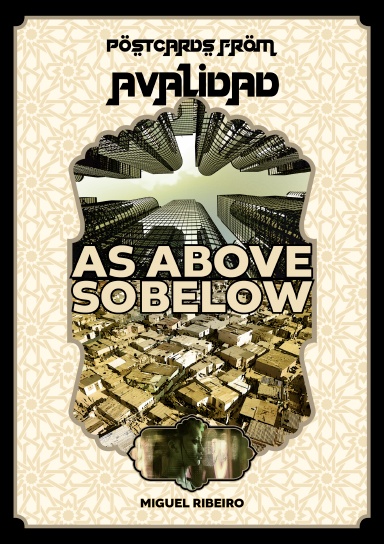
Starting with the table of Contents, the reader will realize that this is a beautiful book.  I really like the cover as well, though I wish the picture on it was a bit less busy.  This is a really gorgeous book and it shows that with some extra loving, and a person who can do layout and graphics and all that jazz (I cannot), a relatively cheap print-on-demand book can be made to look fabulous.

The book has a quick introduction (evil monsters living below ground) and then jumps right into the game system chapter.  In this chapter, the author gives some quick notes on the two game systems for which it was written, and has a very handy several pages on loss of sanity, for those who want to rock the supplement in a Call of Cthulhu style.  There is a list of 14 different mental illnesses which a Referee might inflict on a character.  Interestingly, the book also says that the player can choose the illness himself.  I think this can make for a really interesting game.  I can see a couple of my players really having fun with it.  

The Sanity stat in the game is for *Punk but it could easily be worked into any game I feel, and the same goes for the supplement's fear rolls.  I would definitely work both of these mechanics into a game system I was using for the supplement, if the game did not already have the mechanic.

There is a list of "Appendix N" movies to watch for inspiration (I have seen 8 of them I think, and Dark City is the best of the ones which I have seen).

After this, we get into the meat of the matter.  

Chapter 2 explains how the "adventure" starts.  I use quotes since this is not a traditional adventure.  Those familiar with the author's Giallo "adventures" will feel right at home here.  The adventure has an overarching plot which can be summed up as, "A Portuguese sailor whacks off for some creepy alien entity, scores the gizmo as payment, some other stuff happens, and then the gizmo disappears into Agartha.  The gizmo is worth some serious ducats.  What do you do?"  There is more to it than that, of course, but this is the gist of it.

Like Miguel's Giallo adventures, you get a very simple plot and then a slew of NPCs and locations.  Many of the characters are repeats from the main rulebook, but have abilities altered slightly to bring them all to a similar power level, specifically so they can be used as player characters.  The author does note that some of them might actually have been killed previously since there were not designed originally as PCs.  There is a mix of ZoneSec (remember, this is what passes for cops in this setting), Yakuza, hitmen, hackers, mercenaries, and the typical ne'er do well types that players enjoy playing.  Side note, the character on page 35 looks like a model from the magazine Gothic Beauty that I might have, err, uhhh, noticed from part of my misspent early 20s.  On page 52 there is a picture of a gill woman, which is nice since the gillmen live down below, in Agartha.  This brings us to the end of chapter 3.

Chapter 4 is all about Agartha.  This chapter goes over some NPCs, including Pigface the Mayor.  There is a random encounter chart in this chapter and a few of the adventure locations also have random tables with treasure.  The list of locations is pretty fun and characters can perhaps find a copy of the Necromicon, some sexy underwear, a mutant mating ritual, and for those curious, there is a 33% chance that if you shoot someone in the head who is taking matters into her mouth of painfully and permanently "freeing willy", if you know that I mean.  

The book ends with a not-very-helpful map of Agartha.  I think that with the detail spent on layout in this book, a two-page spread with a more detailed map would have been lovely.

So, what does your not-quite-humble reviewer think?  I like it.  I don't like it as much as the setting book for which this is a supplement but I do like it.  It is a very pretty book, it has useful information, and works well as a supplement to Postcards from Avalidad.

⇒ GRIT: ★★★★☆  As a supplement, this book does what I believe it has set out to do.  I hesitate to use the term adventure for it, since, to me, an adventure is Keep or the Borderlands or Masks of Nyarlathotep.  The book is an adventure location for under the streets of Avalidad, and it is good for what it is.

⇒ VIGOR:  ★★★☆ There just aren't enough adventure locations for me.  I think that if the author cut out all of the possible player characters which were duplicated from the core setting, and replaced those pages with more locations, this book would be better.  I also would have loved to see a few pages with notes on other reasons why characters would adventure to and from Agartha.  The adventure won't take very long without a lot of stuff added by the Referee

⇒ GRACE:  ★★★★ This book is freaking lovely!  The only two complaints I have are that the page numbers on what I assume to be an Islamic pattern are not readable (there are not that many pages like this) and the map at the end.  I'm not going to ding a star for these issues.  This book, to me, is a benchmark on what a home-based, indie rpg publisher can do.


Friday, May 13, 2022

Postcards From Avalidad

Postcards from Avalidad
by Miguel Ribeiro
Postmortem Studios, 2021

Available in pdf from Drivethruprg:   https://www.drivethrurpg.com/

Available in print from Lulu:  Postcards from Avalidad (lulu.com) 


 The Good, the Bad, and the Ugly

Postcards from Avalidad is a 200 page handbook for playing a retro-future noir campaign with demons and a small amount of cyberpunk and a lot of biotech.  It is based on the works of William Burroughs (whom I've not read), mixed with William Gibson's books (which I have read) and the films of Davin Cronenberg (I might have seen one or two).

If you have played Dark Conspiracy from the 1990s, and liked it, then you will like Postcards, as the two are very, very similar.

Avalidad is a city in Morocco, founded in the 1960s.  Formerly, Avalidad was the Tangiers International Zone.  It is a corporate city, owned primarily by Takeda Technologies, though there are other companies as well, many of whom are just fronts for a larger corporation.  

The setting expects that the characters will all work as troubleshooters for what passes as law in the city, called ZoneSec - not exactly cops, not exactly corporate peons, not exactly criminals themselves, but some mix of the three.  Provided the profits of the companies don't take a hit, the characters have free reign but they are expected to follow the orders of their superiors.

The first 10 or so pages of the book describe the author's inspirations, plus a very broad overview of the setting.  The book then has a few pages describing the technology of the setting, again just an overview.  In these sections you start realizing that the author is giving you a fun, pop culture wink, what with Rollerball (the 70s movie) and Leary Pharma (man oh man, have I gotten old), which continues through the book.

Following, you are treated to 75 pages of NPCs, statted for Actual Fucking Monsters (AFM) and *Punk.  I pretty much ignored the stats since I am not familiar with either game.  I did look through them and had a laugh or two at some of the skills on some of the characters, who knew that "fellatio" could have a die rating?!   Two of my peeves with the book show up in the section, however.  First, on at least two occasions, the picture of the NPC doesn't match the description (and I'm 99% sure that one of the pictures is from a British dude on YouTube who does "top 10" list and "did you know" type videos).  Secondly, the page numbers start creeping down the bottom margin until they are unreadable about halfway through the book.  I will blame this on the POD though.

Every NPC has a description, a background, and an adventure hook, which I find very useful.

The next 40 pages are people (more of them), places, and things in Avalidad.  You learn about political and social groups, as well as criminal organizations.  My third gripe happens in this section - the headings are a rust red on army green background, which is very difficult to read, but not as difficult as...

The next 20 pages are about society as a whole in the city, including psionics, mutants, and drugs.  The headings here are army green on rust red and I cannot read a single one.

Both of these sections also include an adventure hook for every entry, which again is an awesome thing to do.

Section 6 is for media and entertainment, which includes pop stars, musical genres (no heavy metal?!  What a ripoff!), virtual entertainment (I think the fleshy game controllers are based on a movie but I can't remember it's name), and Rollerball (err, I mean Rollerclash).  By this part of the book, the page numbers are now visible again.

The remainder of the book is dedicated to technology and drugs, both of which have been discussed throughout, and includes stats for a lot of the neuroware, cyberware, and drugs.  Again, I sort of breezed through the game stats - I would run the game with Savage Worlds or my own Tyndale Game System v.3.

My thoughts?  I love it!  I am a huge fan of Dark Conspiracy and this is a slimmed down version of that game.  The POD quality control on my copy is obviously missing, but this is no fault of the author.  The color scheme, except for title headings is great - the title headings, as I said in some sections, are not readable to me.  I enjoy the marbled border around the pages, which give the book a fun profile when looked at from an angle.  

What could have been better?  I wish the author included a short scenario, maybe 5 to 10 pages, to get the characters started and to include a NPC or two and some corporate intrigue.  


⇒Grit:  ★★★★☆  The setting accomplishes what it sets out to do, though it is marred in some places.  It is organized well, though some entries seem to be randomly placed, i.e. you might find technology spread throughout the book rather than in just one section.  The book has an index, so it gets a solid 4 stars.


⇒Vigor:  ★★★★★ The setting appears that it can be used for extended campaigns without any issues.  Having a plot hook with every entry goes a long way towards this.  I can see a year or two of regular games with just the Postcards book.

 
⇒Grace:  ★★★☆ The book is very attractive but the font colors on the headings leave quite a bit to be desired.  The page numbers wandering around like Bedouin nomads doesn't help, but I do believe this is a POD issue.  Still, I'm grading on the book I have in my hands.

I hope y'all enjoyed my very first review!

- Michael

D&D Capped at Level 3

Using ONLY one of the Basic D&D sets as a complete set of rules. AKA "Holmes Only" D&D This whole project started as a pos...