Showing posts with label sword & sorcery. Show all posts

Friday, September 29, 2023

D&D Capped at Level 3

Using ONLY one of the Basic D&D sets as a complete set of rules.
AKA "Holmes Only" D&D

This whole project started as a post on Dragonsfoot in 2008.
The link is right here -> Holmes as complete game.

Now, I know what you are thinking - how is this a game review?  Technically, it isn't, but this has been stuck in my mind for a couple of weeks so I have gone through the Holmes basic rules, its retroclone Blueholme Prentice, and for the sake of both completeness, and because it is my favorite version of Dungeons & Dragons ever, I did the same for the Moldvay basic rules.

I will be doing some direct comparisons between the three rules sets as well as posting my "house rules" I would use if I ever decide to do this in a real campaign, and not just as an intellectual exercise.

This is the cover of the 1977 Holmes Basic Set rules.

Some notes on it:

  • Classes are fighting man, cleric, magic-user, and thief; it allows dwarves, halfling, elves, and humans as races. 
  • Clerics automatically turn skeletons at level 2 and both skeletons and zombies at level 3.
  • 1st and 2nd level magic-user spells and 1st and 2nd level clerical spells are listed and described.  3rd level magic-user spells are listed but not described.
  • Contains 57 monsters (considering all colored dragons as a singular "dragon", e.g.)
  • All weapons d6 damage, daggers attack 2x per round, heavy weapons every-other-round.

This is the cover of the 1981 Moldvay Basic Set rules.

Some notes on it:

  • Classes are cleric, fighter, magic-user, thief, dwarf, elf, and halfling. 
  • Clerics automatically turn skeletons at level 2 and both skeletons and zombies at level 3.
  • 1st and 2nd level magic-user spells and 1st level clerical spells are listed and described.
  • Contains 68 monsters (considering all colored dragons as a singular "dragon", e.g.)
  • All weapons do d6 damage but an optional rules it to use the d4, d6, d8, and d10, depending on weapon.  All weapons attack once per round.

This is the cover of the 2017 Blueholme Prentice rules.

Some notes on it:

  • Classes are cleric, fighter, magic-user, and thief; it allows dwarves, elves, halflings, and humans as races.
  • Clerics do NOT automatically turn skeletons at level 2 and both skeletons and zombies at level 3, requiring a successful turn check at all 3 levels.
  • 1st and 2nd level magic-user spells and 1st level clerical spells are listed and described.
  • Contains 70 monsters (considering all colored dragons as a singular "dragon", e.g.)
  •  All weapons do d6 damage but light crossbows attack every 2nd round and heavy crossbows attack every 3rd round.


ADDITIONAL NOTES ON CLASSES

According to the Holmes rules, dwarves and halflings MUST be fighting men according to the dwarf and halfling descriptions, however according to the fighting man description, both races can opt to be thieves.  It gets even trickier with elves.  They advance as fighting men AND magic-users according to the both the elf description and the fighting man description, but according to the magic-user description, SOME elves are magic-users.  As a DM, I would be lenient and allow dwarves and halflings to be fighters or thieves and I would allow elves to be fighting men, thieves, or multi-class as fighter/magic-user.

Moldvay uses the much-maligned, but better in my opinion, "race-as-class".  A dwarf is a fighter with some additional special abilities, and the same goes for the halfling.  An elf is a combination of fighter and magic-user.  Mr. Moldvay cleaned up most, if not all, of the head-scratching which made it into Holmes from the 1974 original D&D rules.

Bluehome Prentice, like Moldvay, forces dwarves and halflings into the fighter class and makes it clear from the actual Holmes rules, that elves can be fighters, magic-users, or a combination of both.  Interestingly, Blueholme also has rules for "Combination Classes", which allow characters to combine any two classes (elves do this by default).  Theoretically, you can create a halfling-thief or dwarf-cleric with these rules.

 Mr. Thomas made the decision to never give clerics the ability to automatically turn undead.  I find this strange since he stuck really close to the rest of Holmes for his rules.


OTHER GENERAL NOTES

Treasure types and hordes differ between using a letter (Type A, Type B, etc.) or a number (1, 2, 3, etc.) for treasure types.  Most of the differences in the books, especially in regards to Blueholme Prentice is probably to avoid copyright infringement.

Other than what has been mentioned, all three games are either the same or nearly the same on all other details.   


MONSTERS

All three rules have a good assortment of monsters.  

Holmes has monsters from 1/2 hit die (kobold) through 15 hit dice (purple worm), 4 types of dragons, and 6 types of giants.

Moldvay has monsters from 1 hit point (bat) through 11 hit dice (gold dragon), 6 types of dragons and no giants.

Blueholme Prentice has monsters from 1d2 hit points (normal centipede) through 15 hit dice (storm giant and purple worm), 4 types of dragons and 6 types of giants.

We see that Moldvay, I assume because the Expert set was produced along with the Basic set, has a lower-powered spread of monsters.  Additionally, quite a few monsters are just humans (acolyte, bandit, noble, etc.) with differences in armor, spells, higher-level leaders, etc.  For a game maxing out at 3rd level, I think this is a good choice.  It would be nice to have a few higher-level critters, though, if only to show the DM what his players might be getting up to.  Again, with the Cook-Marsh set right on the heels of Moldvay, high power monsters in the basic set wasn't needed.


MY IDEAS AND NOTES

As an intellectual exercise, as stated before, I decided to make house rules for each of the sets.  I gave myself one page per game, each nicely organized, and (hopefully) easy to understand.

Some other thoughts were to boost the combat ability of fighters since all character classes have exactly the same "to hit" values on levels 1 through 3.  I ended up giving fighters a damage bonus at each level.  I could easily have given them an attack bonus, instead.  I suppose I thought that fighters should be "closers" when it comes to killing foes, especially since all weapons do 1d6 damage across all three sets of rules.

With thieves, I ditched percentile thief abilities completely and went with a 1d6 thief skill test.  I did this partly because thieves are wretched at thievery until mid levels, and I wanted them to be adequate thieves at level 1, and partly because percentile thief skills are too fiddly as a general rule.  They are nearly always at 5% or 10% increments until the highest level as it is.  If you have not read my comparison of White Box Fantastic Medieval Adventure Game and Delving Deeper, rest assured that the authors of those two books feel as I do and ditched the percentage skills, too.

I mentioned clerics and turning a couple of times, so I added back in automatic turning when using Blueholme.

Experience in any of the three games will be an issue if giving experience points for treasure.  To alleviate this, simply switching to a silver standard for purchases and living, while keeping 1 gold piece = 1 experience point is the simplest solution for me.  You could also just give 1 xp for 10 gp, and keep a gold standard.  I prefer a silver standard anyway, so I did what I did.

I also adjusted Holmes' attacks per round, since as written, it is pointless to ever carry anything besides a dagger as a melee weapon and crossbows are horrible, so I gave bonuses when using them.

I have the exact same "X-in-6 Rule" on each document.  This is how I often adjudicate 

- "Hey ref, can my fighter, Conanyan jump across this gorge and attempt to grab that broken rope bridge hanging down on the other side?"  

= "Sure you can, roll 1-3 on a d6!"

- "Hey, I want my magic-user Urkle to do that too!"

= "Ok, if you insist, roll a 1 on 1d6.  Oh wait, you have a 15 dexterity, make it a 1-2 on d6."

In all three systems I allowed higher level spells as rituals.  This would work for non-combat spells, which I find desirous - summoning monsters and dispelling magic seems quite suited to swords & sorcery, while fireball doesn't.

I suppose this is a good time to mention I made additional notes for each rules for a more sword & sorcery game, which is the biggest benefit of limiting all classes to 3rd level.  They are also exactly the same on each of the rules documents.

Oh, one more thing, I don't own Mentzer Basic set, so I could not compare it.  I assume it is nearly identical, as far as rules, spells, and mosters as Moldvay, but if there are differences, one of you fine folks can do your own basic set as entire campaign thingimajig and let me know what you think.

Firstly, the original rules which caused the conversation back in 2008.


Secondly, Blueholme Prentice retroclone.


And finally, my OG game set, Moldvay.


Monday, April 10, 2023

Conan Role-playing Game

Conan Role-playing Game
David "Zeb" Cook

It can be purchased from EBay, for about $300 according to a 15 second search I just did.


The Good, the Bad, and the Ugly.

The Conan RPG is a box set by TSR which came out in 1985.  I didn't know about it until probably 1992, when I saw it in a mall toy store in Virginia.  I bought it and it is one of the few games that I purchased in the 1990s and have kept.

The box includes a 32 page rulebook, a 48 page World of Hyboria (the setting) book, a beautiful folded map of the setting, three blank character folios, one folio filled in with Conan's stats, a reference booklet and the master reference sheets.

Before I get started on the review, let me show y'all the map. It is gorgeous!

Granted, having a full-sized map would be awesome, but I really love having Conan facing off against a couple of beasties.  What will he do with that treasure?  Build a castle?  Donate it to an orphanage?  Hell no!  My man is going to blow it on wenches and wine, in true barbarian fashion!

The Conan RPG was written in the time when TSR turned their energy into color chart games.  Marvel Superheroes,  Gamma World 3rd edition, even my beloved Star Frontiers got the treatment in Zebulon's Guide.  I will go over it a bit more later on but the short-short version is "roll d100, compare result to a column on the chart, and the color shows result".

I have been on record for a couple of decades, stating that ALL of the rules of a game should be included in a 32 page book.  THIS game is the reason why I decided to make that claim online in the early 2000's, on dragonsfoot.org.   This game, for its faults, and there are some, epitomizes game design for me.  It is clear(ish), concise, and the author doesn't vomit useless information all over the game.

The rulebook begins with the traditional "what is role playing?" in the first column on the first page, the second column is "what is in the box", and then the third column begins the rules.  This is on the FIRST PAGE!  How awesome is that?  No God awful fanfic, no long, drawn out lists of people thanked, none of that.  Just game.

An unique thing to Conan (at any rate, this is the only game which I have seen it work this way), is that what are ability scores in other games are determined by character skills, and not the other way around.  Conan is a skill-based game.  Characters pick a list of individual Talents (a mix of abilities, skills, and knowledge in the game).  The Talent Pool score is determined from the talents in the pool.  The talent pools are:  prowess, fighting, endurance, knowledge, perception, and insight.  The general Talent Score is figured by adding up all of the talent scores in the pool and dividing by 10 and rounding down.  It is counterintuitive to people who've been gaming for over 40 years but it works well in practice.

I will use our main barbarian man, Conan, as an example.

  • He has the following Fighting talents (Sword-10, Brawling-7, and Wrestling-5).  Adding these three talents together nets us 22, rounded down to 2.  Conan's Fighting Pool is 2.
  • He has Blacksmith-3 as his only Knowledge talent.  His Knowledge Pool is 0

If you can wrap your head around this concept, and then later on wrap your head around the color chart, this game is a piece of cake.

Creating a character consists of filling out a short form that gives the character a small backstory, which included physical description, dad and mom, dad's profession, and a couple of the character's talents.

Choosing talents is simple and the character must spend some points on his father's trade, must choose at least one talent from each pool, and cannot spend more than 5 points in any one talent.  One thing to consider when generating a character is that what are hit points in other games ("Damage" in this game) is a talent.  This means that no more than 5 points can be applied to it at character creation.  This isn't that big of an issue since the average blow landed will do 1-2 points of damage.  The issue is that every player is going to drop 5 points here by default.  When I ran this game in the early 90s, this is what happened.  It is something that the players feel they must do to keep the character alive during the first adventure.  The game works perfectly well as written.  I think that if I ever run this again, I might have character start with an extra five points, knowing that they will put 5 in Damage.  I don't know, maybe I would keep it as is.

The entire character generation chapter is four pages long, and on one page, two of the colums are filled with some bad ass warrior drawn by Easley.  Characters can choose to take a weakness, which has differing effects.  For instance, "fear of animals" as a weakness means that the character can't take the animal handling talent.  Taking a talent gives your character another 5 points to spend on talents.  Each character gets a selection of three items of equipment.  Since column 1 has only one item - Any weapon, the character realistically picks just two pieces of additional equipment.  There is an amusing typo on this page and "& bridle" shows up with the "100' rope and grapple" selection and not on the "horse, saddle" selection.

Pages 6 through 11 are combat.  Combat is combat in most RPGs, you roll to hit, you do some damage, and some chump might die.  Here are some specifics for the Conan RPG.

  • Initiative is 1d10 plus highest of animal reflexes, movement, or general prowess pool.  Rules are included for both individual initiative and group initiative.
  • Attacker attacks with a specific weapon talent or the general fighting pool.  Attacker rolls d100 on the column for his talent.  The result is either the color white (miss), or green, yellow, orange, or red (usually damage from 1 to 4, one point per color).
  • Defender rolls his defense with whatever weapon he is using.  White result means no damage deflected, green is 1 point, up to red blocking 4 points.
  • A successful hit with damage left over from the parry is applied to the armor worn first.  When that is gone, it does meat damage (lose points from the Damage talent).
  • Armor is specific to coverage of certain body parts and dice are rolled to determine where the blow lands.  The exception is a red attack result, which gives the attacker the option to land a specific blow.  Armor is also heavy and restricting.  Your movement will suffer, and hence your initiative will suffer, by layering on the armor.  Depending on the location of the specific, red-result wound, other problems might occur.  Hint - if your opponent is not wearing a helmet, aiming at the head and getting a red result is the best way to kill a foe. 
  • When the Damage talent drops to 0 or below, the player rolls to stay alive and/or conscious.  White means death, Red means alive and conscious, other colors mean unconscious.

The next two pages cover movement in the game.  This is followed by two pages of dangers such as poison, falling, fire, and drowning.

The magic chapter is also two pages long.  Theoretically any character can learn magic but there are hindrances when doing so.  Social ostracization is one role-playing hindrance, the others are more mechanical - characters will have to start selecting magical weaknesses as time goes on and the character will suffer from Obsession (the desire for more magical power that your current magical power has brought you).  I really like the way this game uses these.  It matches up with the Conan lore quite well.  There are several magical talents (alchemy, mind control, natural laws, etc.) and spells fall under one talent.  There is no list of spells!  The referee is expected to come up with a specific spell if necessary.  Each talent lists what can be done with that talent, broken down by how difficult it is.  

To create an example, let us look to D&D for a minute.  The 2nd level cleric spell "speak with animals" is a moderate Natural Magic spell in Conan.  If the player wants his player to know a spell to do the same thing, he and the referee will come up with a cool-sounding name, any ingredients required, and what happens when the spell is cast.  Don't forget that you will be gaining magical weaknesses when you learn magic!


The witchdoctors of Jhebbal Sag have taught your character the signs to make and tokens needed to speak with wild beasts.  You must speak the words of power while sprinkling ground elk's horn over your head while making the sign of the God with your other hand.

Next follows two and a half pages of Living in Hyboria.  Prices for basic goods are included here, as well as a good ol' reaction table.

The next two pages cover character improvement.  Improvement includes Fame (a score which determines how well your character is known, Expertise, and Excitement.  Every swinging you know what in ancient Greece knew Xena (according to the tv show) but how many knew of Joxer the Mighty?  You start as a Joxer and if you gather fame, you will be the next Xena, known far and wide.  This is Fame.  Expertise is traditional mechanical advancement, points into talents, etc.  Excitement sorta ties in mechanically.  Each character has a number of luck points that only the referee knows about.  Good roleplaying, humor, helping other players to have fun, etc. can add to your pool of luck points.  Luck points are spent do reroll dice or to lower the severity of damage.  Having the referee be the only one who knows the character's total is pretty cool.  I think it would force players to roleplay well in order to keep the pool up.  If the player knows he has only one luck point left, he may not take chances, and how sword & sorcery is that?!  Not very!  

The book next has two pages of how to run Hyborian adventures, followed by two pages of creating adventures.

The book ends with an included adventure (remember folks, this is a 32 page rulebook!)  The adventure is the Tower of the Elephant (the Howard story).

The back cover of the book has a decent index on the inside and the color chart on the back.  Excuse me, the Conan Resolution Table.

I'm going to cover the Reference Guide and Reference sheets together, since to some bad editing or planning, the former flows into the latter.

The Reference Guide includes desctriptions and examples, when needed, of the various talent pools and weaknesses.  This is the first 10 pages.  Note that someone did an oopsie and forgot some talent info, which was stuck into the Reference sheets.  After talents, there is a page of combat modifiers and the hit location chart, followed by a black & white copy of the color chart, then two pages of weapons and armor.  Again someone flubbed it at this point, and the descriptions of armor and weapons were moved to the Reference sheets.  Some of the weapons will be familiar to most gamers but some (cinequesda, holy water sprinkler, and francisca, for example) really need to be defined.  There is a page which includes specific wounds, gems and values, and languages.  The last page of the Reference guide is a list of available talents.  Don't worry folks, they left off quite a few, just to keep life exciting!

In addition to including information left out of the Reference Guide, the Reference Sheets include reaction modifiers, a simple list of what happens when color chart rolls are made, based on what was rolled (combat, falling, poison, etc.)  If you look at the DMs screen for any game, the information normally on them is included on the reference sheets.

The World of Hyboria book is the setting information.  It was written from the hand of one Professor Ervin H. Roberts (EHR, rather than REH).  Well, it is written by this fictitious person after the first couple of pages of introduction, which includes a B&W map of the Hyborian lands and a listing of the Conan stories published in the 1960s and 70s.

The majority of this book in an alphabetical list of people, places, and things in the setting.  There is the occasional doodle, as if done by the esteemed Prof. Roberts.  Twelve pages of bestiarity follows.  It is again written by the fictional professor.  There are 25 creatures included, none of which are real life animals.  These critters are right from the Howard stories.  After the critters, we get two pages of Hyborian deities, followed by two pages of NPCs from the stories.  My namesake appears in this book!  If you are curious about your not-so-humble blog host, I am an absolute bad ass!  The last four pages include a small amount of information on cults and magical items.

Whew, that is all out of the way.  So what are the thoughts of Thoth Amon, the greatest sorcerer of the Hyborian Age?  I love it.  The game suffers with a bit of complexity in regards the color chart that TSR was trying to foist on everything in the mid-late 80s.  I don't like color charts, in general, but the one in Conan is superior to the one in Gamma World 3e.  Once you get the hang of the color chart, it goes quite easy since modifiers move on which column you roll rather than the d100 roll.  This makes it easier.

I should probably drop in an example of this.  Let us say that Conan does not have the Poison Resistance talent but his Endurance pool is 3.  When some Brythunian doxy stabs him with a poisoned needle, he rolls on the 3 column on the chart.  If the poison is old and less potent, maybe it gives a +3 column shift bonus on the check.  Conan's player now rolls on the 6 column of the chart.

I wish the team spent more time and were able to get a complete list of talents in one location, rather than some here, some there, some way over there.  This is my biggest gripe.

Note.  TSR released three published modules for this game.  I have all three and have read all three but it's been over 20 years.  I don't recall any of the modules being great.  I should reread them.

⇒ GRIT: ★★:  Five stars.  As I said, this game piles the entire game system rules (barring two equipment lists, and barring descriptions of the talents) into one 32-page book, which includes art and an adventure.  If Zeb could do that, why can't other game designers?  I'm looking at you, AD&D and new versions with your three "core" books.  If you include every piece of paper in the box into one book, the total would be less than 100 pages.  In my opinion, learning the way the color chart / resolution table is the only real learning curve to get into this game, once your character is generated.  Honestly, though, after the first game session, everyone should know how the chart works.

⇒ VIGOR: ★★★: The game gives a decent amount of information on the Hyborian Age setting. Between the sample adventure, the referee advice, and the World of Hyboria book, I think the game group should be set for a while.  I would have liked a list of talent scores for normal and giant sized animals.  Lions are included in the sample adventure.  I think a one or two page list of animal and giant animal stat blocks would give referees a good idea on which to base homemade monsters.  A gray ape has Claws-20 and Damage-30.  If we knew what a regular old silverback had for scores, we could create a new ape and know that if we want it halfway between real life ape and gray ape, we have a basis on which to determine talents and pools.

⇒ GRACE: ★★:  The box isn't ugly.  The poster map is quite lovely.  The books fall somewhere in between.  The reference sheets and reference guide are purely to hold regularly accessed game information that would normally be on a screen.  I don't fault the authors for what they did here.  I do fault them for not getting Talents in one place and correct.  The World of Hyboria book is written to resemble a professor's notes, so it's not super sexy but I like how it looks.  It looks the way it is supposed to look.  The rulebook is three columns with only a little white space.  Fortunately, the book has lines between the columns to make it easier to keep your eyes in the right column.  A cat named Jeff Butler did the cover and I like it.  Jeff Easley did the interior art so you know it's great!  Headings are bold and organization is good.  It's not as pretty as a 2020s game like OSE or ShadowDark but the rulebook is pure gold by 1985 standards.


Wednesday, October 5, 2022

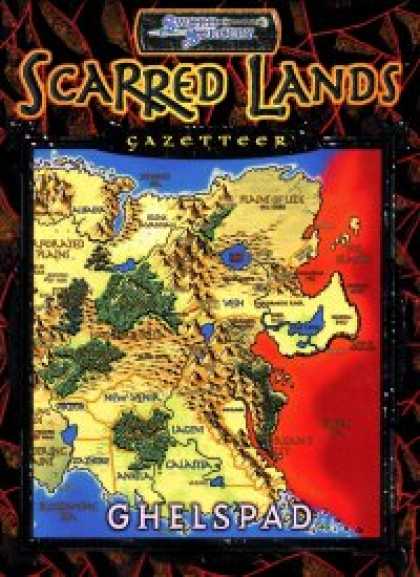
Scarred Lands Gazetteer - Ghelspad

Scarred Lands Gazetteer
Ghelspad

Stephan and Steward Wieck
Published by White Wolf Publishing, 2001

Available at https://www.drivethrurpg.com/


The Good, the Bad, and the Ugly

Scarred Lands Gazetteer Ghelspad (hence Ghelspad) was part of the D&D 3e line produced by Sword & Sorcery Studios, an imprint of White Wolf Publishing.  The book is 48 pages of campaign setting yumminess.  Forget that overly detailed Forgettable Realms hardback that is selling for the price of a used kidney.  If you have fond memories of the World of Greyhawk (either boxed set or folio), you very well might like Ghelspad.  Everything you need to know about the continent is included in this manual.

The inside covers have black & white pictures of the coats of arms for both nations and city states.

The book begins with the History of the Scarred Lands.  The short version is that 125 or so years ago, the gods got into a scrap with the titans.  The gods, as well as one titan who joined them, won the war but the planet has been messed up pretty badly.  The "Scarred Lands" encompasses the entire world, but this book covers just the continent of Ghelspad.

I will note here that throughout the book, the person narrating the section changes, so you may have an uppity wizard narrating one part of the book, or a conniving sycophant of a tyrant narrating a part, etc.

A history of Ghelspad follows. This section gives a brief history of the Divine War, the rebuilding that followed, the Druid War, the Blood Monsoon, the rise of the fore-mentioned tyrant, and the "here you are" point.  The entire history covers only three pages!  Amazing!  The genius of a concise book is that the DM can fill in every minor detail and not have to worry about some obnoxious player who read in some 400 page campaign setting that Super Wizard #1 wears mismatched socks, who then berates the DM for not following canon.

Something that I enjoy is that the Blood Sea actually has blood in it, which causes the red color.  This is because a dead titan is chained at the bottom.  The titans are "dead" but it is more like Cthulhu dead; dead but not really.

A two-page spread map of Ghelspad follows the history.  It is quite nice but it seems obvious that the map was originally in color and they converted to grayscale for this book.  Some of the place names are very difficult to read but I imagine they are easy to spot on a color map.

Nations and City States follows.  Each nation has its common name listed in alphabetical order, the predominant or official worship, the complete name of the nation (as opposed to its common name), the capitol, other cities of note, the ruler, the form of government, population composition (what % is elf vs. human vs. half-orc, etc.), and allies and enemies.  Each nation and city state gets a few paragraphs detailing it.  The continent has two different city states controlled by necromancers.  Some of the details specify certain magical or physical effects.  For instance, the city of Mithril has a giant golem overlooking the city.  The golem has not moved since the Divine War.  Can it move?  Will it move?  Can doughty explorers break into it and look around?  None of this is detailed, leaving it to a crafty DM to determine what the golem actually is or does.  The nations section covers 14 pages.

Topography of Ghelspad comes next.  This section notes many neat, unnatural areas such as a floating island, a forest that seems to never run out of monsters to send into the world, and the Blood Sea that I mentioned earlier.  Reading this section reminds me of reading a Black Company novel, due to the simple but evocative names, "Plains of Lede", "Inferno Gulf", "the Sweltering Plains" are some examples.

The next section of the book encompasses organizations on the continent.  There is a cult of whore-spies who infiltrate the various governments, a group of magic using thieves who are in it for the laughs, a cult of assassins, some Mongol-like horse warriors led by an undead king, some mercenary companies (I wonder if the authors read the Black Company chronicles?), and others.  This section is 7 pages long.

Cosmos and Cosmology follows.  Here is listed the eight gods (at least one died during the Divine War), as well as their titan ally.  The gods do not have alignment listed but it's pretty easy to determine which gods fall where on the law vs. chaos and good vs. evil axes.  The known titans are also listed, along with what they were known for in the old days.  Most of them are dead but still have worshipers, and druids of the Witch Queen and Mother of Serpents, Mormo, still receive spells, so there is that...

The last two pages list calendar days, holidays, the heavens, and planes of existence.

⇒ GRIT: ★★★★ The book packs a whole passel of info into its short 48 pages.  Some gamers would want stats for characters, new spells, and all that jazz.  I don't.  This game setting is truly universal since it has no game stats at all in it.  It can be used for whichever version of D&D the referee wants, or Savage Worlds, or GURPS, or RISUS.  It doesn't matter.  

⇒ VIGOR: ★★★☆: As I stated, as this book is statless and is intentionally sparse with details, the campaign won't be limited as it would be with every nook and cranny detailed, as is common in some campaign settings.  I would have liked to have a better map in this book, as well as regional maps, and perhaps an army roster for gamers who do mass battles.  One thing that is definitely missing is scale on the map which is included.  I have no idea how big this continent actually is.  This is a huge blunder, in my opinion.

⇒ GRACE: ★★★☆:  The book includes some decent line drawings, it has a neat border on most pages, and has plenty of white space to rest the Mark 1's between pages.  The map being a b&w rendering of a color map was a big oops to me.  They should have included a color map or removed all of the labels when it was converted to b&w and retyped the labels, allowing white space around the words. 

Wednesday, August 3, 2022

Warlords of Atlantis

Warlords of Atlantis
By Paul Elliott
Zozer Games 2022

Available at:

Drivethrurpg:  https://www.drivethrurpg.com/

Lulu:  https://www.lulu.com/


The Good, the Bad, and the Ugly

Warlords of Atlantis (WoA) is a supplement for the Barbaric! rpg, which is part of the Cepheus Quantum suite of games; hence WoA can be used with any of the Cepheus/Quantum games.

WoA is a digest-sized, 55-page document.  The version I have was printed from Lulu so I will be reviewing this version.  I did not purchase the pdf from DriveThru so if there are differences with the pdf, I apologize.

The book starts with a quick history of the Atlantean Age, which is around 10,000-12,000 BC in modern day reckoning.  From the first sentence of the first paragraph, vibes of Robert E. Howard are oozing from the text.  "Back beyond the known ages of Man, to the lost beginnings of civilisation, there was a time of war and conflict".  Tell me you can't imagine Mako narrating this!  Also, with this sentence we can learn that the author probably British.

The next two pages consist of maps, one of Atlantis, proper, and the other of Europe, western Asia, and northern Africa in the Atlantean Age - basically the Mediterranean region "Inner Sea".  Both maps are very usable and it was fun to see the differences that Mr. Elliott applied to this region compared to a map I drew years ago for a similar themed campaign.  His is better.

Before I forget, I should review the Barbaric! rules as well.  I really dig them.  Back to the review.

The next eight pages are a gazetteer of the various nations, city states, and colonies, each of which get between one sentence and one half-page of text.  Most of the write-ups have notes on landscape, leader, and maybe local gods.

Modifications to standard Barbaric! character generation comes next.  You are expected to pick an archetype, which gives the character a free trait.  It doesn't state this, but a player could just choose not to take an archetype and not get the free trait.  If I was running a farmer-to-hero type campaign, I would maybe start characters with no free traits.  The list of archetypes includes a couple which give access to new traits from this book, these are Knight (access to Leader trait) and Temple Warrior (access to Sacred Shield trait).  I'm fond of the Merchant Adventurer and it seems to be included for Sinbad the Sailor inspired campaigns.

The following seven pages are write-ups on the various cultures.  The cultures include:  Aquitanians (Spanish-French folks), Arimaspians (Egyptians, but a mix of local guys, the Sokars, and the Anukan, which are the dudes who colonized Atlantis), Atlanteans (they seem to be a mix of Babylonian types and whatever the Anukan are - perhaps pre-Aztecs?), Greeks (come on, you know who they are), Kythians (Celt-Germanic folks), Sokarians (Masai, or a similar tribe, maybe?), Thalangorians (animal-clan-Viking), and Voluscians (Italians who are being influenced by Greek culture and dress).

The next page is a list of weapons allowed (bronze age, plus long sword) and an optional combat rule regarding initiative (longer weapons are better than shorter weapons).

This is followed by a list of 16 sorcerous tomes.  For those who want to know, neither the Scrolls of Skelos nor the Necronomicon are listed.  A shorter magical mishap table immediately follows the list of tomes.  It is quite a bit shorter than the one in the Barbaric! rulebook but it gives the Referee more freedom I think.  There are no "you are followed by cockroaches" mishaps and more "terrible toll on your frail body" type mishaps.

There is a short list of demons (seven of them) and how to summon them, which is followed by a list of the common gods of the land.  There are rules for becoming an acolyte of a deity and the benefits and obligations by doing so.  Since Barbaric! is a sword and sorcery genre game, there are no clerics, per se.  These rules give a way for players who enjoy playing clerics a way to do so.  One thing to note is that Hero Points are only gained by praying to the gods.

There are a few pages of new monsters, as well as a list of critters from the main rulebook which exist in this setting.

The book then has a few pages discussing war and sea travel in the Atlantean Age.  The wind table seems really useful.

We next have six interesting locations detailed, followed by six NPCs.  Tar-Nergal seems like he would make a great "mission giver" if the Referee wants to run his campaign this way.  The players will be sent to various ruins and far-off lands searching for the McGuffin.

The next section is 4 or 5 adventure seeds, all tied together under an adventure arc around two brothers vying for control of a kingdom, once their father passes.  I think this might be fun if the adventures are squished up time-wise.  I know that some players would probably just wander off and do their thing while the kingdom falls - the Ref will need to ensure that the party keeps on track with helping one prince or the other, or both if they want to go that way. 

The second to last section is one page of Atlantean machines - bronze titans, sunstones, Greek fire, etc.  The final section is bringing "pulp heroes" from other campaigns into this campaign.  It includes a handful of 1930s pulp NPCs and a short list of guns.

What are my thoughts, you ask?

I like this supplement.  It is just the right size.  It has just the right amount of detail.  One of my pet peeves with supplements is the information vomit.  Unless it is pertinent to most campaigns, I do not want to read about the 3% chance of the 7th daughter of left-handed galley slaves of having an extra toe.  I want just the basic information.  This supplement delivers the absolute minimal information for a country or culture.  A Barbaric! campaign, with this sourcebook, would make a fine gaming campaign.

⇒ Grit:  ★★★★☆:  This supplement is just what an aspiring Barbaric! Referee needs to get his campaign off the ground.  It is very straight forward and covers all of the bases.  I would have liked to see army lists, since the book includes information on warfare.  Perhaps, a standard soldier or hoplite from a few nations could be included.

⇒ Vigor:  ★★★★☆:  Warlords of Atlantis, as a setting book and rules supplement, works.  I think that having the basic information provided will give gaming groups a good grasp on the Atlantean world.  What I think would make it just a bit better would be more maps, preferably of trade routes, maybe one showing some ancient serpent men ruins, that sort of thing.  With a few more maps, the campaign could go longer for those like me who are not good with the maps.

⇒ Grace:  ★★★☆:  The book is not beautiful but it is also attractive enough.  The cover is pretty cool, the layout is good, and so much better than what I grew up with.  The fonts are nice, the clipart breaks up the text handily, and the white space helps my old man eyes.  I have no fault with Grace but I also can't rave about it.


D&D Capped at Level 3

Using ONLY one of the Basic D&D sets as a complete set of rules. AKA "Holmes Only" D&D This whole project started as a pos...