Showing posts with label retroclone. Show all posts

Friday, September 29, 2023

D&D Capped at Level 3

Using ONLY one of the Basic D&D sets as a complete set of rules.
AKA "Holmes Only" D&D

This whole project started as a post on Dragonsfoot in 2008.
The link is right here -> Holmes as complete game.

Now, I know what you are thinking - how is this a game review?  Technically, it isn't, but this has been stuck in my mind for a couple of weeks so I have gone through the Holmes basic rules, its retroclone Blueholme Prentice, and for the sake of both completeness, and because it is my favorite version of Dungeons & Dragons ever, I did the same for the Moldvay basic rules.

I will be doing some direct comparisons between the three rules sets as well as posting my "house rules" I would use if I ever decide to do this in a real campaign, and not just as an intellectual exercise.

This is the cover of the 1977 Holmes Basic Set rules.

Some notes on it:

  • Classes are fighting man, cleric, magic-user, and thief; it allows dwarves, halfling, elves, and humans as races. 
  • Clerics automatically turn skeletons at level 2 and both skeletons and zombies at level 3.
  • 1st and 2nd level magic-user spells and 1st and 2nd level clerical spells are listed and described.  3rd level magic-user spells are listed but not described.
  • Contains 57 monsters (considering all colored dragons as a singular "dragon", e.g.)
  • All weapons d6 damage, daggers attack 2x per round, heavy weapons every-other-round.

This is the cover of the 1981 Moldvay Basic Set rules.

Some notes on it:

  • Classes are cleric, fighter, magic-user, thief, dwarf, elf, and halfling. 
  • Clerics automatically turn skeletons at level 2 and both skeletons and zombies at level 3.
  • 1st and 2nd level magic-user spells and 1st level clerical spells are listed and described.
  • Contains 68 monsters (considering all colored dragons as a singular "dragon", e.g.)
  • All weapons do d6 damage but an optional rules it to use the d4, d6, d8, and d10, depending on weapon.  All weapons attack once per round.

This is the cover of the 2017 Blueholme Prentice rules.

Some notes on it:

  • Classes are cleric, fighter, magic-user, and thief; it allows dwarves, elves, halflings, and humans as races.
  • Clerics do NOT automatically turn skeletons at level 2 and both skeletons and zombies at level 3, requiring a successful turn check at all 3 levels.
  • 1st and 2nd level magic-user spells and 1st level clerical spells are listed and described.
  • Contains 70 monsters (considering all colored dragons as a singular "dragon", e.g.)
  •  All weapons do d6 damage but light crossbows attack every 2nd round and heavy crossbows attack every 3rd round.


ADDITIONAL NOTES ON CLASSES

According to the Holmes rules, dwarves and halflings MUST be fighting men according to the dwarf and halfling descriptions, however according to the fighting man description, both races can opt to be thieves.  It gets even trickier with elves.  They advance as fighting men AND magic-users according to the both the elf description and the fighting man description, but according to the magic-user description, SOME elves are magic-users.  As a DM, I would be lenient and allow dwarves and halflings to be fighters or thieves and I would allow elves to be fighting men, thieves, or multi-class as fighter/magic-user.

Moldvay uses the much-maligned, but better in my opinion, "race-as-class".  A dwarf is a fighter with some additional special abilities, and the same goes for the halfling.  An elf is a combination of fighter and magic-user.  Mr. Moldvay cleaned up most, if not all, of the head-scratching which made it into Holmes from the 1974 original D&D rules.

Bluehome Prentice, like Moldvay, forces dwarves and halflings into the fighter class and makes it clear from the actual Holmes rules, that elves can be fighters, magic-users, or a combination of both.  Interestingly, Blueholme also has rules for "Combination Classes", which allow characters to combine any two classes (elves do this by default).  Theoretically, you can create a halfling-thief or dwarf-cleric with these rules.

 Mr. Thomas made the decision to never give clerics the ability to automatically turn undead.  I find this strange since he stuck really close to the rest of Holmes for his rules.


OTHER GENERAL NOTES

Treasure types and hordes differ between using a letter (Type A, Type B, etc.) or a number (1, 2, 3, etc.) for treasure types.  Most of the differences in the books, especially in regards to Blueholme Prentice is probably to avoid copyright infringement.

Other than what has been mentioned, all three games are either the same or nearly the same on all other details.   


MONSTERS

All three rules have a good assortment of monsters.  

Holmes has monsters from 1/2 hit die (kobold) through 15 hit dice (purple worm), 4 types of dragons, and 6 types of giants.

Moldvay has monsters from 1 hit point (bat) through 11 hit dice (gold dragon), 6 types of dragons and no giants.

Blueholme Prentice has monsters from 1d2 hit points (normal centipede) through 15 hit dice (storm giant and purple worm), 4 types of dragons and 6 types of giants.

We see that Moldvay, I assume because the Expert set was produced along with the Basic set, has a lower-powered spread of monsters.  Additionally, quite a few monsters are just humans (acolyte, bandit, noble, etc.) with differences in armor, spells, higher-level leaders, etc.  For a game maxing out at 3rd level, I think this is a good choice.  It would be nice to have a few higher-level critters, though, if only to show the DM what his players might be getting up to.  Again, with the Cook-Marsh set right on the heels of Moldvay, high power monsters in the basic set wasn't needed.


MY IDEAS AND NOTES

As an intellectual exercise, as stated before, I decided to make house rules for each of the sets.  I gave myself one page per game, each nicely organized, and (hopefully) easy to understand.

Some other thoughts were to boost the combat ability of fighters since all character classes have exactly the same "to hit" values on levels 1 through 3.  I ended up giving fighters a damage bonus at each level.  I could easily have given them an attack bonus, instead.  I suppose I thought that fighters should be "closers" when it comes to killing foes, especially since all weapons do 1d6 damage across all three sets of rules.

With thieves, I ditched percentile thief abilities completely and went with a 1d6 thief skill test.  I did this partly because thieves are wretched at thievery until mid levels, and I wanted them to be adequate thieves at level 1, and partly because percentile thief skills are too fiddly as a general rule.  They are nearly always at 5% or 10% increments until the highest level as it is.  If you have not read my comparison of White Box Fantastic Medieval Adventure Game and Delving Deeper, rest assured that the authors of those two books feel as I do and ditched the percentage skills, too.

I mentioned clerics and turning a couple of times, so I added back in automatic turning when using Blueholme.

Experience in any of the three games will be an issue if giving experience points for treasure.  To alleviate this, simply switching to a silver standard for purchases and living, while keeping 1 gold piece = 1 experience point is the simplest solution for me.  You could also just give 1 xp for 10 gp, and keep a gold standard.  I prefer a silver standard anyway, so I did what I did.

I also adjusted Holmes' attacks per round, since as written, it is pointless to ever carry anything besides a dagger as a melee weapon and crossbows are horrible, so I gave bonuses when using them.

I have the exact same "X-in-6 Rule" on each document.  This is how I often adjudicate 

- "Hey ref, can my fighter, Conanyan jump across this gorge and attempt to grab that broken rope bridge hanging down on the other side?"  

= "Sure you can, roll 1-3 on a d6!"

- "Hey, I want my magic-user Urkle to do that too!"

= "Ok, if you insist, roll a 1 on 1d6.  Oh wait, you have a 15 dexterity, make it a 1-2 on d6."

In all three systems I allowed higher level spells as rituals.  This would work for non-combat spells, which I find desirous - summoning monsters and dispelling magic seems quite suited to swords & sorcery, while fireball doesn't.

I suppose this is a good time to mention I made additional notes for each rules for a more sword & sorcery game, which is the biggest benefit of limiting all classes to 3rd level.  They are also exactly the same on each of the rules documents.

Oh, one more thing, I don't own Mentzer Basic set, so I could not compare it.  I assume it is nearly identical, as far as rules, spells, and mosters as Moldvay, but if there are differences, one of you fine folks can do your own basic set as entire campaign thingimajig and let me know what you think.

Firstly, the original rules which caused the conversation back in 2008.


Secondly, Blueholme Prentice retroclone.


And finally, my OG game set, Moldvay.


Monday, July 31, 2023

Modern Necessites (OSE Version)

Modern Necessities - Old School Rules for Modern Themes
by The Scrying Dutchman

  • You can purchase the pdf and the drivethru rpg version of the printed book here:  https://www.drivethrurpg.com
  • You can purchase the the lulu version of the printed book here:  https://www.lulu.com
  • I have not seen the product on the Necrotic Gnome website but I believe they don't stock print-on-demand products, in house.

For the record, I purchased the Lulu version, as I have never had a bad Lulu print but I've had numerous poorly printed books from Drivethru.  As of 31 July 2023, the Lulu version is also $6 cheaper!  Get on it folks, you won't be disappointed!


Four days.... I've been alive in this Hell for four days.  Again we hear the suppressive fire starting from across the river - the Volga - that bitch of a river that has drunk the souls of my entire platoon... and the platoon before that.  Four days.  My beautiful twin sister, Olga, is dug in beside me.  Poor Olya, I pray that her scars don't keep her from a good husband some day.  She is adjusting dials on some device sent down from Moscow.  She was told it will protect our emplacement from explosions - something about radio frequencies and tuning ley lines.  My Olya is the smart twin.  I'm the sniper.  With shaking hands, I finish loading my battered Mosin.  I know from experience that they will stop shaking when the iron monsters of the 14th Panzer (Ork) roll into view.  I pray that if she and I survive this battle that Olga returns home.  Stalingrad is no place for my sister.  Four days...


The Good, the Bad, and the Ugly

Modern Necessities is a set of character classes, equipment, and rules for adding modern combat into an Old School Essentials (OSE) game.  This book cannot be used as a complete game, as is.  You need to have either OSE, a TSR version of Dungeons & Dragons, or some form of retroclone or OSR product for the basic rules.  There is also a version of this book for the 5th edition of what WotC calls "D&D". I haven't seen it and won't spend my hard-earned scrilla on 5e.

 Physically, the book is a bit taller than normal, US-sized books.  For my fellow 'murcans, this book is 11.5" inches high and 8.25" wide.  This equates to 29.5cm high and 21cm wide for my Euro-friends, Aussies, and Canuckistanis.

The cover is pretty cool but I'm not exactly sure what it represents.  There's a pointy-eared fellow, a chick with a pistol, maybe a medusa with a gatling gun and an ogre holding an old timey bomb.  This is just a guess.

After the title page, table of contents, and introduction from the author, the book jumps right into the new classes.  There are a lot of them.  Each class, in OSE tradition, is detailed on one page.  The format uses bullet points with paragraphs as needed for more detailed information.  The second page includes tables for each class (XP, HD, attacks, skill success, saving throws, etc.)

The classes are:  Soldier, Heavy Gunner, Crook, Tech Expert, Sniper, Survivalist, Hired Killer, Medic, Psychonaut (magic-users who get their spells from hallucinogenic drugs and communing with inter-dimensional entities), Wheelman, Ninja, Exorcist (what it sounds like), and Face (the sexy, talker folks).  The rest of the classes should be self-explanatory.  I wish Mr. Dutchman would have reorganized the class chapter to keep all of a character class' details on facing pages.  Sometimes it is but sometimes you have class information on the front and charts on the back of a single.

Note that some of the classes have access to spells.  For a more realistic setting, the referee will have to ignore this.  Tech Experts get access to technomancy spells (detailed in this book), Medics and Exorcists get access to cleric spells.  Psychonauts get access to magic-user spells.  Faces get access to magic-user spells (illusionist spells, if Advanced OSE is in use).

After classes, we get a 2-page spread on races.  Dwarf, elf, gnome, halfling, half-orc, and human are the options.  They are the same as the OSE versions but are given traits and flavor on how they might behave in a modern society.  Dwarves are old-time fans and are good with revolvers, sawed-off shotties, and the like.  Half-orcs are [apparently] dressed as gopniks are best with "spray and pay" weapons.  You get the idea. 

The next 35 pages are guns and gear.  

There is a simple way to use "spread quality" tagged items, such as shotguns.  In this case, if your character is blasting some schmuck with a 12-gauge, and his homie is standing within 5 feet of him, there is a 2-in-6 chance that he sucks up some shot himself.  I am not sold on the "full auto quality" tagged weapons.  Each character has a standard Armor Class but full auto targets AC 5 [14] and anyone within 10 feet is hit with this as the target number but then saves for half damage.  I can see a player whose character has a better AC complaining about this.  With D&D-style AC to be hit and not armor reduction, I don't know if I could come up with a better mechanic.  I don't know.  I'd have to think about it.

The author has some fun with the weapon descriptions and it tickles me.  Here is the description of the Fire Axe, as an example.  "Carried by firefighters and often stored away in buildings for use in emergencies.  Sometimes slamming it into someone's chest counts as an emergency."  Dry and funny.

I won't spend too much time on the weapons, even though it is dang near half the book.  Weapons are broken out into tables based on the class of weapon, light, medium, heavy, etc.  Taking two pistols to compare, James Bond uses a Walther, .32 caliber pistol, according to the Dr. No movie.  Bond can take out the evil SPECTRE schmucks at 30/60/90 range with 1d4 damage.  Dirty Harry, on the other hand, with his .44 magnum, "the most powerful handgun in the world", blows away rapists at 60/120/180 range with 1d8+1 damage.

The rules eschew bullet counting and the game relies on a Reload Number, instead.  A d6 is rolled after an encounter and if the result is below a certain number, the weapon must be reloaded (again, not "bullets" but rather an item called "ammo reload", which is whatever number of bullets are needed).  Don't worry. it appears to work better than how I am describing it.  This simplifies counting ammunition, which is probably good for a military game with bullets whizzing by.  If emulating a spy novel, where maybe only a handful bullets are ever fired, it might not be necessary.  Overall, I enjoy the reload.  For the record, our famous British spy has to reload with a 2-in-6 chance and our favorite San Francisco ass-kicker has to reload with a 4-in-6 chance.

Later on in the book, we get a rules and table for damaging vehicles and occupants of vehicles.  I think that the table could have been included in the main weapons tables easily enough.  It is always a single-digit number and the tables have room.

I am really happy to say that Mr. Dutchman lists weapons by "type" and not specific weapons.  He does include examples in the description.  My dad's old Winchester .30-30 is a "lever action rifle", journalist's favorite punching bag death machine is listed as "assault rifle".  The author failed to take into account the +1 Charisma bonus that the AK-47 wielders get when shooting next to those inferior AR-15 chumps.  Oh well, maybe in the next edition!

There is a list of firearm attachments (night vision, suppressor, etc.)  Armor affects AC, as expected in OSE.  I think the author went a bit too crazy with armor types but I understand his reasoning because some "armors" have special properties (NBC suit makes you immune to diseases while wearing them, etc.)

The next chapter is for vehicles.  There is a very simple mechanic for shooting into vehicles.  Each vehicle has a Vulnerability Rating (VR).  Vehicles are immune to weapons which have a Vehicle Damage (VD) stat equal to, or lower than, the VR.  Let's go back to our two literary heroes for a minute.  Bond has his Walther in hand and wants to stop the Peterbilt bearing down on him.  James empties is mag into the truck's hood and not a damn thing happens.  Bond's 'Murcan comrade whips out his .44 magnum heater, *BOOM*  *BOOM*, he drops two rounds into the engine block, damaging the truck.

The vehicle list is by type, just like weapons, and not specific models of cars, boats, helicopters, or tanks.

Technomancy spells are next listed.  Some are super hacker type spells.  Some make weapons "magical", imparting a bonus to hit. There are six levels of spells, with eight spells per level.  It would be nice to have a line delineating the breaking point between spells.  Or perhaps a table break.

A chapter on NPCs follows.  There are 16 NPCs included.  You get a commando, detective, cyber criminal, some other humans, and a cybernetically upgraded dog, called Drone Dog.  It reminds me of one of the Sprawl Trilogy books where some tinker in the woods had a pack of enhanced dogs.

Chapter 10 is optional rules.  Hit locations, "cinematic" mode, damaging armor, gun jams, etc.  Cinematic mode is when the players want to run either a Rambo game or a James Bond game.  Characters damage enemy Hit Dice rather than Hit Points.  Enemies damage character's Hit Points, but all weapons do between 0 and 4 points of damage.  This is the same rule from the excellent Scarlet Heroes OSR game.  There is also an optional rule for Experience Points that I think would be needed for any modern game, other than a game where the PCs are bank robbers.  James Bond is a bad ass but he isn't looting the corpses of fallen enemies, looking for chump change.  He is a bad ass because he has completed missions.

⇨ GRIT: ★★★★ This supplement definitely brings OSE into the modern age.  The rules are mostly useful for modern campaigns which involve heavy firepower.  The game is guns heavy and light on spy gadgets, is what I'm saying.  I don't know if Mr. Dutchman intended it this way, maybe he is planning a spy supplement for spy craft?  Mr. Dutchman states in his introduction that players can "revisit old classics with an AK-47 in hand and a vest full of grenades".  He then mentions what I believe are hints about Ravenloft and Isle of Dread.  I think it would be a heck of a good time playing this.

⇨ VIGOR: ★★☆: As a set of rules, they work.  There is no setting information in the book and this might be intentional, as the rules are generic enough for most modern combat settings.  If the author ever does a second edition, I would love to see a few 1-2 page mini settings.  Maybe he does a mini setting which is very D&D but with guns, another which is very realistic but the characters go to a lost dinosaur island, which may or may not be Jurassic in nature, another where the characters are womanizing superspies, out to foil the plots of some supervillains with goofy names, another where they are cowboys who defend the herds from rampaging ankheg, etc.  Giving the referee and players a handful of samples, to me, is always a plus.

⇨ GRACE: ★★☆: This is a decent-looking book.  Having all tables and class info on a page spread would do wonders.  Also, by eliminating the space between bullet points in the NPC chapter would allow another one or two foes or friends to be added.  I also would like the aforementioned weapons vs. vehicles score in the table with the weapons.  Those complaints aside, the book is laid-out quite well.  It has a modern layout, plenty of white space to break up the text, and there aren't random tables showing up on page 23, referencing something from page 50.  The art is decent to good.  My personal favorite is the drow on page 1, showing her rack, with her finger to her lips and a submachine gun ready to go.  I think perhaps having a more unified art style would be better (the sexy drow just mentioned is cartoony but a bit serious in tone vs. the demon gal on page 35 which is cartoony, but more in the way of Who Framed Roger Rabbit).  I hope that makes sense. 

Monday, March 27, 2023

Colony of Death

Colony of Death
Weird Fantasy Roleplaying in 17th Century Maryland
Mark W. Hess

Available at https://www.drivethrurpg.com or lulu.com, which is where I got it, I believe.

The Good, the Bad, and the Ugly

Colony of Death, Weird Fantasy Roleplaying in 17th Century Maryland, is a supplement for Lamentations of the Flame Princess (LotFP) including a setting and several adventures.  As it is a supplement for LotFP, it is recommended for folks 18 years, or older.  In fact, on the title page, it states precisely this.

Taking a quick side-trek, I lived in Maryland for three years, in a town between St. Mary's City, which this supplement is for, and Washington, D.C.  It was really fun reading about places I have actually visited and reading about a cryptid that I actually heard tales about!  If y'all get a chance to visit, take the time to do so. There is (or was before the covids) a reenactment from the colonial times in a rebuilt village.  Lots of cool history.  Plus, if you have any interest in visiting churches, some of the oldest Catholic ones in the USA are here).

Back to our regularly scheduled review.

As this supplement is for LotFP, which is a standard OSR game, this setting can be used for any OSR game.  I don't own LotFP, and when I run the adventures in this book, I will use real D&D, White Box, Blueholme, or something similar.

The book starts with a quick introduction and then gets into the colony of Maryland.  George Calvert, the first Lord Baltimore, was granted the lands on which to build St. Mary's City.  Lord Baltimore wanted to prove that Catholics and Protestants could live, and work, together without fear of the hangman's noose or burning pole.  When the colony is settled, there were natives inhabiting the lands.  The natives were mostly friendly with the English. 

A page and a bit of the next page include a timeline from 1608 through 1650, when the adventures in this book take place.  Included in the timeline, which very well could affect interactions within the settlement, are accounts such as:  witchcraft being made illegal in 1635 (burn them all!), the Susqeuhannock indians, along with New Sweden, going to war with Maryland in 1644, a Protestant uprising during the English Civil War, ending with King Charles getting a "nip off the top" in 1649, somewhere around the shoulders; of course the Prots decided to attack the Caths in this period.  Puritans set up their own settlement in 1649, as well, which will put even more pressure on what was intended to be an exercise in Catholic-Protestant harmonious living.

This is where we stand - the year is 1650, St. Mary's City, once the home of peaceful coexistence between Protestant and Catholic English, and some friendly Natives, has suffered ten years of warfare.  Can the two groups of Englishmen repair the breach?  What about the Indians?  Will they continue to coexist with the English, or will they want war?  Can Maryland protect the interests of its various inhabitants against the aggression of neighboring New Sweden and Virginia?  The colony is ripe for adventure!

After the timeline, there is a listing and a bit of info on St. Mary's City, Providence, and Kent's Island.  These are the only cities listed and referees are encouraged to add villages, trading posts, etc.

Next, we get a page and a half about the people in the colony, as well as a very small hex map of the region, from criminals and indentured servants, to the local native tribes, to the European settlers.

Following, we have two pages on New World diseases.  Every month, characters make a saving throw to not catch a disease.  That's pretty hardcore.

The next two pages are encounter tables.  All good OSR settings need encounter tables.  Colony of Death, being a good OSR setting, has them.  The tables include real life critters like black widows, pirates, black bears, and rattlesnakes, but it also includes some disputed critters, such as sasquatch and the very, very Maryland cryptid, the Goatman!  When I read this far into the book, after I bought it a couple of years ago, I was tickled!  There are eight pages detailing these critters, following.  I wish more art was added in this section as there is a lot of white space, which could have been filled with line art, even if it is old timey clip art.

This ends the primarily setting information.  Several adventures follow, many of which include more snippets of setting information.

St. Mary's Shoemaker adventure includes a map of St. Mary's City, as well as some businesses in town.  The adventure involves the characters trying to solve a murder mystery.

The Hell's Bell adventure finds the characters discovering an unknown German village.  Hopefully one of the players chose German as a language slot!  This adventure is very Lovecraftian - village of hicks in the woods who are a little too closely related on the DNA scale, if you know what I mean.  What is with the bell?  Why do people keep going missing?

The Hand and Eye of Loki take the adventurers in the lands claimed by New Sweden.  Again, people are going missing.  Are Indians killing settlers, or is it something more mysterious?

To Burn a Witch is the next adventure.  Providence is a Protestant town, through and through.  The characters arrive just when a local gal is about to pay the price for wallowing with the Devil.  She is young and beautiful.  Is she guilty?  Is she innocent?  Will the characters rescue a damsel in distress or let her burn?

Another side trek.  Did y'all know that before he got famous for being a king and having the Bible, which was forever to include his name, translated into English, James was hip to the ways of witchcraft?  He wrote a book about it.  Sometimes the only way to deal with a witch is to burn it.


The Appendix of the book includes four pages of common names, broken down by both male and female, and by language - Algonquin, English, German, and Swedish.

A two-page spread map follows the first appendix.  It is a lovely map, 10 miles per hex, but unfortunately all of the important settlements are in the gutter of the page.  Splitting the map in two and leaving half an inch per page for the gutter would make the map so much more useful.

The final appendix discusses tobacco as currency, and growing tobacco.  This is another historical shout-out since tobacco was actually used as currency in the Maryland colony.  There are rules for running a tobacco plantation and the consequences due to soil depletion.

There is another cool town in Maryland you can visit called Port Tobacco.  It is in a Charles county, right off US301 highway.  It's another place you can visit in real life if you happen to travel through the area.

In conclusion I will say that I love Colony of Death.  Love it, love it, love it.  It is not perfect and I certainly have gripes, but I can wholeheartedly recommend that any referee who wants to set a campaign in the New World, pick this up.

⇒ GRIT: ★★★:  Being a mere 58 pages, with half of that relegated to adventures, this book doesn't give a whole lot of wallop.  What it does include, though, will whet the referee's appetite for sure.  I would love to have seen more details on the culture of the local natives.  I really would have liked to see a price list for items for sale in both St. Mary's City and the trading posts.  It is mentioned that prices are included in the LotFP rulebook, which I don't own.  As tobacco is the currency in the colony, having a list of gear which can be purchased, with the corresponding price in tobacco, would have been excellent.

⇒ VIGOR: ★★★: As with GRIT, since the supplement is so short, you won't get years of play with only what is included.  However, what is included will get a game group quite a few sessions I believe.  Adding in things like trade routes between the various colonies could increase the vigor of this product.  I also would have liked to have a page or two of adventure hooks.  The adventures included are delightsomely dark and twisted, but what about more "normal" adventures?  A list of adventure hooks is always gold.

⇒ GRACE: ★★: The book is perfectly functional but not beautiful.  The cover is pretty cool, with a Schneller Geist flying over what appears to be a homestead next to a hill.  Internally, the book is well-layed out with a single column on most pages but two in the few places where it makes sense to have two columns.  The line art is functional but there should be more when there is a half page of white space.  The map, as noted, really, really needs to be split into two.  This map is my biggest gripe about the book.  If the author decided not to include art to fill up the white space, removing the white space would give another page, which could be used for adventure hooks, price lists, or something else.

Friday, March 24, 2023

GORE (Generic Old-school Role-playing Engine)

GORE Generic Old-school Role-playing Engine

by Daniel Proctor
Goblinoid Games, 2007

It can be purchased from https://www.drivethrurpg.com  This appears to be pdf only and as I have it as a softback book, it was available in this format at some point, as well.


The Good, the Bad, and the Ugly

GORE, written by Dan Proctor, is Goblinoid Games' contribution to the Basic Roleplaying (BRP) world, using OGL 1.0a.  Unlike the BRP "Gold Book", GORE is trim and sexy, weighing in at 52 pages.  This game includes its own license for 3rd parties to use called the GORE License 1.0.  As far as I know, Stuart Marshall's The Secret of the Whispering Wood is the only other GORE product, but I could certainly be mistaken.

If, dear reader, you are familiar with any other BRP game, nothing in GORE will come as a surprise.  For those of you who may not be familiar, all BRP games are percentage-based, where a skill of 40% means that your character has a 40% chance to succeed, barring any modifiers.

GORE uses the standard polyhedral dice.  It is an attribute and skill-based game without the need for classes or levels.  The ability scores are pretty much like every other game from the 1980s.  The two exceptions being Size (character's mass) and Power (force of will, and innate magical ability for setting which use magic.  The other attributes are strength, constitution, dexterity, intelligence, and charisma.  Scores are figured by rolling 3d6 for each, with an alternate method for higher-powered characters, which uses 2d6+6.  Hit points are figured by averaging constitution and size.

If an ability score needs to be tested, it is multiplied by 5 and the percentile dice need to beat this number.  Sometimes, characters will have to determine if something is successful when being opposed.  This is called Opposition.  The traditional arm-wresting is a good example.  To determine the % chance of success, the character pits his strength against his opponent's strength, looking a chart (the Opposition Table) which will give the actual chance the character will succeed.

Most tests the character will make, however, are based on skills.  Every character has a base % chance to succeed at any skill (5% for art, 35% for climbing, 15% survival as examples).  The Dodge skill defaults to the character's dexterity x 2.  Some skills, computers for instance, have a base % chance based on era.  In a standard fantasy setting, the skill would not exist; in a 70s blacksploitation movie setting, it might default to 5%, whereas a modern spy thriller setting might default to 40%.  Players may want to choose a profession for their character, which can be anything.  The book does have 25 or so professions, covering the most common genres.  The GM and players might need to brainstorm a bit for professions which are not included.  Each profession gives five to seven suggested skills.  Professions are not required, though.  Players can put skill points into any skill available for the setting.  Professions just give the player some things he can focus on for his character.

There are 35-40 skills or so in the rulebook, but not all will be available in all genres.  Some skills, for example Science, may require a specialty.  Characters get 250 points to spend on skills, keeping in mind that all skills have a base %, so if the player drops 20% into a 5% base skill, he now has 25% in that skill.  Make sense?

Improving skills is one of the great thing about GORE, and other BRP games.  Instead of gaining experience points and then at some point, voila! I'm a 3rd level dwarf, each skill is improved separately.  The two methods included are 1) the player gets to pick three skills he wants to improve when the GM says it is allowed, or 2) the player makes note when a skill has been used exceptionally.  In either case, the player rolls d%, and if the result is higher than the current skill level, it goes up by 1d10%.  No skill can be improved beyond 98% though, so there is always a chance for failure.

A roll of 00 results in a fumble.  A roll of 20% of the skill score results in a critical success.  In the case of our 40% score I mentioned in paragraph 2, this means that a roll of 01-08 is a critical success.  I think this complicates the game a bit too much.  Some newer BRP games rule that dice rolls which succeed, and are also doubles (11, 22, 33 for our 40% dude) are considered a critical success.  I prefer this.

 The Game rules chapter follows.  In includes the majority of situations which might arise in any genre.  Acid, drowning, and fire are pretty universal for any setting, but this chapter includes things that you may not consider until the situation arises.  Examples include air pressure, aging, and radiation.  In this chapter is also included fumble charts for weapons, which I believe should be relegated to the combat chapter.  In addition to fumbles, injuries, light blows, and the optional hit locations should also have been in the combat chapter.  Two rules to note here are poison and radiation.  These make use of the Opposition Table, pitting the potency of the poison or radiation against the constitution of the character.  A cool Radiation Exposure Table is included for what happens when a human is dosed with them good ol' rays. This table is for "realistic" game genres, though.  Gaining x-ray vision or learning to shoot eye lasers are not options!

The Combat chapter is next.  Players will quickly realize that GORE, and most BRP games, are based on RuneQuest, which is a rules-heavy combat-based game.  Place in combat is based on Strike Ranks (initiative).  Both the attacker and the defender roll their weapon skill.  Combatant A has 40% scimitar skill and Combatant B has a 30% hatchet skill.  Depending on how well each combatant rolls, determines the result of the attack.  Combat adds another complication by adding impale as a result, in addition to fumble, failure, success, and critical.  Every blow in combat needs to have a chart consulted to find the result.  If Combatant A is attacking and rolls a 36 (success) and Combatant B is defending and rolls a 02 (critical), then no hit is scored.  The crunchy factor of combat in GORE puts me off running the game.  If I was to run this game, I would disregard the table and find a much more streamlined way of judging combat.

There are a few other rules in the combat chapter for mounted combat, gun malfunctions and reloading, unarmed combat, etc.

Magic comes next.  Magic-using characters know a maximum number of spells equal to their intelligence attribute.  The ability score, power, determines if the character can learn spells, and how many Magic Points he has to power his spells.  By default, a power of 16+ is required to be a spell-caster, but like everything else, this can be adjusted for different genres.  There are nine pages of spells, including many old standbys from D&D or OSR games, such as web, purify food and drink, cure wounds, spider climb, and remove disease.  The more powerful offensive spells such as fireball and lightning bolt are not included.

We are now through page 44.  Page 45 is a one-page distillation of the rules called Lite GORE.  This is my jam!  GORE, excepting the painfully crunchy combat, is a smooth game.  It isn't "rules lite" but it is very close, by default.  Lite GORE tells us to ignore hit locations, serious wounds, and most skills.  It consolidates the 40 or so skills previous into 27, which will be trimmed again, depending on genre.  Initial skill points needs to be cut back for this abbreviated list.  The book recommends a maximum of 200 points for characters.  Unfortunately, the author didn't take this opportunity to take a virtual scythe through the combat mechanics and distill it down into a more simple form.

The next seven pages are equipment lists, broken down by time period.  Four of the lists are all rotated from portrait to landscape, making you flip the book to read.  This is an annoyance but the lists are serviceable.  

The book then ends with the two licenses I mentioned above.

⇒ GRIT:  ★★★ This book includes nearly everything you would need to run a game in many genres.  I think it fails in a couple of regards, however.  It includes realistic rules about radiation but where are the rules for a Gamma World game?  I want my Hoops, dangit!  If you want to play a D&Dish game with both wizards and clerics with varying spell lists, you will need to do some work separating spells and probably adding some more.  I am giving it 4 stars since you will be able to run 90% of common game genres with just this one book.

⇒ VIGOR:  ★★★  Like the grit score, GORE includes enough, rules-wise, for a long-lived campaign.  Since this is a concise book of mechanics, there is no fluff.  If this game was genre emulation of one genre, the score would be 1 or maybe 2 stars.  Since it is trying to be a universal system, and the advancement mechanic is so very simple, GORE is solidly 3 stars.

⇒ GRACE:  ★☆☆ GORE is not a pretty book.  It is certainly competent.  The small amount of art included is decent.  The cover I like quite a bit, with the red on black Cthulhu chilling in the sea.  Most of the included line art appears to be a cat named David Sharrock, and is all Cthuluesque or snakemen.  I enjoy it.  The layout of the book could certainly use some work.  For example, the SCUBA skill is listed on the very bottom of a page, bolded, and the page has to be flipped to see the details.  This happens a couple different times.  The tables changing view is an annoyance.  I think that all tables could have been made readable in portrait mode.  The book is certainly more readable than some of its 1980s forebears, however.

Thursday, January 5, 2023

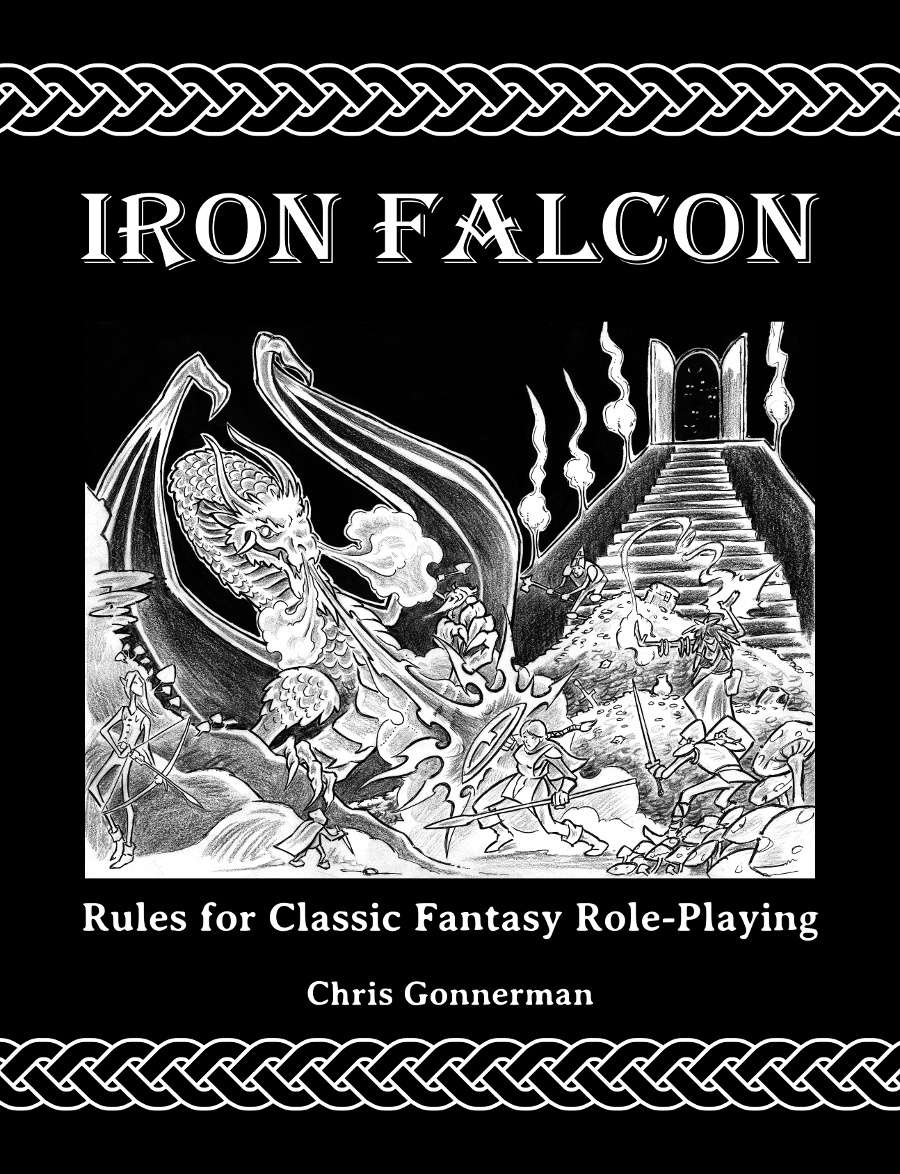
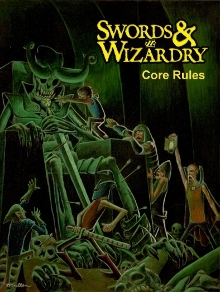
Comparing Blueholme Journeymanne, Iron Falcon, and Swords & Wizardry Core

Since I had such a fun time in my previous post comparing WB:FMAG and Delving Deeper, I thought I would compare three other retroclones that are based on OD&D plus Greyhawk.  Technically, Blueholme is based on Dr. Holmes' rules, which were designed to restate the OD&D rules in a coherent fashion.  The Journeymanne rules are really close to OD&D though, so I think it is fair to compare here.


Blueholme Journeymanne is the Holmes 1977 version of the game, expanded to 20 levels.  It is written by Michael Thomas.  Iron Falcon is a different way of saying Grey Hawk, which is Chris Gonnerman's contribution to the early days.  Swords & Wizardry core is by Matt Finch.  All of the games go to at least 20 levels, so these comparisons should be kosher.  I will abbreviate them as Blue, IF, and Core, to make my typing easier.  I was going to abbreviate Blueholme Journeymanne as BJ but I know how you degenerates think!  For shame!

I purchased Blueholme from Drivethru, I believe.  I don't see S&W Core listed as a hardback so I perhaps got it from Lulu.  I know that Iron Falcon came from Lulu since it is the newest of the bunch.  Here are the Drivethru links if you want to pick any of them up:


Blueholme Journeymanne
Iron Falcon
Swords & Wizardry Core

I am not using Swords & Wizardry complete since it includes OD&D booklets which the other two do not include.  I own all three of the books I'm comparing in the post in hard back print on demand, so please keep that in mind when I discuss the physical books.

I am going to pick a handful of topics and then compare and contrast them between all three of these books.  I will also compare them to God's Own D&D from time to time, as necessary.  I, of course, mean the Moldvay-Cook 1981 version of the rules, sent down from Heaven into the mind of Saint Moldvay, to write and publish via TSR.  If any of my biases come through, you can probably assume it is because no D&D version is as good as his version.  I will also be scoring with 2, 1, or 0 points, for highest, middle, and lowest.

Oh, I will also go ahead and choose which of the three I prefer for each of my comparisons.  At the end, we will all know which one I would keep if I could keep only one.  I am excited to find out!

Comparison #1:  Ability Scores

All three games have the standard six, of course.  Each of the three games has idiosyncrasies and none of them match 100% with any other for all abilities but some match for individual abilities.

Strength:  Blue does not have ability score modifiers here, allowing only a prime requisite adjustment for fighters.  Core and IF both match exactly, assuming you translate the coins-to-pounds weight adjustment.  Both allow only fighters to receive bonuses for melee attacks and damage but both allow it for other classes with GM approval.

Intelligence:  Blue gives one additional language per point of INT over 10 but does not not give us details on intelligence for chances to learn spells, nor number of spells known until the chapter on classes.  IF uses the same additional language range as Blue but allows magic-users to only learn spell levels up to a number based on their INT score.  Core does not have this rule.  All three have minimum and maximum spells known for magic-users and also a chance to learn spells.  They are basically the same but Core gives a 4% greater chance to learn spells with an 18 INT.  Intelligence is the prime score for magic-users, of course.

Wisdom:  Core gives a bonus spell to clerics if their wisdom is 15, or higher.  No other benefit, other than prime requisite bonus, is given for any of the games.  Wisdom is the prime score for clerics.

Constitution:  Blue and IF match up here, giving bonus hit points starting at a score of 15, or higher; the bonus ranging from +1 to +3 hp per level.  Core gives a +1 bonus at 13 but does not improve.  Both IF and Core have a resurrection survival number, while Blue does not.

Dexterity:  All three games give a +1 bonus to attack rolls if dexterity is 13, or higher.  Core and IF give a bonus to armor class with high DEX.  Core is a straight +1 bonus while IF ranges from +1 to +4.  The +4 of IF seems too high, to me, but I think that this corresponds with Core's "parrying" for fighters.  Dexterity is the prime requisite for thieves, of course.

Charisma:  All three games use charisma for followers, as should be expected.  Core limits followers ("special hirelings" in their lingo) to 7, while Blue and IF max at 12.

I am not a fan of large ability score modifiers.  I actually think that ability scores can be either done away with or severely limited.  In the original game, a high score was mostly to get an experience bonus, so I suppose they need to be kept for that reason.  I like IF and Core for limiting the melee combat modifiers to just fighter.  Personally, I'd rather the modifier go to all classes and limit the level-based melee "to hit" bonus even further for non-fighters.  IF's dexterity AC modifier is nuts.  Maxing at +3 is acceptable since there is only a 0.5% chance of rolling an 18 with 3d6.  You ARE doing 3d6, in order, I hope?!  I like the 12 followers for Blue and IF.  I have never used min and max spells and spell level limits based on intelligence so I'm tossing that right out for any game.  I think I am going to have to choose Blue for the best ability score section since it is the most streamlined, though I would prefer a melee combat modifier, whether limited to fighters, or not.  It's a tossup for 2nd place but since I prefer a HP modifier based on CON and the 12 followers, let's go with IF in 2nd place.  None of them match up to the streamlined BX modifiers.

Blueholme:  2
Iron Falcon:  1
S&W Core:  0

Comparison #2:  Classes

All three games have the core four classes - cleric, fighter, magic-user, and thief.

Clerics:  all three games do not allow the cleric to receive spells until 2nd level.  Here are tables to show number of spells allowed per level, based on character level.

Blueholme Cleric Spells per Level:
Level    1st    2nd    3rd    4th    5th    6th    7th       
5            2        2        -        -        -        -        -
10          3        3        3       3        3       -        -
15          6        6        6       5        5       2        -
20          8        8        8       8        8       5        2

Iron Falcon Spells per Level:
Level    1st    2nd    3rd    4th    5th    6th    7th       
5            2        2        -        -        -        -        -
10          3        3        3       3        3       -        -
15          6        6        6       5        5       2        -
20          8        8        8       8        8       5        2

S&W Core Spells per Level:
Level    1st    2nd    3rd    4th    5th    6th    7th       
5            2        2        -        -        -        -        -
10          3        3        3       2        2       -        -
15          6        6        6       5        5       2        -
20          8        8        8       8        8       5        2

You can see that spells available per day are nearly identical, with Core limiting a smidge in the mid levels.

Clerics can turn undead in all three versions.  Blue cleric's roll 2d6, IF rolls 1d20, and Core rolls 2d10.  Using 2d6 limits the types of undead the cleric can turn in Blueholme, but this is what I'm used to seeing in BX.  All three have automatic turn and destruction of some undead, based on the cleric's level.  Clerics max rolled hit dice is level 8 in Blue and level 9 in IF and Core.  All games have d6 hit dice for clerics.

XP for levels, Cleric
Level    Blueholme    Iron Falcon    S&W Core       
5            12,001            12,800            12,000
10          300,001          400,000          310,000
15          800,001          1,240,000       590,000
20          1,300,001       2,560,000       940,000

There is a noticeable difference when clerics reach high level, or rather the xp required to reach high levels. 

Both Blue and Core include building a stronghold in the character description chapter and Blue also includes rules for creating holy water and healing potions. 

Fighters:  As I stated earlier, under Dexterity, IF builds in "parrying" into armor class with high scores.  Core has a parrying bonus, which is actually a penalty that enemies have to attack the fighter.  This bonus maxes at +5 (well, -5 for enemy attacks, actually).  Blue doesn't have anything like this but gives fighters a bonus to damage with all weapons, ranging from +0 at 1st level up to +9 at 20th level.  Core gives multiple attacks to foes of 1HD or less.  Both Blue and Core have baked-in stronghold rules within the character class chapter. 

Fighters roll d8 for hit points in all three.  Rolled hit dice cap at 10 in Blue, 9 in IF, and 9 in Core.

XP for levels, Fighter
Level    Blueholme    Iron Falcon    S&W Core       
5            16,001            16,000            16,000
10          360,001          500,000          350,000
15          920,001          1,500,000       850,000
20          1,320,001       2,500,000       1,350,000 

We see that Blue and Core are pretty close through all levels for XP required.  IF is the outlier and I can't figure out why since they have few abilities than the either two rule sets. 

Magic-users:  All three books allow magic-users to cast spells, of course.  Blue includes the INT-based spell bonuses in this section of the book, which is an odd choice.  I get that only MUs will need this chart, but it would perhaps look "cleaner" if this info was included in ability scores.  At any rate, the info is here.  As you should expect by now, Blue and Core include rules on strongholds included with class details.  Blue includes rules for spell research and scrolls in this chapter, Core includes them in the magic chapter, while IF doesn't include them at all, as we should expect by now.

Magic-users roll a d4 hit die in all three games, Blue and Core has them roll through 11th level, while IF has MUs stop rolling for hit points at 9th level

Blueholme Magic-user Spells per Level:
Level    1st    2nd    3rd    4th    5th    6th    7th    8th    9th       
5            4        2        1        -        -        -        -       -      -
10          4        4        3       3        2        -        -       -      -
15          5        5        5       4        4       3        1       -      -
20          7        7        7       7        7       7        3       3     2

Iron Falcon Spells per Level:
Level    1st    2nd    3rd    4th    5th    6th    7th    8th    9th
5            4        2        1        -        -        -        -       -      -
10          4        4        3       3        2        -        -       -      -
15          5        5        5       4        4       3        1       -      -
20          7        7        7       7        7       7        3       3     2

S&W Core Spells per Level:
Level    1st    2nd    3rd    4th    5th    6th    7th    8th    9th
5            4        2        1        -        -        -        -       -      -
10          4        4        3       2        2        -        -       -      -
15          5        5        5       5        4       4        2       -      -
20          7        7        7       7        7       7        3       3     2

 All three games are pretty close in magic-user spells per day.  Core gives a couple more spells at high levels.

XP for levels, Magic-user
Level    Blueholme    Iron Falcon    S&W Core       
5            20,001            19,200            20,000
10          200,001          600,000          200,000
15          700,001          1,700,000       700,000
20          1,200,001       2,800,000       1,200,000  

Blue and Core match up in regards to experience required.  IF is similar at low levels but by mid levels, they are really jacking up the XP required.  This is less noticeable with clerics and fighters but it really is noticeable with wizards.  I personally think that Blue and Core requirements are too low at mid and high levels.  Once magic-users hit the mid levels in Core and IF, it is easier for them to level than either clerics or fighters.  I would prefer to have wizards' requirements higher than other classes through all levels.

 Thief:  The Greyhawk supplement added the character class, thief.  Some groups out there who play OD&D play a thiefless game.  I get that but as thief is probably my favorite class, I don't think I'd run a game that way.

 All three games allow thieves to backstab unaware foes.  All three games also award extra damage based on the level of the thief.  Blue has x2 damage at level 1, increasing up to x6 damage at level 17.  IF follows this scheme but awards x7 damage at level 21, which Blue doesn't go to.  Core tops out at x4 damage at level 8.

The other thief skills are what you would expect from any version of traditional D&D - open locks, remove traps, hide in shadows, hear noise, etc.  These are represented as a % chance of success, as normal.  Of course, % chance is dumb, and thief skills should be x-in-6 like all other skills (especially since hear noise is traditionally x-in-6; White Box FMAG and Delving Deeper are an improvement with x-in-6 for all thief skills), or d20 like combat and saves.  Having one particular set of abilities percentage-based was an odd choice, even in 1974.  Blue has hear noise being a % chance, while IF and Core keep the normal x-in-6.  IF and Core allow thieves to read languages at 3rd level, Core allows them to read magical writings at 9th, while IF allows this ability at 10th level.  Blue allows these from level 1, and also allows thieves to use magic wants at 1st level, even if the chance of success is very small.

Blueholme Thief Abilities by Level:
Level    Climb    Hear    Hide    Locks    Move    Pockets        
1            80%       35%     10%    15%      20%      20%
5            100%     65%     35%    40%      45%      45%
10          125%     105%   75%    75%      85%      85%
15          150%     130%   105%  115%    115%    115%
20          175%     155%   130%  140%    140%    140%

Iron Falcon Thief Abilities by Level:
Level    Climb    Hear    Hide    Locks    Move    Pockets 
1            87%       1-2       10%    15%      20%      20%
5            91%       1-3       35%    40%      45%      45%
10          94%       1-4       75%    85%      85%      85%
15          97%       1-5       93%    93%      95%      95%
20          99%       1-5       98%    98%      100%    100%

In IF, Pick Pockets and Move Silently use the same column for success.

S&W Core Thief Abilities by Level:
Level    Climb    Hear    Hide    Locks    Move    Pockets 
1            85%       1-3       10%    10%      20%      15%
5            89%       1-4       30%    30%      40%      35%
10          94%       1-5       75%    75%      80%      70%
15          99%       1-6       100%  100%    100%    100%
20          99%       1-6       100%  100%    100%    100%

In Core, thief skills max out at level 16.  Hide in Shadows and Open Locks have different columns for success but the % chance is exactly the same.  Also, in Core, removing traps and picking locks are the same skill, called Delicate Tasks.

You will notice that Blue has chances which go above 100%.  The rules note that sometimes the skill check will be modified based on the ease of task.  The other two don't specify that task difficulty is taken into consideration and both IF and Core are pretty close as far as success chance goes.

Blueholme does not modify the success chance based on the race of the thief while both IF and Core do.  This would be fine if either humans got bonus points to put where they want or to give some for of penalty to at least one skill for non-humans.  As it stands, non-humans get nothing but bonuses in Core and IF.

Both Core and Blue have thief strongholds (thieves' guilds) while IF ignores this yet again.

All three games use the d4 for hit dice for thieves.  Blue and Core max out with 10 hit dice and IF maxes at 9.

XP for levels, Thief
Level    Blueholme    Iron Falcon    S&W Core       
5            9,601              11,200            10,000
10          125,001          350,000          120,000
15          750,001          1,400,000       760,000
20          1,375,001       2,500,000       1,410,000 

As with all classes, Blue and Core but jive with each other pretty well while IF is quite a bit higher XP required for mid and high levels.

In summation for the classes, each of the games works with XP requirements within the game itself, though Iron Falcon requires quite a bit more experience at mid and high levels.  This will slow down character progression, of course, which isn't a bad thing, but it should be noted.  I don't really have a preference with either slow or fast advancement since the DM is going to award bonus XP anyway if he wants the characters to advance faster.  Blueholme and Core are very compatible, but with the additional information included in Blue, I find that I like it the best.  I will say that I enjoy having Iron Falcon cap all hit dice at 9.  Core gets 2nd billing in this category

Blueholme:  2+2=4
Iron Falcon:  1+0=1
S&W Core:  0+1=1

Races:  Bluholme Journeymanne takes the bold move here to not include the standard elf, dwarf, and halfling.  They note that many of the monsters can be used as PCs  Blueholme apprentice does use the standard races so I will use them for this comparison.  I have already noted that demihuman thieves have bonuses.  Both IF and Core limit demihumans in level, which is how it should be.  Blue does not have this limit.  All three games limit classes available by race, which is also a good thing.  Core does have an optional rule to allow demihumans to advance past maximum level, which requires a XP penalty once they reach "maximum" level.  I find this a good way to continue advancement.

Dwarves in Blue gain a +2 on saving throws, they save as 4 levels higher in IF, and Core gives them a +4 bonus.  In all three, dwarves are good at dwarfy stuff like finding moving rooms, new construction, and all that.  

Both IF and Core limit dwarven fighters to level 6, 7, or 8, depending on the character's strength.  Blueholme Apprentice requires all PC dwarves to be fighters, Core allows fighters or fighter/thieves, while IF allows fighter, cleric, or fighter/thief.  Dwarven clerics are limited to 7th level in IF.

Elves are great at finding secret doors (4-in-6) in all three games and elves are immune to ghoul paralysis in all three, but you have to look in the monster section for ghouls to realize this in IF.  Apprentice requires elven hit dice to d6 for all allowed classes.

Blueholme Apprentice allows elves to be fighter, magic-user, or fighter/magic-user.  IF allows fighter, cleric, magic-user, thief, fighter/magic-user, fighter/thief, magic-user/thief, or fighter/magic-user/thief.  In IF, fighters are limited to 4th or 5th level, depending on strength, magic-users are limited to 8th or 9th, depending on intelligence, and I already mentioned IF dwarven clerics.  Core requires PC elves to be fighter/magic-user (hearkening back to both OD&D and God's Own BX), thief, or fighter/magic-user/thief.  In Core, the fighter portion of elves is limted to 4th, 5th, or 6th level, depending on strength and to 8th or 9th level as magic-users, again, depending on intelligence.

In regards to halflings, Apprentice requires that halfling fighters use d6 for hit dice, and also requires all PCs to be fighters.  Halflings in Apprentice receive +2 to all saving throws and attack with +1 bonus with all ranged weapons.  IF gives them a +3 bonus to hit with all ranged weapons and allows halflings to be fighters or thieves, limited to 4th level as fighters.  In IF, they also roll all saving throws four levels higher.  Core gives halflings a +4 bonus on all saves and a +1 bonus with missile weapons.  They also limit halflings in the same manner as IF.

IF alone allows half-elves as a choice.  They can be any class or multi-class, with either two or three class choices.  They are limited to 6th level as clerics, 6-8 levels as fighter and/or magic-user, depending on the character's strength or intelligence.

Frustratingly, IF and Core allow unlimited levels for demihuman thieves.  With the extra bonuses for thief skills and unlimited level advancement, demihuman thiefs are always going to overshadow their human compatriots.

I think Blueholme Journeymanne dropped the ball by not including these common races in the book.  I had to purchase Apprentice and print out the page and stick it in the book.  Allowing monster races hearkens back to the days of old, which is fine, but it was a big miss to not inlcude all standard races.  Core also allows DMs to include various monsters as PCs, if wanted.  IF is silent on minotaur thieves and harpy wizards.

Overall, I like the way Iron Falcon does races the best, with Core following behind.  Including clerics as an option pushes IF to the top.  Blueholme fails here due to lack of standard races in the rule book.

Blueholme:  2+2+0=4
Iron Falcon:  1+0+2=3
S&W Core:  0+1+1=2

Alignment is the standard Law-Neutrality-Chaos in both IF and Core, while Blue uses Dr. Holmes' 5 point aligment (LG, LE, N, CG, and CE.  I think both are fine and I'm not going to award points to any game for this.

Equipment:  All three games have a decent list of gear available for purchase by characters.  Both Blue and IF group same items so it will cost a whole number of gp to purchase, while Core uses fractions of gold.  It costs 1 gp for 12 iron spikes in both IF and Blue, where it cost 0.05 gp for one iron spike in Core.  

Armor Class for armor tracks across all three books but the prices vary.  Blue and IF price chain mail at 30 gp and plate at 50 gp while Core has them at 75 and 100 gp, respectively.  

The weapon list in Blue and Core match up pretty well.  

Blue follows the Holmes set and has all weapons do d6 damage as the standard rule but allows for an option where light weapons do lesser of 2d6, heavy weapons do the better of 2d6, and extra-heavy weapons do the best of 3d6.  Attacks per round are also addressed in Blue (light 2 attacks per round, heavy attack every other round, and extra heavy allows one attack every 3rd round).  This is all well and good, but just using other polyhedral dice for damage makes more sense to me.

Core uses "standard" dice for damage, which might be modified.  For example, a crossbow does 1d4+1 damage, a battle axe does 1d8, and a two-handed sword does 1d10.  Core has a single number for range while Blue and IF write out the ranges for missile weapons by range category.

Both Blue and Core have a good range of weapons, hitting all of the standards.  IF, on the other hand, is missing the short sword, which is a pretty common weapons in D&D games.  IF inlcudes line items for spear, thrown or thrust, spear, set vs. charge, and spear, thrust vs. charge while the other two games just have spear as a single item.  IF throws back to differing damages for small and medium creatures and for large creatures.  Core wisely went away from this.  Core also notes that some weapons, when used in two hands, do +1 damage.

Blue and IF have prices for ships and rules for waterborne movement while Core does not.  Core has movement but not prices (technically, it has a price for a rowboat).

I like the look of IF's equipment charts, I find that they include the most information and the layout is nice.  Core's weapons tables include the information needed but are not very handsome.  Blue missed out by not having variable weapon damage by polyhedral as either a core rule or option.   I also like that Core has both descending AC and ascending AC as options.  Blue has descriptions for all equipment items, or at least most of them, I didn't count them.  Core has descriptions for a few items and IF describes none.  I will rate them as Core, Blue, and then IF for the equipment chapter.

Blueholme:  2+2+0+1=5
Iron Falcon:  1+0+2+0=3
S&W Core:  0+1+1+2=4

 It looks like all three books are now getting closer together!

Combat:  since all three games have a descending armor class as either the only resolution or an option, I will use it for comparison.  All three games use the same 2-in-6 surprise mechanic.  IF and Blue have a reaction table, while Core does not.  Blue has five results for reactions while IF has three.  Both would work fine.  I don't know why Core left this bit out, it is a standard in old school gaming.

Core includes two initiative systems, one of which is based on the Holmes set.  Blue and IF have one initiative system.  Blue and Core have specific segments in which combatants act (surprise, then spells, then ranged, etc.), whereas IF doesn't specify initiative based on weapon use.  All three systems give fighters the best attack rolls (this makes sense), Blue and IF lump thieves and clerics together, while Core lumps thieves and magic-users together.

For the tables below, I'm going to use THAC0, which isn't a standard option in any game.  For those youngin's out there who haven't used it, THAC0 is the "To Hit AC0".

Blueholme THAC0, per Level:
Level    Fighter    Cleric    Magic-user    Thief      
1            19            19                19            19
5            17            17                19            17
10          12            14                17            14
15          10            12                14            12
20           6             10                12            10

Iron Falcon THAC0, per Level:
Level    Fighter    Cleric    Magic-user    Thief      
1            19            19                19            19
5            16            17                18            17
10          12            15                15            15
15           8             12                13            12
20           4              9                 10             9

S&W Core THAC0, per Level:
Level    Fighter    Cleric    Magic-user    Thief      
1            19            19                19            19
5            17            17                18            18
10          12            14                15            15
15           9             11                13            13
20           6              8                 11            11

As we see, each game is within 2 points (10%) at each of the notated levels.  Any of the three games is fine with the numbers.  I do question lumping thieves and magic-users together in Core, though.

Blue has rules for parrying (allowed to all classes and not just fighters), subdual damage, shooting into melee, retreating, special attacks (oil, poison, wolfsbane, etc.) and siege engines.  IF has rules for charging and oil.  Core has rules for subdual damage, shooting into melee, and two-weapon fighting.

Blue has two examples of combat, Core has one example that includes adventuring and combat.  IF has no examples.

All three games use saving throws and they are close enough that I'm not going to bother typing them out.  Core has a single saving throw as default but includes the standard old school saving throws as an option.

IF inlcudes weapons vs. armor worn in an appendix.  I would probably never use this but it is pretty cool that they inlcuded it as an option.  IF has damage determined by foe's size so they might as well have included this.

Core has its positive points but I find that Blue takes the cake here.  IF is perfectly acceptable in regards to combat but it falls behind its two homies.

Blueholme:  2+2+0+1+2=7
Iron Falcon:  1+0+2+0+0=3
S&W Core:  0+1+1+2+1=5
 

Spells:  Blue takes the bold move to require clerics to have spell books.  They are basically missals, but the author doesn't use that word.  Other than that, all three games are pretty much the same in regards spellcasting.  

In organization, Blue organizes spells by class and level while the other two have spells combined into one alphabetical section.  I prefer this way.  The spells are pretty much the same between all three versions.  Blue includes reversed spells as specific spells in their lists while the other two notate that a spell can be reversed, either in the list (IF), or in the description (Core).  Blue and Core include range and duration in the spells header.  IF requires you to read through the description.  Blue makes it a point to have the same number of spells available for each spell level (praise the Lord!) while IF and Core have a varying number of spells at each level.

* Cure Light Wounds cures 1d6+1 hp in each version. 
* Light has a 120' range and duration of level x 2 turns in Blue and IF, while in Core it is a 60' range and duration for clerics is 2 hours and for magic-users it is 1 hour + 10 min per level.
* Magic Missile requires an attack roll in Blue and does 1d6+1 damage with two missiles at 3rd level, three at 5th level, and one additional missile for each two levels, thereafter; range is 70/140/210. IF does not require a to hit roll, does 1d6+1 damage, and adds two missiles for each 5 additional caster levels (three missiles at 6th, five missiles at 11th, etc); range is 150'.   Core does either 1d6+1 damage with a successful attack or 1d4+1 with an automatic hit, at 5th level the caster gets three missiles, five missiles at 10th level, etc. and the range is 150'.  

I like the way Core does magic missile but dislike the way they chose to do light.  I dislike Blue's spells broken down by class and level but enjoy the headers having range and duration.  IF falls in the middle.  I like Blue having both standard and reversed spells in their spell tables, as well as the same number of spells (disregarding reversed) at each level I'm giving Blue the win here with IF coming in 2nd. 

Blueholme:  2+2+0+1+2+2=9
Iron Falcon:  1+0+2+0+0+1=4
S&W Core:  0+1+1+2+1+0=5
   

Adventuring:  All three games have some typical adventuring rules.  I won't list them all but just generalize.

Blue has all adventuring rules in one chapter of the book.  IF is very pared down from Blue but does include the most important rules, such as traps, listening at doors, finding secret doors, and land/air/water movement.  There is a different reaction table in IF for NPCs and the book lists 8 different types of specialists, plus a page of men-at-arms.  Blue has 10 NPC types plus several types of mercenaries.  Core has 13 types of NPCs but lumps all mercenaries into one type.  Core has movement rates but has rules for doors, traps, and whatnot spread throughout other chapters of the book, from ability score generation to "high level adventuring".  IF has no specific rules for strongholds or pricing for structures, which makes sense since it wasn't even brought up in the class section.  Core has a very limited selection of structure prices but does have some rules.  Blue has the most exhaustive list of the three books.  Blue also has a pretty comprehensive chapter on designing the campaign setting.  Core has a cool dungeon laid out as a sample, as well as a one-page campaign setting and map.  IF has no campaign information.  All three games include random encounter tables based on dungeon level or terrain type.  Blue-IF-Core are the winners.  I could have gone either way with IF and Core but since IF has most of it's adventuring rules in one place edges them ahead of Core.

Blueholme:  2+2+0+1+2+2+2=11
Iron Falcon:  1+0+2+0+0+1+2=6
S&W Core:  0+1+1+2+1+0+0=5
   

Monsters:  All three books have good selection of monsters and all three have the usual suspects that one would expect to see in a core rulebook bestiary.  Blue has stat blocks differentiated by using bold type.  There is not a lot of space between each critter.  IF uses a clean table layout, with a large, bold font for monster type.  Core uses a bold font as well but separates the monsters with white space.  I will be judging art later one but a note that Blue has more of its monsters illustrated.

Goblin:
Rules                    HD      AC      Damage    Align        Other?      
Blueholme           1d6        9        1d6            2N:1LE    -1 attacks in daylight
Iron Falcon          1d8-1     6        1d4            C              -1 attacks and morale in daylight
S&W Core           1d6        7        1d6            C              -1 attacks in daylight
All three games have damage by weapon as an option for goblins.

Red Dragon, Adult:
Rules                    HD      AC      Damage            Align        Other?      
Blueholme           10d8      2        4d6/1d6/1d6     1N:1CE    fire breath weapon 50 hp damage
Iron Falcon          10d8      2        3d10/1d4/1d4       C           fire breath does uninjured hp in damage
S&W Core           10d8      2        3d10/1d8/1d8       C           fire breath weapon 50 hp damage
I selected middle stat block for all three, figuring it was halfway between young dragon and old dragon.  Red dragons do not cast spells in Blueholme, and at the middle age category cast two 1st and two 2nd level spells in IF; however number and levels of spells varies by age category..  In Core, they cast 1d4 1st level, 1d3 2nd level, and 1d2 3rd level spells.  Blue has only white, black, red, and brass dragons.  Core has black, blue, gold, green, red, and white.  IF has black, blue, brass, bronze, copper, gold, green, red, silver, and white.

Black Pudding:
Rules                    HD      AC      Damage    Align        Other?      
Blueholme           10d8      6        3d8            Nil            only damaged by fire
Iron Falcon          10d8      6        3d8            N              unaffected by weapons or lightning
S&W Core           10d8      6        3d8            N              immune to cold
All three games are very similar with black puddings.  The notable differences are immunities.  Blue has them dividing in two when hit by any attack; IF has them dividing when hit by weapon or lightning; Core has them dividing only when hit by lightning.

Stirge:
Rules                    HD      AC      Damage            Align        Other?      
Blueholme           1d8        7        1d3                       N           1d4 blood drain per round
Iron Falcon          1d8        7        1d4                       N           1d4 blood drain per round; +2 attack rolls
S&W Core           1d8+1    7        1d3                       N           1d4 blood drain per round
We see here that stirges are pretty close.  Blue switches from Nil to Neutral for alignment (black pudding is Nil) and I don't know why.  IF stirges have the most details given, including that a stirge will flee if it kills a foe in order to digest the blood.

Finally, let us end with the humble zombie.

Zombie:
Rules                    HD      AC      Damage            Align        Other?      
Blueholme           2d8        8        1d8 or 1d4            Nil         immune to charm and sleep, salt poisons
Iron Falcon          1d8        8        1d8                       C            never check morale
S&W Core           2d8     8 or 7   1d8                       N            some might be contagious
Our simple walking dead fellow.  Blue gives damage for both fist and bite and we are back to Nil for alignment.  Hearkening to real voodoo lore, zombies might be poisoned with salt and the zombies are immune to a few spells.  IF specifies that their zombies never check morale but the other two systems don't mention any specific morale rules for zombies.  Core gives an option for movie zombies, in that they can transmit a disease to create more zombies.  It specifies that this is optional. 

Blue has a decent list of monsters unique to itsself - amazon, dagonite, deep one, dreenoi, and the great race are some examples.  The other two rules don't have anything too different.  Blue has four standard horses, IF has three standard plus an optional "paladin's steed", and Core has one lonely horse.

Blue has 114 general monsters, discounting types of giants, types of dragons, types of horses, etc.  IF has 89 general monsters.  Core has 96 monsters, including a large list of demons.  Blue has a small number of demons.

Judging between the three games for monsters is difficult.  They all have good and bad points.  I like that Blue has more types of monsters but dislike their limited selection of dragons.  IF has the best layout in this section but all three are totally usable.  Both Blue and Core have rules for creating or modifying monsters.  I think I will place Core in the lead here as it has both a good selection of critters and they cover the broadest base.  Blue comes in 2nd as they have the largest selection of monsters and also have some cool Cthulhuesque type foes.  So far, this is the hardest category to judge.

Blueholme:  2+2+0+1+2+2+2+1=12
Iron Falcon:  1+0+2+0+0+1+2+0=6
S&W Core:  0+1+1+2+1+0+0+2=7
   

Treasure:  Of course, all of the rules have a chapter on treasure.  Blue and IF have the standard "treasure type" that all versions of D&D, except S&W uses.  Core has a simple hoard mechanic, and the DM has to "trade out" the treasure value for gems and magic items.  I find this the least useful way of doing it.  The types of magic items are comparable between all rules.  Blue has a broader range of enchantments, from -4 AC armor to +5 AC armor, -2 weapons to +4 weapons.  IF goes from -2 to +3 for armor and -2 to +4 for weapons.  Core ranges armor and weapons from -3 to +5.  All three have the standard magical items that adventurers like to find - healing potions, elven cloaks, and the like.

Core has the worst treasure section I feel.  I don't like their trade out system and their magical item selection required the referee to roll on chart A, then maybe chart B, then maybe chart C, etc.  Blue and IF limit moving from chart to chart to just one jump, say roll and get a +1 weapon and then roll to find out it's a dagger.  That sort of thing.  I think that I prefer the treasure system in Blue to IF, but just barely.  Blue's layout is better, breaking up charts rather than having ten charts on facing pages.

Blueholme:  2+2+0+1+2+2+2+1+2=14
Iron Falcon:  1+0+2+0+0+1+2+0+1=7
S&W Core:  0+1+1+2+1+0+0+2+0=7
   

Optional Rules:  Blue has one page of optional rules, covering ability rolls, additional classes (none inlcuded but says it is easy), alignment change, and "no hope" characters.  They also have a usable character sheet but it is pretty ugly.  IF has an extensive selection of optional rules, including the weapon vs. armor that I mentioned already, paladins, intelligent swords (Core has one in its magical item list), and different ways to run the game for Referees (Author's choice, Oldest school, and Full Gary), variant rules for spellbooks, a campaign checklist, and a very ugly, but usable, character sheet.  Core has a handful of variant rules spread throughout the book (ascending or descending armor class, single save or standard saves, etc.)  The Core character sheet is, by far, the best looking.

I'm giving props to IF here.  It's section on options is quite large and they are all lumped in the appendices, showing that they aren't core rules.  Blue is quite limited and their optional rules aren't really necessary.  I like Core's options for saving throws and combat but I don't like that you have to read side bars to see them.  I am going to go with IF, then Core, and finally Blue for optional rules.

Blueholme:  2+2+0+1+2+2+2+1+2+0=14
Iron Falcon:  1+0+2+0+0+1+2+0+1+2=9
S&W Core:  0+1+1+2+1+0+0+2+0+1=8
   

Physical Book:  All of the books are hardback and print on demand.  All three are perfectly usable and all three were not that expensive.  

Peter Mullen did the cover for Core.  He is my favorite rpg artist after Erol Otus.  The cover of Core is freaking amazing.  Alexander Cook did the cover for IF. It is decent but I find that I prefer the other two covers.  Blue was done by Jean-Francois Beaulieu.  It also is really, really good.  I think that most folks would find it the best of the three but since I have a think for Otus and Mullen, I'm going with Core as the best cover.

Blue has the most interior art and it's nearly all good or great.  Mr. Thomas manned up and commisioned some topless women, which is always nice - it hearkens back to the earliest days.  There is even a spooky piece, used to illustrate zombies.  Anyone who played AD&D back in the day will recognize the homage paid in the piece with some folks dividing treasure.  IF has the least amount of art.  Some of it is good or great and some is just passable.  Core has some really good art, including full-page art, but there isn't a lot of it, though it has more than IF.

The paper quality is what you would expect from a POD book - good but not silky smooth.

The layout for some portions of IF I find I like the best, but this isn't consistent through the book.  Blue has the best, most consistent layout, and I find I prefer this layout the best.  Core isn't bad but formatting every table with equally-sized rows (a good thing) and then aligning them all to the top causes me mental anguish.  There is so much space wasted.  Blue > IF > Core

Blueholme:  2+2+0+1+2+2+2+1+2+0+2=16 <- winner winner chicken dinner
Iron Falcon:  1+0+2+0+0+1+2+0+1+2+2=11
S&W Core:  0+1+1+2+1+0+0+2+0+1+0=8
   

Final Thoughts:  It looks like Blueholme Journeymanne is my favorite of the three rulebooks.  Not one of the three is bad, however.  I am kinda tempted to use Blueholme for my next game instead of what I am currently planning (BX/OSE), just to see how it works out.

If I did use it, I would probably change the following:

1.  Adjust ability score modifiers a bit, maybe give a bonus for high strength, limited to +1 or +2.  Maybe.
2.  Use the standard elf, dwarf, and halfling.  I prefer humanocentric campaigns but you can't stroll through Alfheim or the Five Shires and not trip over an elf or halfling.  Also, they would be limited in levels.   I would use the classes allowed as Iron Falcon does it, but with a higher level limit and definitely limit the demihuman thieves.
3.  Ditch thief % scores and do d20- or d6-based success.  I do this for every D&Dish game I've run since the 1990s.  Percentage just irritates me.
4.  Use traditional polyhedral damage with weapons, daggers do d4, short swords do d6, normal swords do d8, etc.  I would also ignore the attacks per round and say that all weapons attack once per round except heavy crossbows, which attack every other round.
5.  I'd also probably give fighters two attacks at 10th level and three at 20th level.
6.  I think that I might prefer the 1d20 cleric's turning.  I know that I like giving low level clerics the ability to turn more powerful undead, even if it is only a 5% chance.

D&D Capped at Level 3

Using ONLY one of the Basic D&D sets as a complete set of rules. AKA "Holmes Only" D&D This whole project started as a pos...