Monday, June 27, 2022

Postcards From Avalidad - As Above So Below

Postcards From Avalidad - As Above So Below
by Miguel Ribeiro
Postmortem Studios, 2021

Available in pdf from Drivethrurpg:  https://www.drivethrurpg.com/

Available in print from Lulu:  https://www.lulu.com/

 The Good, the Bad, and the Ugly

As Above So Below is a supplement/adventure to Postcards From Avalidad (hence, PFA), the cyber-horror-punk-noir-ish game I reviewed previously, on May 23, 2022.

The book is 96 pages long, including table of contents, OGL, and map.

Whereas PFA details the Moroccan city above-ground, As Above So Below details the city below the streets.  The city below can be reached from a handful of points from Avalidad, proper.  Avalidad, below, is called Agartha.  As with PFA, this supplement includes stats for both Actual Fucking Monsters (AFM) and *Punk.  As I mentioned on my review of PFA, I know very little about either game system.  From the character's stat blocks, I suspect I would prefer AFM.

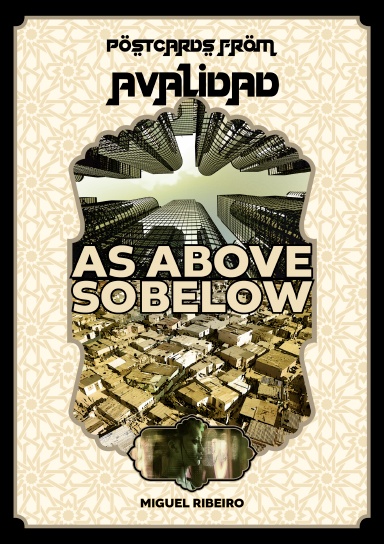
Starting with the table of Contents, the reader will realize that this is a beautiful book.  I really like the cover as well, though I wish the picture on it was a bit less busy.  This is a really gorgeous book and it shows that with some extra loving, and a person who can do layout and graphics and all that jazz (I cannot), a relatively cheap print-on-demand book can be made to look fabulous.

The book has a quick introduction (evil monsters living below ground) and then jumps right into the game system chapter.  In this chapter, the author gives some quick notes on the two game systems for which it was written, and has a very handy several pages on loss of sanity, for those who want to rock the supplement in a Call of Cthulhu style.  There is a list of 14 different mental illnesses which a Referee might inflict on a character.  Interestingly, the book also says that the player can choose the illness himself.  I think this can make for a really interesting game.  I can see a couple of my players really having fun with it.  

The Sanity stat in the game is for *Punk but it could easily be worked into any game I feel, and the same goes for the supplement's fear rolls.  I would definitely work both of these mechanics into a game system I was using for the supplement, if the game did not already have the mechanic.

There is a list of "Appendix N" movies to watch for inspiration (I have seen 8 of them I think, and Dark City is the best of the ones which I have seen).

After this, we get into the meat of the matter.  

Chapter 2 explains how the "adventure" starts.  I use quotes since this is not a traditional adventure.  Those familiar with the author's Giallo "adventures" will feel right at home here.  The adventure has an overarching plot which can be summed up as, "A Portuguese sailor whacks off for some creepy alien entity, scores the gizmo as payment, some other stuff happens, and then the gizmo disappears into Agartha.  The gizmo is worth some serious ducats.  What do you do?"  There is more to it than that, of course, but this is the gist of it.

Like Miguel's Giallo adventures, you get a very simple plot and then a slew of NPCs and locations.  Many of the characters are repeats from the main rulebook, but have abilities altered slightly to bring them all to a similar power level, specifically so they can be used as player characters.  The author does note that some of them might actually have been killed previously since there were not designed originally as PCs.  There is a mix of ZoneSec (remember, this is what passes for cops in this setting), Yakuza, hitmen, hackers, mercenaries, and the typical ne'er do well types that players enjoy playing.  Side note, the character on page 35 looks like a model from the magazine Gothic Beauty that I might have, err, uhhh, noticed from part of my misspent early 20s.  On page 52 there is a picture of a gill woman, which is nice since the gillmen live down below, in Agartha.  This brings us to the end of chapter 3.

Chapter 4 is all about Agartha.  This chapter goes over some NPCs, including Pigface the Mayor.  There is a random encounter chart in this chapter and a few of the adventure locations also have random tables with treasure.  The list of locations is pretty fun and characters can perhaps find a copy of the Necromicon, some sexy underwear, a mutant mating ritual, and for those curious, there is a 33% chance that if you shoot someone in the head who is taking matters into her mouth of painfully and permanently "freeing willy", if you know that I mean.  

The book ends with a not-very-helpful map of Agartha.  I think that with the detail spent on layout in this book, a two-page spread with a more detailed map would have been lovely.

So, what does your not-quite-humble reviewer think?  I like it.  I don't like it as much as the setting book for which this is a supplement but I do like it.  It is a very pretty book, it has useful information, and works well as a supplement to Postcards from Avalidad.

⇒ GRIT: ★★★★☆  As a supplement, this book does what I believe it has set out to do.  I hesitate to use the term adventure for it, since, to me, an adventure is Keep or the Borderlands or Masks of Nyarlathotep.  The book is an adventure location for under the streets of Avalidad, and it is good for what it is.

⇒ VIGOR:  ★★★☆ There just aren't enough adventure locations for me.  I think that if the author cut out all of the possible player characters which were duplicated from the core setting, and replaced those pages with more locations, this book would be better.  I also would have loved to see a few pages with notes on other reasons why characters would adventure to and from Agartha.  The adventure won't take very long without a lot of stuff added by the Referee

⇒ GRACE:  ★★★★ This book is freaking lovely!  The only two complaints I have are that the page numbers on what I assume to be an Islamic pattern are not readable (there are not that many pages like this) and the map at the end.  I'm not going to ding a star for these issues.  This book, to me, is a benchmark on what a home-based, indie rpg publisher can do.


Monday, June 13, 2022

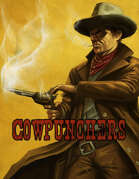
Cowpunchers

Cowpunchers
Crunch-light Roleplaying in the 1870s Southwest

by Jonathan Torres "The Basic Expert"

Available in pdf from Drivethru RPG:   https://www.drivethrurpg.com/
Or in print from Lulu:  https://www.lulu.com/


The Good, the Bad, and the Ugly

Cowpunchers is a short, 22 page, game.  It is set in the desert southwest of the USA, following the American Civil War (or 2nd Revolutionary War, the 2nd War for Independence, or a few other options, depending on where you call home).

The book is illustrated by the author, giving it a nice, consistent look.  

Cowpunchers is a d6-only dice pool system.  If you don't like die pool games, you probably won't like this one.  There is no limit for the amount of dice rolled from what I read, which can conceivably cause problems as characters grow in power.  Yes, this is also a level-based game; fortunately, it is classless, so the author did not need to shoehorn in "cowboy", "train engineer", or "Apache" into classes.

Right off the bat, we learn that the Referee in this game is called the Range Boss.  I like that.

Characters have three ability scores (vigor, finesse, and smarts), which should be self-explanatory.  Ability scores are rolled with 3d6.  The first brush with the dice pool system happens here.  Characters with low scores (3 to 6) get 0 "bonus dice", average characters get 1, and high scores give 2 dice.  These dice are added to a single d6 that everyone gets to roll to succeed at tasks.  Each ability score also has a modifier, which is used in rare circumstances.  The modifier matches the number of bonus dice.

Characters will roll from one to three 6-siders to ability score tests and saving throws, which are ability score tests.  This is one "core die" and 0, 1, or 2 bonus dice, based on ability score.

There is an average-sized list of skills and all of them could potentially be important in a campaign.  Most of them make perfect sense, a couple are for social encounters, and one is escamatoge.... gezundheit!  My favorite description of a skill is for "Cookin'".  When the posse sits down around the camp fire and ol' Cookie hands out the beans and bacon, a cookin' roll is made; if successful, the posse each gains 1d3 hp.  I know that I usually feel better about life after a good meal!

Characters begin with 3 to 18 skill dice, depending on how smart they are and how well they roll.  This is a place where one character can be significantly outclassed by another.  Doing some of that there cowboy math, I reckon that the average dummy (smarts 1-6) will have 4 skill dice, the average cowpoke will have 8, and that educated feller from back east will have 12.  I don't mind this spread but since there is no limit, from my reading of the book, of points to be assigned to a skill, our high IQ snake oil salesman from some yankee hellhole city might be able to drop 18 points into one skill!  This means 19 dice on a roll!  This is pure on crazy, I reckon!

This is where my first house rule would come into effect.  I would have some sort of limit to skill dice.  Maybe at 1st level, players can put 0-3 dice in a skill, allow a 4th die at 6th level and a 5th at 10th level.   Or, not allow skill dice more than half the character's level, rounded up.  Or, something. 

So, when the player grabs that handful of dice and rolls it, he is looking for 5s and 6s, which are successes.  Moderately difficult tasks require 1 success, hard tasks require 2, and extremely difficult tasks require 3, or whatever the Range Boss determines is needed.  A 1 or 6 on the core die is a fumble or critical.

Hit points are rolled with a d6, with a minimum of 6 hp for a character with no bonuses.  these hit points won't last long - see below.

The game has a paragraph for movement and one for advancement.

Next comes weapons, and here is where another eye-opener occurred to me.  Most weapons are reasonable as far as damage goes, basically 2d6 for most firearms, but perhaps with a +1 or +2 bonus, and a 12-gauge shotgun does 3d6 damage.  Just from this, the reader will realize that combat can be very deadly, very quickly.... and then we get to the rifles.... a regular old John Wayne-style Winchester can make 3 or 5 shots per round, depending on model!  A cowpuncher letting loose with his Model 1866 will do an average of 35 points of damage if he targets one foe!

The weapons section finishes with some rules on adapting other real world guns to the system.

The section on combat specifies that a character can do a move and attack, two moves, or two attacks per turn, and nowhere that I've seen limits the shots from a gun.  If a character stands still and uses both attacks with his $45 Winchester, does this mean he averages 70 points of damage?  If this is the case, I would absolutely remove the "shots per turn" from every weapon for house rule #2.

There is a decent equipment list, and I really like that there is a listing for housing costs.  The characters can pool their money and start their own homestead, right from character creation.  Equipment is recorded based on the number of "slots" it needs. 

I've already gone over the basics of combat and the combat section of the rules just has a handful of modifiers for shootin' tests, such as range, firing from horseback, etc.  Losing dice from the pool is a really fun way to do it and saves all them new-fangled mathing that real cowpokes don't know nuthin' bout, anyhow, other than maybe countin' heads of cattle.  There are a few paragraphs on duels, for those posses who want to do the old Main Street showdowns.

Next we get a couple of pages on cover, reactions, damage (you really, really do not want to get hit!), travel, and how much a feller ought to eat.  

A short section follows with some standard critters and townfolk.  The rules end with reaction rolls and random encounters.

The rulebook ends with a sample town, some buildings in said town, and a gang of the villainous sort, who enjoys raiding this town.  I think any genre game really needs to have a section like this.  I would have loved the author to have included about twice the number of adventure seeds (there are six) but I dig that one of them can lead to a supernatural campaign.

The book ends with a character sheet and the standard OGL that most games seem to have.

My overall impressions are that the game is really good.  There are a handful of sentences that needed another couple of read-throughs to fix some grammatical issues.  Of course, this Range Boss durn sure can't find the one that really stuck out to me, but trust me, it was there, two words were reversed.

⇒Grit:  ★☆ The rules seem like they would really work, with the caveats I mentioned above in regards skill dice.  The book is very short but touches on all of the standard cowboy movie tropes.  A campaign based on any of the small handful of cowboy movies I've seen could be played through with this one book.

⇒Vigor:  ☆ My big issue with the skill dice is slinkin' in like a rattler into a bedroll.  If a character starts out with a god-tier skill check, what is the point of advancement?  Other than that pretty big (to me) problem, and the one sample town/adventure, I would really like to see 6 to 10 pages on some historical details, railroads, conflicts between the settlers and Indians, and between the various settlers themselves.  If the War to End Yankee Oppression just ended, I would like to see at least something on why this war led to hordes of people moving to the West.

⇒Grace:  ☆ This game is good-looking, in its functional way.  It isn't beautiful, and some blank space between paragraphs would be appreciated, but there is nothing wrong with the book.  I think that if it was reformatted for a 6x9 printing, it would be much better.  The copy I got from Lulu is very floppy due to thinness, and I think that a smaller form would suit it quite well.  The art is really good, I think.  I would like to have some more pieces in it, especially in the equipment chapter so those of us who did not grow up on westerns have some clue what these items looked like.  I know exactly what a Winchester looks like and how it feels in the hands, but I wouldn't know a Mauser 1871 if it jumped up and bit me.


Sunday, June 5, 2022

The Legacy of Zorro

The Legacy of Zorro Introductory Adventure Game
By Mark Arsenault
Gold Rush Games 2001

Availability is probably only through Ebay or on the "make it go away shelf" in your local gaming store.


The Good, the Bad, and the Ugly

The Legacy of Zorro Introductory Adventure Game (LoZ, hereafter), like the Masters of the Universe game I reviewed a couple of weeks back, was intended as the first book in a line of RPG books.  

The Zorro campaign is set in 1820, in California.  Characters are cohorts of the famous Zorro.  Zorro cannot be everywhere at once so he recruits the player characters to help him in opposing the corrupt governor, comandante, and alcalde in Pueblo Los Angeles.

After the traditional "what is a rpg", websites, and all that jazz, the LoZ book gives some basic information on California in the early 19th century.  You find here forms of address for high status individuals, landowners, and rules for who can carry a gun or a sword.

Following the basic campaign information on the world of Zorro, there are 6 pages of rules, which constitutes the entirety of the rules!  This is amazing.  All games should strive for such concise rules.  The rules are based on Fuzion, which I might review at some point.  

I should note that there are no character creation rules.  Like the MotU game, these rules would have been included in a subsequent release.

Character abilities are ranked from 2 to 6, and include Mental, Physical, Action, and Movement.  Characters have special attributes, two of which make obvious sense - Hits and Defense.  There are a few other abilities that are specific to this game.  The first is Faith, which can be used so gain a bonus on dice rolls which are peaceful or beneficial to others.  The second is Pride, which the player can use to gain a bonus on dice rolls which are selfish or violent.  Both Faith and Pride can be used to reduce damage to the character in combat.  The last special attribute is called Z Points.  By spending a Z Point a character can accomplish extremely heroic feats.  Swinging from a chandelier and flipping into a triple lindy through the glass window, and landing in the saddle of your horse would be a good example.

The list of skills is very broad and very brief - which is perfect for a skill-based game.  Actually, the skill list in LoZ is about perfect.  The skills are:  Athletics, Combat, Education, Reasoning, Social, and Shady (thief skills fall in this category).  Skills are ranked from 1 to 7.  

To succeed in a task, a character will roll 3d6 and add a skill score and ability score to this.  The total of these three numbers must meet, or exceed a difficulty number.  Easy tasks require a 10, average 14, hard 18, etc.  A dice roll of 18 is a critical success while a roll of 3 is a critical failure.

Combat follows this same principle, but includes pinning opponents, breaking pins, blocking, retreating, and whatnot.

An example of play follows, along with the included characters.  The character sheets are simple and have a nice layout, along with a picture of the character.  The characters which can be played are Miguel Galvez, who is a teniente (lieutenant) in the Spanish army, Esperanza Salazar, the daughter of a wealthy land owner, Luis Valasco, a commoner thief, and Father Sebastio Miro, a compassionate priest.  Each character has a special talent that can be used during a game - Esperenza has a knack with horses and Father Sebastio can heal characters by spending Faith, as examples.

The last page of the rules portion of the game is a one-page summary of the rules.  

Following this, the LoZ book includes a sample scenario.  The scenario is 7 pages long and is followed by a 2-page spread of the fort (cuartel, in the lingo).  The scenario has the characters rescuing Zorro.  The scenario is decent but nothing extraordinary.  It functions as a good introduction to get the players into the setting.

So, is this game good?  Yes, it is good for what it is - an introduction.  A follow up book, The Legacy Continues, promised to have character creation rules.  I don't know if this book every came out.  The Fuzion rules are good enough and this book whittles them down to their base, which is a plus.

⇒ Grit:  ★★★☆  This game is an introductory game and does not pretend otherwise.  The rules are clear, concise, and work for the genre.  I love the short skill list, the broad ability scores, and the lack of over-complicated rules.  I would rate this 5 stars if there were actual character creation rules.  I don't knock it being an introductory but the players won't get much use out of this game after a few sessions.

⇒ Vigor:  ☆ Players will get very little from a Zorro campaign using just this book.  The base information for a California campaign is good, and the introductory adventure serves to get the players into the genre, but there is next to nothing here to keep the campaign moving along.  Without any rules for character advancement or character creation, players will probably get bored with playing these characters.

⇒ Grace:    This book looks really good.  The cover is really cool and I like it a lot.  The character sheets are lovely and I really enjoy having examples for nearly all of the rules - remember that the entire rules section is only 6 pages!  I have no complaints with any of the layout choices.  The map of the fort is really well done, too.  The font is readable and not too small.  This short book of rules is nearly perfect when it comes to the Grace category.  

Sunday, May 29, 2022

Gang Busters B/X Edition

Gang Busters B/X Edition 1920's Role-playing Adventure Game
by Mark A. Hunt, copyright 2019


Where to buy:  https://www.drivethrurpg.com


The Good, The Bad, and The Ugly:

Gangbusters B/X Edition (GBBX) is a B/X reworking of TSR's 1982 Gangbusters RPG.  A player who has played the 1981 version of Dungeons & Dragons, or one of its many OSR clones will be able to play GBBX with minimal effort.  The rulebook, more or less, follows the same layout as original BX D&D.

What is called the Dungeon Master in D&D is here called the Judge, Gamemaster, Referee, or Ward Boss.

The book lays out a handful of campaign types, criminal, detective, law enforcement, reporter, or strange mysteries.  I imagine that a campaign would work really well with a combination of the above.  Having one player a G-Man and another a gangster probably would not work out that well in the long run, but having one player as an undercover agent could be all sorts of fun for a one-shot or short campaign.

Character creation is nearly identical to normal D&D and this game uses the same ability scores and bonus/penalty scheme.  The classes available are the Brutish, Connected, Educated, and Street Smart.  My first annoyance with the rules is on page GB10, where the hit dice are reversed for the Educated and Street Smart - the character creation example in this chapter has the correct hit dice.  Characters top out at 6th level, as opposed to 14th in standard BX D&D.  This could be a good thing or a bad thing, depending on what sort of campaign the players want.  I think it is a good thing.

Each class has certain special abilities.  Some examples are the Brutes, who don't suffer the standard -4 penalty to attack rolls for improvised weapons at 2nd level and the Educated, who pick areas of expertise.

GBBX does use alignment but it is basically how law-abiding the characters are.  I feel that this could probably have been left out of the game; however, I understand that it is included to remain compatible with BX D&D.  Character type could also have been left out and left to simple roleplaying.  Character types include options such as assimilated, city slicker, immigrant, and troublemaker.  

This game uses "the common tongue" for the primary spoken language.  It could easily have been called English, since this is exactly what the "common tongue" is.  The language chart also should have been adjusted for actually spoken 1920s languages common in the USA.  According to the rules, with a random roll, there is a 5% chance of speaking German or Spanish but a 10% chance of speaking Hindi.  This is just an odd choice.  The author is presumably trying to match the 1d20 language table from BX.

My third gripe is the way Armor Class is figured.  If the character wears a 3-piece suit, he will be AC 3 (16 ascending, in more modern games), while wearing farmer's overalls gives an AC of 7 (12 ascending).  This, to me, is a mind-bogglingly bad decision.  If I ever run this game, all characters will be AC 9 (10 ascending), regardless of clothing, with a bonus for a bullet proof vest or a parka, maybe.

After character creation, we get into the meat of the rules.  The game does a really good job of detailing the life of an adventurer in the 1920s, including crime, stolen goods, police patrols, street gangs, retainers (see below on an issue with this), and starting a legitimate (or not) business.  The Competition saving throw is a really elegant way of determining how much money a business can make and avoids the minutia of counting dimes and nickles.

Retainers is an issue.  The Charisma ability score gives the maximum number of retainers allowed per character but the "Starting a Gang" chapter totally ignores this.  Assuming I understand the mechanic here, a retainer costs a number of "Influence Points" and the maximum number equals the character's Charisma score.  I think that I like this way of doing it more but if this is how the rules are supposed to work; the Charisma "Max number of retainers" should have been left out - again, assuming I am reading this correctly.  Unless, of course, the Influence Points is counted up and compared to the Maximum number of retainers?   The rules are pretty unclear.  Recruiting a thug costs .5 Influence while a femme fatale costs 3, for those who are interested.  

There is a sample city included for those who do not want to base the game in a real city.  It is called Rock Junction and is near Lake Michigan.  

The Building Adventures chapter also includes some nice random charts.

Investigations is an interesting chapter and includes this game's version of the Turn Undead table, which is used for roughing up and threatening NPCs.  A level 1 character cannot convincingly threaten a real gangster or G-Man.  I think using the NPC reaction or retainer table would make more sense but it is amusing to use a version the Turn Undead table.

NPCs, trials, witnesses, law enforcement resources, and encounters come next and are basically what you would expect.  All of it is good information.  You can tell that Mr. Hunt did his homework.

Vehicle combat gets its own chapter, which is appropriate for a game where gangsters can ride along on running boards with Tommy guns.

Adversaries gets a chapter, of course, and includes some era standards - mobs, sheriffs, moonshiners, gangsters, etc.  There is a small section on Creatures of the Night for those who want to have the supernatural in their games.  I would love to see this fleshed out with its own chapter - perhaps move all of the fantasy options to an appendix.

Morale and combat work exactly the same as traditional BX D&D.  Guns have special rules for bursts, sprays, unloading with both barrels of a shotty, cover, etc.  Variable weapon damage is mentioned, but since the weapon tables shown previously don't mention that all weapons do d6 damage and instead have the "variable damage" listed, it is pretty silly.  I feel that the optional rule should be for all weapons to do d6 rather than the variable, which anyone reading the book in order will have assumed is how it works.  Players choosing to be "shot in the arm" is a pretty neat optional rule.  With this, players can have their characters take a penalty to attack rolls and movement in order to not lose hit points.

Healing is a bit better than standard D&D since medical care is more advanced than in fantasy land.

Saving throws work as you would expect but the saving throws are: moxie (grit, willpower, etc.), quickness, toughness, driving (this seems odd but I think it works), and observation.  Interestingly, Wisdom, which the rules note includes perception, modifies moxie but not observation.  I understand that willpower is a part of Wisdom and I assume that Mr. Hunt did not want Wisdom to be overly useful for saving throws.  If/when I run this, I might change this up a bit.

The rulebook ends with a page on Mysterious Powers (think the Shadow or the Phantom) and a page of inspirational bibliography.  There is also a standard character sheet, as most games include.

Included in the 64 pages are all that is needed for a 1920s campaign.  I would have loved to have seen a more detailed setting - say 10 to 12, or more, pages of the sample city, region, NPCs, and a sample adventure that can be used for one or two of the campaign types.  A sample city map would be nice.

One thing to note is that this game is riddled with typographical and capitalization errors.  The book specifies two individuals were proof readers and I would love to have these two gentlemen spend more time on this.  In one particular paragraph on page GB24, I count 2-3 missing commas and maybe an "and" or a semi-colon.  


⇒Grit:  ★★★★  All of the rules you will need are here.  I would have liked an extra page or two of supernatural content but since this game is trying to be a standard Roaring 20s game, I won't ding it.


⇒Vigor:  ★★★ The game would probably work, as is, but with another 10 or 12 pages of setting info, perhaps a timeline of the 1920s including some tie-ins between the timeline and the sample setting, I think this game could easily be 4 or 5 stars.  As it stands, the Judge is going to have to do quite a bit of research on the 20s to make the game believable.

 
⇒Grace:  ★★★☆ The rulebook has a nearly perfect layout - as did the game on which this is based.  With some more art and far, far fewer typos and missing commas, and consistently using bullet points (pick all small or all large!) and tabbing indents, it would be 4 stars for sure.  The Sequence of Events table on page GB55 causes my soul to ache.

Wednesday, May 18, 2022

The Masters of the Universe Role Playing Game

The Masters of the Universe Role Playing Game
By Ross Babcock and Jack C. Harris
FASA Publishing, 1985

Availability is probably only through Ebay and a search of 17 May 2022 shows none available.


The Good, the Bad, and the Ugly

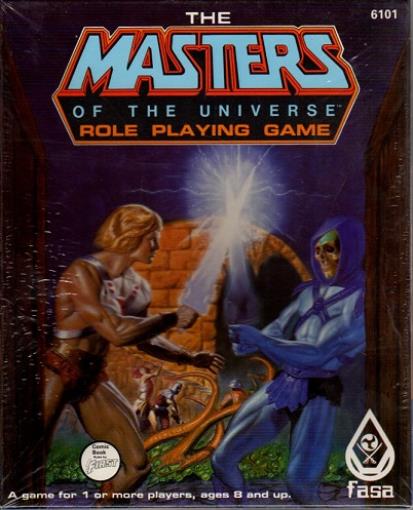
The Masters of the Universe Role Playing Game (henceforth MOTURPG) is not a standard rpg but rather it is more of a board game with roleplaying elements tacked on.  MOTURPG came as a boxed set, including a 24-page rulebook, stand up counters for the heroes and villains, character sheets for the heroes, and a map of the dungeon, and a card explaining that some characters in the game have spells listed which are not included in the boxed set.  According to this card, the Advanced version of the game is to be released in "the fall of 1986".  I don't think it was.

The counters include characters such as Trap Jaw, Skeletor, Evil-Lyn, He-man, Orko, Teela, and the unfortunately named Fisto.  I think that Fisto must have had a rough childhood.  There are also counters for monsters and treasure, but not that many of either.

The game board is laid out in squares.  The dungeon is supposed to be Snake Mountain.  The game expects to have the characters use the game board.  With a competent Referee, the game board won't be needed, perhaps dictating that Movement Points are rather yards/meters moved per turn or something.

The character sheets are for the characters included in the game.  Each sheet includes what you would expect, such as ability scores, skills, spells, special abilities, possessions, life force, and magic points for the spellcasting characters.  Oh, each one includes a picture of the character, competently drawn.

Ability scores are rated from 11 through 66.  Poor Fisto has a Magic score of 11 and He-man, of course, has a Strength of 66.  The other abilities are Agility, Intelligence, and Life Force.  The definitions are the usual in every game; however, Life Force = hit points.  Skills are rated from 1 (basic familiarity) through 6 (master).  He-man, having paid his 30 silver to be the main character, rather than the much cooler Skeletor, has his sword skill rated at 6 and his pistol and rifle skills are rated at 3, which is higher than Man-at-arms, who one would think would be an expert at weapons, but is barely competent with a 2.  Ram-man has the animal skill rated at 3 - presumably because of his name?

Special Abilities are based on the character.  Orko can fly and teleport without using Magic Points, Ram-man can use his "Ram-attack", which causes 20 damage against foes but he suffers 4 points of damage, himself.  Both of these numbers are divisible by 4, which I make a point of questioning, below.

Half, or more, of the rulebook is a comic book.  Players and Referees might be tempted to skip reading the comic but a nearly all of rules are included in this section.  He-man and the Sorceress (Rawr! I always dug her when I was a youngster) explain the rules to a kid from Earth who gets magicked from home to Eternia.  The goal of the adventure is to steal the Crown Jewels from Skeletor.  I don't remember much slang from the 80s other than radical and tubular, but the He-man writers must have had a good laugh with names like Fisto and Crown Jewels!

I keep saying Referee like there is actually a player who is the Ref.  There isn't.  Monster reactions, treasure, and the like are controlled via random dice rolls.  I say Referee because one can easily be involved, and will need to be involved if the game progresses beyond the simple board game into real role-playing.

In MOTURPG, weapons do a static amount of damage, which to my minimalist thinking is a good thing.  Swords to 12 damage, pistols do 16, rifles do 24, and clubs and other melee weapons do 8.  Remember that I said ability scores can be as low as 11?  If you are so unfortunate to have Life Force of 11, any hit other than a club will end your adventuring career.  Telee has the lowest LF of 36, however, so she can soak a couple of laser pistol blasts before going down on the next hit.  A good punch lands 4 points of damage, unless you are He-man, whose punches cause 8 damage.  I can only assume they do these amounts of damage since the LF ability is actual hit points.  A smart Referee would have Life Force divided by 4, rounded, and then use that has hit points and then divide all damage by 4 (they are all divisible by 4) to make the number crunching easier.  I would.

The comic describes a handful of spells, and shows how that loser, He-man, needs the help of an 8-year old 80s kid rocking a Luke Skywalker haircut to beat the mighty Skeletor!  Spells are pretty easy to figure out, flying lets you fly, teleport allows you to teleport an enemy to any square on the board, and some spells have a range based on squares (Shield spell covers 3 squares).

The center of the rulebook has the encounter tables which are to be used, spell casting instructions, the combat table and modifiers by weapon.  Spell casting is 1d6 + skill level vs. difficulty of 3 on the chart.  Combat is 1d6+ skill level + weapon modifier vs. foe's 1d6 + skill level + weapon modifier.  Comparing the two numbers on the chart gives the final result.  The result can be anything from attacker hits foe for damage to attacker and defender hit each other to attacker misses and has a penalty next round to attacker drops weapon and inflicts damage on himself.  

Magic items can give a boost on the attack roll or have some other effect.  The Blast Jewel is a device used in attacking but it's weapon modifier is based on the user's Intelligence and Magic ability scores.

Since this game was released in 1985, it hadn't yet fallen pray to the Satanic Panic, and demons are mentioned.  Skeletor the Mighty is able to summon them - which is much cooler than having 'roid rage muscles, in my humble opinion.

The rulebook ends with character sheets for the foes and monsters.  The mighty Skeletor rocks it with a Magic ability of 62 and carries a +4 magic sword.  Each foe has a list of tactics he will use depending on which hero he faces.

There are no character creation rules in this game.  Presumably, they would have been included in the Advanced rules, which I don't believe ever were published.  This game would certainly rate higher if you can actually play your own self-created character.  The comic book part of the rules seems to imply that this was going to be the case.

GRIT:  ★★★★☆ The game certainly works well as a board game with a small amount of roleplaying added.  A good Referee can take what is here and expand upon it to make a full-fledged RPG.  If rated as a standard RPG, it would be 1 star.  The game does accomplish the task it has been set.

VIGOR:  ★ The game fails big time here.  Imagine playing Chutes and Ladders over and over again, but you get to pick a weapon or spell and there are enemies on the board and you won't be far off.  After playing this 2 or 3 times, I would be done forever.

GRACE:  ★★ The box is pretty, if the characters don't look exactly like their cartoon counterparts.  The contents don't look bad.  The comic book portion of the rules are well-drawn and match the cartoon pretty well.  Little Boy Skywalker Cut could easily have been me from 78 to 83.


Friday, May 13, 2022

Postcards From Avalidad

Postcards from Avalidad
by Miguel Ribeiro
Postmortem Studios, 2021

Available in pdf from Drivethruprg:   https://www.drivethrurpg.com/

Available in print from Lulu:  Postcards from Avalidad (lulu.com) 


 The Good, the Bad, and the Ugly

Postcards from Avalidad is a 200 page handbook for playing a retro-future noir campaign with demons and a small amount of cyberpunk and a lot of biotech.  It is based on the works of William Burroughs (whom I've not read), mixed with William Gibson's books (which I have read) and the films of Davin Cronenberg (I might have seen one or two).

If you have played Dark Conspiracy from the 1990s, and liked it, then you will like Postcards, as the two are very, very similar.

Avalidad is a city in Morocco, founded in the 1960s.  Formerly, Avalidad was the Tangiers International Zone.  It is a corporate city, owned primarily by Takeda Technologies, though there are other companies as well, many of whom are just fronts for a larger corporation.  

The setting expects that the characters will all work as troubleshooters for what passes as law in the city, called ZoneSec - not exactly cops, not exactly corporate peons, not exactly criminals themselves, but some mix of the three.  Provided the profits of the companies don't take a hit, the characters have free reign but they are expected to follow the orders of their superiors.

The first 10 or so pages of the book describe the author's inspirations, plus a very broad overview of the setting.  The book then has a few pages describing the technology of the setting, again just an overview.  In these sections you start realizing that the author is giving you a fun, pop culture wink, what with Rollerball (the 70s movie) and Leary Pharma (man oh man, have I gotten old), which continues through the book.

Following, you are treated to 75 pages of NPCs, statted for Actual Fucking Monsters (AFM) and *Punk.  I pretty much ignored the stats since I am not familiar with either game.  I did look through them and had a laugh or two at some of the skills on some of the characters, who knew that "fellatio" could have a die rating?!   Two of my peeves with the book show up in the section, however.  First, on at least two occasions, the picture of the NPC doesn't match the description (and I'm 99% sure that one of the pictures is from a British dude on YouTube who does "top 10" list and "did you know" type videos).  Secondly, the page numbers start creeping down the bottom margin until they are unreadable about halfway through the book.  I will blame this on the POD though.

Every NPC has a description, a background, and an adventure hook, which I find very useful.

The next 40 pages are people (more of them), places, and things in Avalidad.  You learn about political and social groups, as well as criminal organizations.  My third gripe happens in this section - the headings are a rust red on army green background, which is very difficult to read, but not as difficult as...

The next 20 pages are about society as a whole in the city, including psionics, mutants, and drugs.  The headings here are army green on rust red and I cannot read a single one.

Both of these sections also include an adventure hook for every entry, which again is an awesome thing to do.

Section 6 is for media and entertainment, which includes pop stars, musical genres (no heavy metal?!  What a ripoff!), virtual entertainment (I think the fleshy game controllers are based on a movie but I can't remember it's name), and Rollerball (err, I mean Rollerclash).  By this part of the book, the page numbers are now visible again.

The remainder of the book is dedicated to technology and drugs, both of which have been discussed throughout, and includes stats for a lot of the neuroware, cyberware, and drugs.  Again, I sort of breezed through the game stats - I would run the game with Savage Worlds or my own Tyndale Game System v.3.

My thoughts?  I love it!  I am a huge fan of Dark Conspiracy and this is a slimmed down version of that game.  The POD quality control on my copy is obviously missing, but this is no fault of the author.  The color scheme, except for title headings is great - the title headings, as I said in some sections, are not readable to me.  I enjoy the marbled border around the pages, which give the book a fun profile when looked at from an angle.  

What could have been better?  I wish the author included a short scenario, maybe 5 to 10 pages, to get the characters started and to include a NPC or two and some corporate intrigue.  


⇒Grit:  ★★★★☆  The setting accomplishes what it sets out to do, though it is marred in some places.  It is organized well, though some entries seem to be randomly placed, i.e. you might find technology spread throughout the book rather than in just one section.  The book has an index, so it gets a solid 4 stars.


⇒Vigor:  ★★★★★ The setting appears that it can be used for extended campaigns without any issues.  Having a plot hook with every entry goes a long way towards this.  I can see a year or two of regular games with just the Postcards book.

 
⇒Grace:  ★★★☆ The book is very attractive but the font colors on the headings leave quite a bit to be desired.  The page numbers wandering around like Bedouin nomads doesn't help, but I do believe this is a POD issue.  Still, I'm grading on the book I have in my hands.

I hope y'all enjoyed my very first review!

- Michael

Thursday, May 12, 2022

Games I Like

 I was in the gym last night and realized that it might be useful for folks if I gave a short list of games I like and why I like them.  This might help folks decide if they can trust my ratings.


My three favorite role-playing games:

1.  1981 Moldvay-Cook version of the Basic and Expert Dungeons and Dragons sets (henceforth called BX).  This is probably the most versatile D&D rules sets ever printed.  Anything can be removed from the game without breaking anything else and Referees can add whatever they want to the game and it won't break.  Don't like percentage thief skills?  Replace then with x-in-6, d20 vs. target number, or any other mechanic.  Since every mechanic in the game is a separate entity, they are all replaceable or adjustable and won't have an effect on other mechanics.  Versions of D&D with feats, skills, backgrounds, etc. are all designed to have all parts work together, causing more difficulty when excising bits that you do not like.

2.  Star Frontiers.  Star Frontiers is a dead simple, percentile-based game of space opera.  It was the first science fiction game I owned and it is still my favorite.  Dralasites, Yazirian, and Vrusk were so cool that modern versions of D&D have stolen them wholesale.  If I run a one-shot for people who have never played a RPG before, Star Frontiers is my go-to game.

3.  Savage Worlds.  SW is basically the exact opposite of what I like about BX D&D.  It is fiddly, rules heavy, especially during character creation and advancement, has an off-the-wall initiative mechanic (playing cards), it uses advantages, disadvantages, what in modern D&D are called feats, skills, but for all that, I really love this game.  The game is generic and can theoretically be used for any genre.  The tagline "fast, furious fun" isn't 100% accurate but it is close enough.  If I want to run a skill and feat style game, SW is my choice.


Honorable mentions:

Warhammer Fantasy Roleplaying 1st edition.  I don't care for the rules but I love, love, love the setting.  One of my homebrew fantasy settings is a complete ripoff from WFRP's Old World.

Blueholme.  This is an OSR retroclone of the Holmes version D&D basic set, modified to allow 20 levels.  If I started playing D&D in 1979 instead of 1981, this game and BX would no doubt be swapped.  

Buck Rogers XXVc.  Everyone else dislikes this game and/or makes fun of it.  Like WFRP, the rules aren't great (in this case, it is based on AD&D 2nd edition) but I adore the setting - solar system bound space opera. 

Gamma World.  I always enjoy getting to play this game but rarely do.   Rolling up a character that is riddled with defects can be a lot of fun.  I am also a big fan of post apocalyptic fiction and I am pretty sure this is the game that got me into it.

Wednesday, May 11, 2022

My Inital Review Rating System

Hello!

My initial blog post is to explain the rating system I intend on using for RPG products.

I intend to rate products on three metrics with a rating of 1 to 5 stars on each.  The metrics I will use initially are:

Grit:  Grit is my rating for how useful the game or supplement appears to be.  Games, supplements, and modules which I find to work really well will get higher scores.  A module that works as is will be rated higher than one which requires a lot of work from the Referee to be useful.  This rating will not be based on the number of rules in the product.  A Free-kriesgspiel Revolution (FKR) product with one page of rules will be judged on that one page and won't be compared to whatever new-fangled, three rulebook system is currently in vogue.  Conversely, a 400-page rules tome will be rated on the rules tome itself and not compared to a 32-page game.  Comparisons might certainly appear but the judging will be apples-to-apples, to the best of my ability.


Vigor:  Vigor is my rating for how much longevity the game, supplement, or module will provide.  A setting that I find has unlimited potential will rate higher than one which seems like it would work well for a one-shot.  A boxed set with 200 pages of text and 20 maps may not be any more useful than a 32-page setting book if the boxed set digs way down into the nitty gritty that will very unlikely to come up in a campaign.


Grace:  Grace is how beautiful I find the product.  Artwork, layout, and general usability will be judged.  A module with tiny and tight text will rate lower than one with a clean layout and lots of breaks to rest the eyeballs.  If I rate something that is a Print-on-demand (POD) product, I will try to separate flaws in the physical product due to printer error from defects caused by the author.  Books that have a usable index and easily determined page numbers will rate higher than a manifesto written on a stenographer's pad while hiding out in a Montana cabin.


I might change my rating system if I think of one better.  

Since people are insane, I suppose I should mention that my ratings are 100% subjective.  You might very well find that you love something I dislike and you dislike something I love.  This is how the world works and there is no need for you to have hurt feelings.

I intend to mostly rate products that are not mainstream or are out-of-print.  You probably won't find any reviews of currently in-print D&D products.

I also will endeavor to leave links where a project might be purchased, if it is currently in print.

D&D Capped at Level 3

Using ONLY one of the Basic D&D sets as a complete set of rules. AKA "Holmes Only" D&D This whole project started as a pos...